


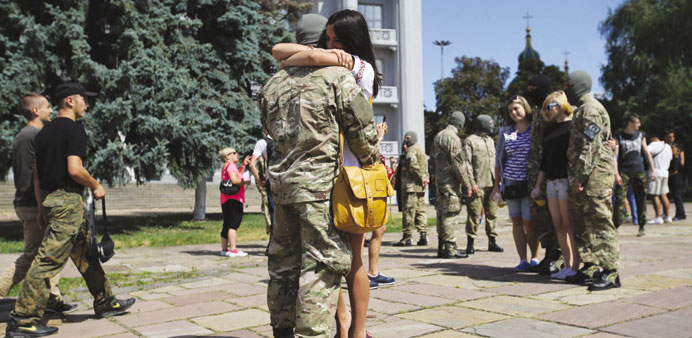
A member of the ‘Azov’ Battalion gets a farewell hug during a ceremony yesterday sending soldiers to eastern Ukraine, in Kiev. The ‘Azov’ Battalion is a volunteer unit of the Ukrainian National Guard.
Kiev forces battled into a key rebel bastion yesterday as Moscow denied fresh claims that Russian rocket launchers had crossed over into Ukraine to bolster the separatists’ flagging insurgency.
In Berlin meanwhile the foreign ministers of Russia, Ukraine, Germany and France gathered for a crisis meeting, and Germany’s Frank-Walter Steinmeier said talks would be “all about finding a roadmap toward a sustainable ceasefire”.
The German minister said however before the meeting that a political solution to the stand-off in eastern Ukraine remained far off.
“The situation in Ukraine remains difficult. The news from today shows that we are far from an end to the conflict. People are still dying. We have no ceasefire. We are far away from a political solution,” Steinmeier said.
He also expressed hope that an agreement could be reached on allowing a Russian humanitarian aid convoy into Ukraine, saying that “we will see this evening if the final obstacles can be overcome”.
“It would be good if this humanitarian aid could arrive where it is needed, in Luhansk, in Donetsk and other cities in eastern Ukraine,” he added.
Kiev’s military meanwhile said that it hoisted the national flag over a district police station in a northeast suburb of the second-largest rebel bastion of Luhansk after a fierce battle with pro-Russian separatists on Saturday.
A push into the city limits of the stricken 420,000-strong industrial hub would be a major breakthrough for government forces after four months of fighting that has claimed more than 2,100 lives and brought the region to the brink of a humanitarian catastrophe.
Ukraine also ramped up the stakes before the talks in Germany by alleging another military convoy including three Grad rocket systems crossed over from Russia.
The fresh claims come as a furore still swirls over Kiev’s earlier boasts that it destroyed part of a Russian armoured convoy that breached the frontier on Thursday.
Ukraine’s Foreign Minister Pavlo Klimkin said the talks in Germany with his Russian counterpart Sergei Lavrov would “not be easy” as Germany also demanded that Moscow clarify rebel claims that they had received hundreds of fighters trained in Russia to shore up their insurgency.
“It is important to stop the flow of weapons and mercenaries from Russia,” the minister wrote on Twitter yesterday.
A Kremlin spokesman denied that Moscow had sent “equipment” across the border, its latest dismissal of persistent allegations by the West that it is arming the rebels.
“We have repeatedly said that no equipment is being sent there,” Kremlin spokesman Dmitry Peskov told Govorit Moskva radio.
The Putin aide did not mention the rebels’ additional claim of having been sent a fresh injection of troops trained “on Russian territory”.
The self-proclaimed head of the “Donetsk People’s Republic” told a rebel meeting in a video posted on YouTube that their units had been reinforced by 1,200 fighters “who have received four months of training on Russian territory”.
Separatist leader Alexander Zakharchenko added that Russia had also secretly sent 30 tanks and 120 items of other military hardware using border crossings that are under the insurgents’ control.
The announcement appeared to confirm repeated charges by Kiev and its Western allies of Putin providing illicit support for the eastern uprising in order to keep Ukraine unsettled and hamper its pro-European drive.
German Chancellor Angela Merkel has called on Moscow to “clarify” Zakharchenko’s claims.
Meanwhile, Russia and Ukraine continued to haggle over a mammoth Russian aid convoy parked near the border as officials said inspections of the roughly 300 lorries would not start yesterday.
An AFP journalist saw 16 trucks drive from a parking lot where they have been idling since Thursday to a Russian border post some 30km (20 miles) away.
The West and Kiev fear the convoy could be a “Trojan horse” to help the rebels in eastern Ukraine, or provide Moscow with an excuse to send in the 20,000 troops that Nato says it has massed on the border.
The International Committee of the Red Cross (ICRC), which is overseeing the aid delivery, has said that Russian and Ukrainian officials agreed on procedures to check the cargo – supposedly bound for Luhansk – but insisted that “security guarantees” are still needed on how the vehicles could cross rebel-held territory.
“There will be a meeting tomorrow between all the parties involved. There will be no inspection of the lorries today,” Paul Picard, a monitor from the Organisation for Security and Co-operation in Europe (OSCE) told AFP at the border.
Ukraine President Petro Poroshenko told US Vice-President Joe Biden on Saturday that the separatists had yet to grant safe passage for the aid.
The Ukrainian government has officially recognised as humanitarian aid cargo the Russian convoy that has been held at the border with eastern Ukraine since August 14.
Social Policy Minister Lyudmila Denisova confirmed that the convoy includes nearly 2,000 tonnes of food supplies, sleeping bags and generators.
Russia’s foreign ministry has repeatedly demanded that Kiev cease fire in order for the aid to reach residents of blighted cities in eastern Ukraine who have been stuck for days without water or power.
Around the region fierce clashes continued between government and rebels, with Ukraine’s military saying that a MiG fighter jet was shot down not far from Luhansk and the pilot parachuted to safety.
The search for the site of the wreckage was under way.
No additional details were immediately available.
Luhansk has been the scene of some of the heaviest clashes, and local authorities said that power and water were not working for a 15th day running in the increasingly deserted city.
The United Nations says more than 285,000 people have fled the fighting in the east.
Authorities in the besieged main rebel city of Donetsk said shelling killed 10 civilians and wounded eight in 24 hours as government forces tightened the vice on rebels there.
An AFP journalist found the wreckage of houses still smouldering after a ferocious bombardment of a western suburb of the mining hub.