


By Denise Marray
|
|
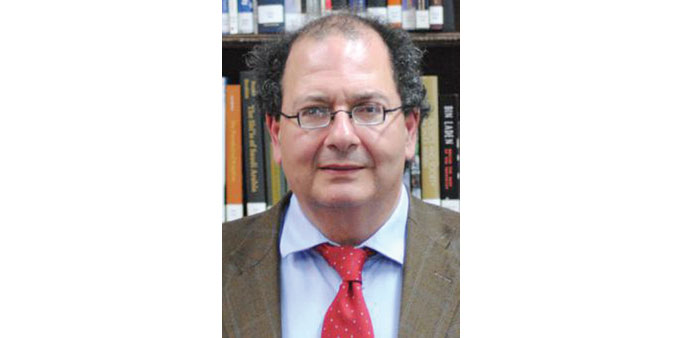
The position of Hamas has been strengthened since the latest war between Israel and Gaza, according to Nadim Shehadi, associate fellow, Middle East and North Africa Programme, Chatham House.
In an interview with Gulf Times, Shehadi, who is currently in Beirut, said the evolving position of Hamas would have a long-term impact on the outcome of the peace process
between Israel and the Palestinians.
A key element in the long-term outcome is that Israeli public opinion is now more likely to be engaged in the debate on peace given the impact of the conflict on day-to-day security. People feel insecure and now have a vested interest in finding a solution that will end the threat of further outbreaks of violence.
“Previously people in Israel were unconcerned and had no incentive to make difficult decisions. This war has changed that due to the disruption of Israeli life,” Shehadi observed.
Also critical is the fact that Hamas is now re-engaged with the broader resistance front. As Shehadi pointed out, Hamas has been drawn back into the resistance alliance formed of Iran, Syria and Hezbollah. “Hamas has emerged as a strengthened element and it has marginalised the role of the PLO,” he said.
Because of these two factors, Shehadi expected Hamas to be “a party to be reckoned with” in the on-going peace negotiations. He also expected Hamas to secure concessions that would influence the balance of power between Hamas and the PLO.
“Whatever concessions Hamas will obtain in the Cairo talks, such as prisoner release or easing of the siege, it will claim that they were obtained through resistance, whereas the PLO has obtained almost nothing through 20 years of negotiations.”
He pointed out that “the Cairo talks are not part of the ‘peace process’ as such; rather they are one of the consequences of the failure of the latest round of what was called the Kerry initiative”.
Speaking of Qatar’s role, he observed that Qatar is the only Arab country that has good relations with Hamas. However, he also noted that Qatar does not enjoy good relations with Egypt which makes for a complicated situation as Cairo is at present the only open channel for negotiations.
Shehadi directs a programme on the regional dimension of the Palestinian refugee issue in the Middle East peace process. He is also a senior member of St Antony’s College Oxford where he was director of the Centre for Lebanese Studies from 1986 to 2005.
Chatham House, the Royal Institute of International Affairs, founded in 1920, is an independent policy institute based in London.