


Evening Standard/London
Britain has deployed a spy plane to boost humanitarian efforts in Iraq as fighting in the country intensifies, it has emerged.
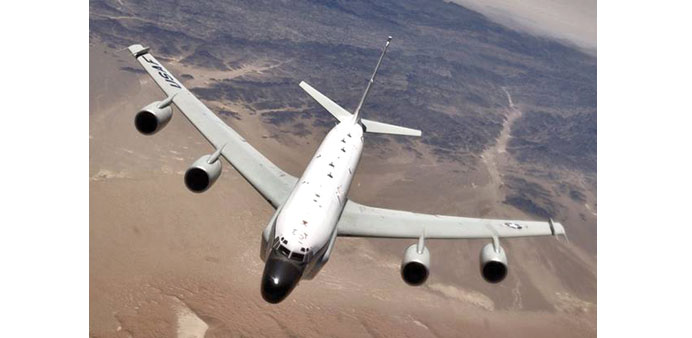
The ministry of defence confirmed the intelligence-gathering Rivet Joint has carried out several flights over areas in the north of country which have been targeted by advancing Islamist extremists.
The disclosure came as reports emerged that at least 80 Yazidi men have been killed and women and children abducted by Islamic State forces, whose mass executions have shocked the world.
The Rivet Joint is a reconnaissance aircraft equipped with an array of sensors which are used to pick up electromagnetic signals and determine the locations of people on the ground.
An MoD spokeswoman said: “Rivet Joint has helped build an understanding of the humanitarian situation in Northern Iraq and the associated ISIL (another name for the IS) threat.
“The intelligence and insight it has provided has guided our humanitarian efforts, giving us an accurate picture of what is going on on the ground so that we could best deliver aid to the Yazidi people.”
It also emerged today that a fresh consignment of British aid has been flown in to Iraqis fleeing the advance of Islamist extremists amid reports of another massacre of religious minorities.
The US said its drones had destroyed two armoured vehicles reported by Kurdish leaders as being used by Islamic State (IS) forces to attack civilians near Sinjar.
In a signal of the international concern, the United Nations Security Council last night unanimously approved a resolution designed to choke off the terrorists’ funding and recruitment.
It imposed sanctions including a travel ban and asset freeze on six prominent extremists and warned action could be taken against anyone held responsible for aiding the cause.
Sir Mark Lyall Grant, the UK’s UN ambassador, said the resolution represented a “comprehensive rejection” of IS.
But he said it was only a first step and urged the international community to be “resolved, active and creative in considering what further measures should be taken to tackle this terrorist scourge”.
The vote came after European Union (EU) foreign ministers approved the arming by member states of Kurdish troops trying to resist the extremists’ push to expand their sphere of control in Iraq.
Foreign Secretary Philip Hammond said Britain - which has so far only been transporting weapons provided by other countries - stood ready to “consider favourably” any request by Kurdish leaders for it to join countries such as the United States and France by directly supplying military equipment.
The latest delivery of aid, sent from UK stores in Dubai and Gloucestershire, was made up of 8,000 cooking sets for some of the estimated half a million refugees in camps in Dahuk province.
They are aimed at allowing almost 40,000 people to cook for themselves rather than queuing at makeshift canteens in sweltering heat.
International development secretary Justine Greening said: “Displaced Iraqi people who have managed to escape Mount Sinjar have walked many miles in searing heat, and now find themselves in camps cut off from their homes and without any possessions.
“They have shown immense courage to get off the mountain and the UK is committed to giving them support. These kitchen sets will enable displaced people to feed themselves and their families.”
The UK has so far committed £13mn in new assistance in response to the crisis.
But the chairman of the commons defence committee Rory Stewart - a former deputy governor of an Iraqi province who is visiting Kurdistan - warned a long-term strategy was needed and that Britain lacked adequate information about the situation.
The Tory MP said the present violence “feels like the beginnings of a civil war”.
“We need far more information; I don’t personally feel we have enough diplomats on the ground who really understand who Isis are and what’s going on,” he told Channel 4 News.
“But we also need to accept that in the end Isis are a seriously bad force and anything that we can do to protect populations and contain their expansion we ought to.”
He said, however, that he believed it would be “very difficult” to secure public and parliamentary support for UK air strikes after the experience of the aftermath of the 2003 invasion.
Britain is to keep up its surveillance flights over northern Iraq to try to stop more minority groups coming under jihadist attack, defence minister Michael Fallon said on Saturday.
Fallon was speaking on a visit to Cyprus from which Britain has been making its aid and surveillance flights over Iraq out of its sovereign air base at Akrotiri on the south coast.
“We are continuing surveillance of northern Iraq so we can have a better picture of the humanitarian needs there,” Fallon said, after talks with Cyprus President Nicos Anastasiades.
“We are flying aircraft over Iraq so we all have a better understanding of where the next threat is coming from and whether there are other minority groups that face the kind of barbaric terrorism that we have seen,” he said, according to a statement released after the meeting.
Britain deployed Tornado fighter jets to Akrotiri earlier this month for its Iraq surveillance flights.
Fallon held talks with commanders at Akrotiri before heading to the meeting with Anastasiades at his residence in the hill resort of Troodos.
Britain retained two sovereign base areas on Cyprus when the Mediterranean island won independence in 1960.