


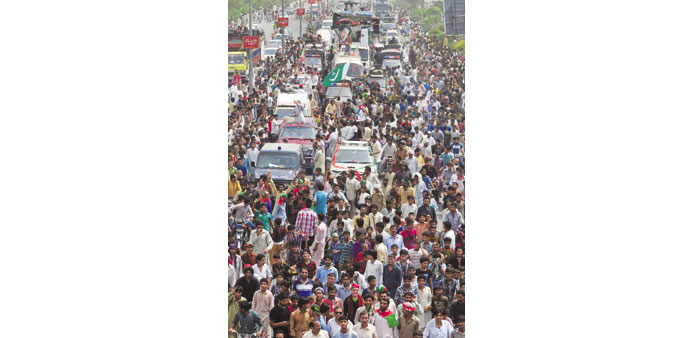
Supporters of cricketer-turned-politician Imran Khan take part in a protest march to Islamabad, in the eastern city of Gujranwala yesterday.
Agencies/Islamabad
Clashes broke out yesterday as protesters led in convoys by cricketer-turned-politician Imran Khan and a populist cleric advanced on the Pakistani capital to try to topple the government they say was elected by fraud.
Khan and preacher Tahir-ul-Qadri say the May 2013 general election that brought Prime Minister Nawaz Sharif to power in a landslide was rigged, and are demanding he resign and hold new polls.
They plan to rally in Islamabad to press their claims, at the end of a “long march” - in reality a motorised cavalcade - which set off on Thursday from the eastern city of Lahore, around 300km away.
Police and witnesses said activists from Khan’s Pakistan Tehreek-e-Insaaf (PTI) party clashed with supporters of Sharif’s Pakistan Muslim League-N (PML-N) in the town of Gujranwala, some 200km southeast of Islamabad.
Khan said shots were fired on his march, telling ARY television news: “They threw stones at us while standing at police vans. They fired bullets at us.”
However, police said there were no shots and a news agency photographer at the scene also heard no gunfire.
“Workers of PTI and PML-N clashed in Gujranwala and threw stones at each other,” a police spokeswoman said. “There was no firing incident.”
The photographer said a group of up to 40 youths who were following the convoy and shouting slogans clashed with workers from Khan’s party before being dispersed by police.
Marvi Memon, a PMLN member of parliament and spokeswoman, said the events in Gujranwala were “regrettable” but said there was no shooting and her party’s workers had been provoked by what she called Khan and Qadri’s “violent speeches.”
Punjab Chief Minister Shahbaz Sharif, the premier’s brother, ordered an investigation into the clashes and appealed for calm.
Supporters of PTI, which came third in last year’s election, lined up to welcome the convoy in towns along the Grand Trunk Road which links Lahore and Islamabad.
Exact numbers on the march were difficult to judge, and more people are likely to join it as it passes through towns along the route, but Khan already hailed it a success.
“I can only see that the monarchy is nearing its end,” Khan said, referring to Sharif.
“The people have decided as I had said that 1mn people will come to Islamabad, and they have come out.”
Both Khan and Qadri had originally planned for their marches to converge on Islamabad on Thursday, Pakistan’s Independence Day, but it now looks likely that neither will reach the city before early today.
A spokesman for Qadri, the head of his own Pakistan Awami Tehreek (PAT) movement, said that their convoy was further along the road to Islamabad than PTI’s, in the town of Jhelum, some 120km south of the capital.
“Our convoy is moving at a very slow pace and we expect our arrival in Islamabad very late tonight,” he said.
Security in Islamabad has been ramped up in recent days, with more than 20,000 police and security forces on the streets.
After days of speculation that the authorities would seek to stop marchers entering the city, Interior Minister Chaudhry Nisar Ali Khan said Thursday that both parties would be allowed to hold rallies.
Almost all roads into the city had been blocked with barbed wire and shipping containers, but many barriers were removed yesterday.
Government officials have accused the march organisers of trying to derail democracy and Sharif said the marches were a distraction from more pressing issues.
PMLN spokeswoman Memon said Khan had ignored constitutional routes to address his grievances, including an offer by Sharif to set up a judicial commission to investigate rigging allegations.
“All his efforts are undemocratic and unconstitutional and an effort to derail democracy,” she said.
Pakistan is waging a military offensive against Taliban hideouts in the northwest, while also trying to boost a sagging economy and solve a chronic power supply crisis.
Highlighting the fragile security situation facing the country, militants attacked two airbases in the southwestern city of Quetta on Thursday, with 12 attackers killed by security forces.
Some members of Sharif’s ruling party have suggested the protests are secretly backed by elements in the powerful military, which has had an uneasy relationship with Sharif.
How far Khan and Qadri succeed in destabilising the government is likely to depend on the stance taken by a military, which has a long history of mounting coups.
While few people think there will be a coup many officials fear the threat of unrest will increase the military’s hold over the government.
The military has been frustrated with the government, in particular over the prosecution of former army chief and president Pervez Musharraf for treason.
There was also disagreement between the government and the army on how to handle the Pakistani Taliban with the army favouring military action and the government holding out hope for peace talks.