


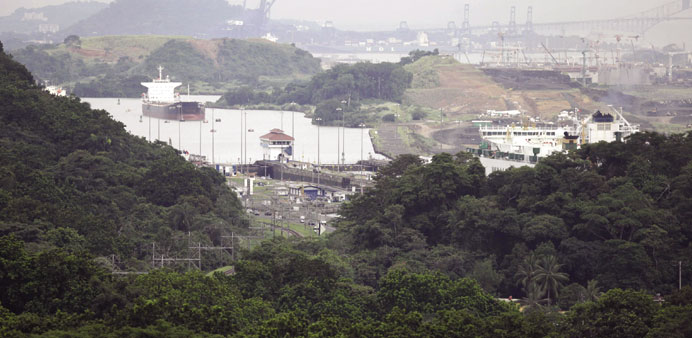
A cargo ship passes the Pedro Miguel locks at the Panama Canal. Panama will celebrate the 100th anniversary of the canal tomorrow.
The Panama Canal is set to celebrate its centennial tomorrow, but it isn’t looking back as much as its looking forward.
The waterway that officially opened on August 15, 1914, when the canal’s first pilot made the first official transit of the canal, is in the midst of a construction project on a third set of locks and has an eye on further updates needed to maintain its status as a crucial instrument in world trade.
“We are currently in a context of expansion, on the 100 years of the canal, to cater to new markets and serve current markets more efficiently,” Francisco Miguez, executive vice president of Administration and Finance at the Panama Canal Authority (ACP), said.
A mammoth work of engineering that has been described as the eighth wonder of the world, the canal was built by the US, which took over the project after France gave up on a similar undertaking in 1889.
Construction claimed the lives of tens of thousands of workers, most of them victims of tropical diseases like yellow fever and malaria.
The 80-km-long canal, whose administration was transferred from the US to Panama on December 31, 1999, is now being challenged by actual and projected competition.
There are plans for similar, longer canals farther north in Nicaragua and Guatemala, and the Panama Canal has lost some clients to Egypt’s Suez Canal and other routes.
In the search for improvements, Panama’s Canal Affairs Minister Roberto Roy noted that construction of a fourth set of locks, for gas-carrying ships, is set to be assessed once the third set is completed.
Miguez recalled the “unfortunate” delay by the international consortium in charge of building the third set of locks for $3.2bn, but he said the expansion to accommodate post-Panamax vessels would be ready by December 2015.
Panamax are the mid-sized cargo ships that are capable of passing through the lock chambers of the canal.
A spat between GUPC, the acronym for the Spanish-named group that includes the Spanish construction company Sacyr Vallehermoso, Italy’s Salini Impregilo, Belgium’s Jan de Nul and the Panama’s Constructora Urbana - and Panamanian authorities over extra funds stopped construction for several weeks in February.
The new set of locks will make the canal between the Pacific and Atlantic oceans accessible for larger freighters that can carry more than 13 rows of containers (known as TEUs) across the vessel.
The works are not affecting current use of the canal, Miguez said, and around 6% of world trade continues to go through the waterway. Canal operations are improving through, among other things, a programme that allows ships to schedule their passage in advance.
“We are trying to be increasingly predictable for our clients,” Miguez said.
Canal authorities are also planning to build a large container transfer hub in the Corozal area, on the Pacific. The waterway itself is “one of the logistical links” in Panama, which also is home to the canal’s two terminal ports, the transistmic railway, the Colon Free Trade Zone, a banking centre and an air traffic hub.
However, it is the world-famous canal that has given the country a globally recognizable name.
The waterway starts in Colon, in northern Panama, on the Atlantic, and ends near Panama City, in the south, on the Pacific.
The locks take ships up to the artificial lake Gatun, 27m above sea level, and down again. Vessels take on average 13 hours to go through the canal, and around 14,000 ships go through it every year.
Since Panama took over management of the waterway in 1999 in line with an agreement that US president Jimmy Carter and Panamanian general Omar Torrijos signed in 1977, Panama’s economy has drawn more than 10bn dollars from the canal, according to official figures. It is the country’s pride and joy, and it will most likely remain so for many years to come.
“A lot of things can change, but for as long as there is globalisation and maritime trade exchange, the Panama Canal will remain important for the world, because it is a shortcut. And Panama will continue to benefit from it,” Manuel Benitez, deputy administrator of the ACP, said.