


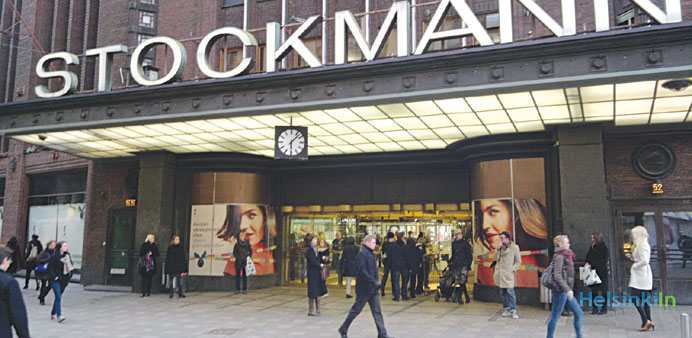
Half of Stockmann’s sales come from Finland, with Russia accounting for 16%, although home sales are also sensitive to Russia’s economy as tourists are frequent shoppers, especially at the flagship store in Helsinki.
To put in place new reporting structure, mulls strategy; analysts expect it to rent out space in stores; could exit Russian department store business: analyst; department store chain Seppala Q2 revenue disappointing: company; July sales fall 9.4% from same month a year earlier
Finnish retailer Stockmann’s Russian sales fell by nearly 15% in the second quarter, as the weak rouble eats into buying power, while revenue at home was down 10% and profits slumped, hit by a recession now set to get worse due to the trade sanctions imposed on and by Russia over the Ukraine crisis.
Reporting a bigger than expected 88% drop in operating profits to €3.5mn for the quarter, the company said it saw its revenue in euros declining this year and operating profit would be “significantly” down on last year, seeing no respite from its problems, which it has promised to start tackling after a strategy review, the results of which are due to be announced later this year.
Shares in the company were down 1.4% at €9.825 1222 GMT, a fall of 11% so far this year.
Before the results analysts had expected the company to report an operating profit of €13.4mn for the second quarter and a 53% fall in the total for this year, to €28.9mn, according to Thomson Reuters data.
“The market environment in Russia continues to be challenging, as the Russian rouble remains weak and the country’s future economic direction is unclear,” Stockmann said.
“The operating environment is unstable and the crisis in Ukraine has considerably increased political tensions globally,” the company said, adding that trade sanctions could further weaken the Russian business.
Total group sales fell 8.9% to €495mn in the second quarter, with losses in Finland and Russia offset by still profitable operations in Norway and Sweden, while group sales in July were down 9.4% at €133.4mn, led by a 12.3% fall in department store sales in Russia and the Baltic states and 14.3% fall in Finland.
Just under half of Stockmann’s sales come from Finland, with Russia accounting for 16%, although home sales are also sensitive to Russia’s economy as tourists are frequent shoppers, especially at the firm’s flagship store in Helsinki.
Analysts said the company could decide to reduce its operations in Russia when it comes out with a new strategy later this year.
“I would not be surprised if they were to pull out of the Russian department store business,” Inderes analyst Sauli Vilen said. “But even that would not solve the core of the problem, they have to reinvent the department store business.”
In addition to the department stores, Stockmann operates the Seppala and Lindex fashion chains.
Seppala, already deeply in the red, made a further operating loss of €5.5mn on sales of €23.6mn in the second quarter. Vilen said Stockmann could decide in its strategic review to scrap the Seppala brand, closing some stores and converting others to Lindex.
“The outlook for the rest of 2014 is challenging, since there are no signs of any significant improvement in the market environment,” Stockmann’s chief executive Hannu Penttila said.
As a first step to overhauling the business analysts now expect the company to bring other retailers into its department stores by renting out floorspace. In its results statement, Stockmann said it would introduce a new reporting structure, which separates real estate out as a discrete business segment.
While it ruled out selling its most valuable properties in Helsinki and St Petersburg, analysts said it could increase the amount of store space which it rents out to other retailers.
“Stockmann has to increase the number of shops-in-shop, rent out floor space in their stores to other retailers,” said Vilen, who has a ‘reduce’ recommendation for the shares. “I would not be surprised if in a few years, they had rented out 30 to 50% of the Helsinki store’s floor space.”
Calling the location the best in the Nordic country, he did not expect any difficulties in finding tenants.