


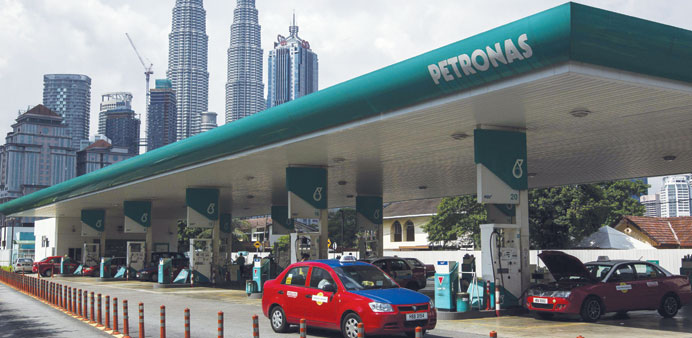
Malaysian state energy firm Petronas said yesterday its second quarter net profit surged 38% year-on-year boosted by higher oil and liquefied natural gas sales volume.
Petronas, the source of about half of Malaysia’s budget revenue, said net profit for the three months ending June climbed to 21.06bn ringgit ($660.8mn) from 15.26bn ringgit compared to the same period last year.
Revenue, meanwhile, jumped 15% to 85.36bn ringgit during the quarter, helped by the local ringgit weakening against the dollar.
On the outlook for the year, the company said: “The board expects the overall year-end performance of Petronas Group to be fair within the challenging business environment.”
Petronas said total domestic and international production rose 6.3% in the second quarter to 2.21mn barrels of oil equivalent a day from 2.08mn barrels a day last year.
Petronas, Malaysia’s only Fortune 500 company, said it increased output in South Sudan, Iraq and Malaysia.
Shamsul Azhar Abbas, Petronas chief executive, was cited by Dow Jones news wire as saying that the company aims to increase the contribution that foreign operations make towards profit from 10% currently to 20% within the next five years.
Tata Steel
Tata Steel reported yesterday that quarterly group net profit slid a bigger-than-expected 70%, hit by one-off charges, but added its European operations were picking up.
Despite a “healthy improvement across geographies”, Tata Steel, India’s biggest producer, said the performance was not enough to overcome one-time costs which pushed earnings sharply lower than financial market forecasts.
Net profit slid to Rs3.37bn ($55mn) in the first financial quarter to the end of June from Rs11.39bn a year earlier on sales that climbed 11% to Rs364.27bn.
The earnings undershot estimates by analysts who had forecast the steel-maker would post net profit of just over Rs9bn.
“Operating performance improved across all geographies,” said the company, part of the sprawling Tata tea-to-cars conglomerate, adding that in Europe it would keep concentrating on reducing expenses and improving operations.
But a steep fall in the cost of raw materials such as iron ore and coking coal and more stable steel prices failed to offset one-off costs of Rs2.62bn.
“European steel demand is moving in the right direction,” said Karl-Ulrich Kohler, chief executive of Tata Steel in Europe, where the company ranks as number-two steel producer.
“Though demand remains well below levels we would regard as healthy, we can see greater stability emerging in the markets we serve,” Kohler added.
Tata Steel paid $13bn in 2007 to buy rival Anglo-Dutch steelmaker Corus, which has plants in Britain and continental Europe, vaulting from 56th-largest steel-maker in output globally to one of the world’s largest producers.
Macy’s
Macy’s cut its full-year same-store sales forecast, after second-quarter sales failed to make up for weakness in the first quarter when harsh winter weather kept shoppers away.
Macy’s earnings for the quarter ended August 2 also missed the average analyst estimate as the company discounted heavily to win business, squeezing gross margins.
The company said yesterday that margins would be flat to slightly down for the rest of the year.
Shares of the company, which also owns the high-end Bloomingdale’s chain, fell as much as 6%.
“...Many customers still are not feeling comfortable about spending more in an uncertain economic environment,” Chief Executive Terry Lundgren said in a statement.
US retail sales unexpectedly stalled in July, data showed yesterday, pointing to some loss of momentum in the economy. The sales were the weakest since January.
Shares of Macy’s rivals Kohl’s Corp and Nordstorm Inc were down 1.8% and 1.2% respectively.
Net income rose to $292mn, or 80 cents per share, from $281mn, or 72 cents per share, a year earlier.
Total sales rose 3.3% to $6.27bn, after declining about 2% in each of the previous two quarters.
Sampo
Finland’s Sampo Group has raised its forecast for profits this year on its property and casualty insurance business If, after policyholders made no large claims in the Nordic region in the first six months.
If’s chief executive, Torbjorn Magnusson, said conditions for insurers were exceptional in all Nordic countries, resulting in the company’s best ever first half for profitability.
The second-quarter combined ratio at If also fell short of expectations, 86.5% compared with the average forecast of 85.6% given in the poll, enough to send Sampo shares down 2.8% to 36 euros, although the price is up 56% over the last 24 months, compared with a rise of 37% in the Helsinki market’s general index.
“This is a stock that has risen quite strongly, the expectations are high for the company. I would expect the stock to recover,” said Nordea analyst Paavo Ahonen, who had a ‘buy’ rating on the shares.
If’s strong position in all Nordic and Baltic countries balances out any hits from a single market, giving it an advantage over more localised rivals.
Sampo’s chief executive Kari Stadigh told a news conference that a recent forest fire in Sweden will show in If’s numbers in the third quarter, but the impact is not expected to be significant.
Sampo’s overall pretax profit in the second quarter rose 2% from a year ago to €465mn ($622mn) on the back of increased investment income. The result beat the average forecast of €435mn.
E.ON
Germany’s biggest utility E.ON posted a 12% drop in first-half core profit, hit by a weakening currency in Russia, its most important foreign market that is the target of Western economic sanctions over Ukraine.
E.ON yesterday said earnings before interest, tax, depreciation and amortisation (EBITDA) at its Russian energy business declined by a quarter due to a drop in the rouble, and warned the currency could fall further.
The rouble has dropped 7% against the euro so far this year, as the Ukraine crisis has intensified.
The sanctions imposed on Russia’s defence, oil and financial sectors in response to Moscow’s support for separatists waging an insurrection in Ukraine are intended to hurt an already weak economy.
Some German companies operating in Russia, including car manufacturers and drugmakers, have already said the crisis was hurting their businesses.
The Ukraine crisis is the latest blow for E.ON which, like other German utilities, has seen its profits and share price tumble in an energy sector shake-up that has promoted solar and wind generation at the expense of utilities’ gas-fired power stations.
Investors and analysts have pointed to Russia as a potential source of risk for the company, whose total investment in the country will grow to €10bn ($13.4bn) next year.
Tencent
Tencent Holdings, China’s biggest listed tech firm, posted its second quarter of year-on-year profit gain of more than 50% as smartphone gaming revenue continued to grow at a breakneck pace.
Net income rose 59% to 5.84bn yuan ($949mn) in the three months to end-June compared with a year earlier, Tencent said yesterday. That beats a mean estimate of 5.73bn yuan based on a Thomson Reuters SmartEstimate poll of 10 analysts.
Tencent, with a market cap of more than $160bn, has built its success on WeChat, known as Weixin in China. Through the mobile messaging app, the arch-rival of Chinese e-commerce giant Alibaba Group Holding Ltd has been raking in money since it introduced smartphone games in late 2013.
The Shenzhen-based company is also monetising games on its other large mobile social network, Mobile QQ.
“Revenue growth in the online game business mainly reflected contributions from smartphone games integrated with Mobile QQ and Weixin, as well as growth in PC client games,” Tencent said in its earnings release.
Overall revenue climbed 37% to 19.75bn yuan in the second quarter. In the first quarter, Tencent’s net profit rose 60% to a record 6.46bn yuan.
Deere
Deere & Co posted a lower quarterly profit yesterday and cut its full-year outlook as declining grain prices discouraged farmers from purchasing its tractors, harvesters and other agricultural machinery.
The Moline, Illinois-based company, the world’s largest maker of farm equipment, said it now expects to earn $3.1bn in fiscal 2014, down from its previous forecast of $3.3bn.
The company said it expects total US farm cash receipts, which correlate closely with investment in new ag equipment, to fall to $387.1bn in 2014, down from $407.1bn in 2013 and below its previous forecast of $392.7bn.
Ann Duignan, an analyst at JP Morgan, said the company’s forecast, which came just one day after the US Department of Agriculture released its World Agricultural Supply and Demand Estimates, remained “overly bullish.”
The USDA predicted US corn production will top the 14bn-bushel mark for the first time ever this year. It also said it expects the US soybean crop to come in at a record of 3.82bn bushels, up 16%.
The prospect of a bumper crop has sent corn and soybean prices plummeting and soured farmers on making new capital investments in their operations.
Deere also cut its forecast for South America, where rising interest rates in Brazil and tight credit in Argentina are hurting sales.
Deere said it now expects full-year industry sales in the region to fall 15% in 2014, down from a previously forecast decline of 10%.
Lawrence De Maria, an analyst at William Blair & Co, said the lowered outlook proved that Deere, which outperformed rivals Agco and CNH in previous quarters because of strong back orders, was “not immune” to the deteriorating fundamentals in the sector.
For the most recent quarter ended July 31, Deere reported a net profit of $850.7mn, or $2.33 a share, compared with $996.5mn, or $2.56 a share, a year earlier.
Stockmann
Finnish retailer Stockmann’s Russian sales fell by nearly 15% in the second quarter, as the weak rouble eats into buying power, while revenue at home was down 10% and profits slumped, hit by a recession now set to get worse due to the trade sanctions imposed on and by Russia over the Ukraine crisis.
Reporting a bigger than expected 88% drop in operating profits to €3.5mn for the quarter, the company said it saw its revenue in euros declining this year and operating profit would be “significantly” down on last year, seeing no respite from its problems, which it has promised to start tackling after a strategy review, the results of which are due to be announced later this year.
Shares in the company were down 1.4% at €9.825 1222 GMT, a fall of 11% so far this year.
Before the results analysts had expected the company to report an operating profit of €13.4mn for the second quarter and a 53% fall in the total for this year, to €28.9mn, according to Thomson Reuters data.
Total group sales fell 8.9% to €495mn in the second quarter, with losses in Finland and Russia offset by still profitable operations in Norway and Sweden, while group sales in July were down 9.4% at 133.4mn euros, led by a 12.3% fall in department store sales in Russia and the Baltic states and 14.3% in Finland.
Swiss Life
Insurance giant Swiss Life yesterday posted better than expected first-half net profit, driven by strong growth in the Swiss market.
The group also said it was expanding its real estate management operations with the purchase of German company Corpus Sireo.
In the first six months of the year, Switzerland’s largest life insurance company saw its net profit swell to 487mn Swiss francs (€401mn, $536mn), up 3.1% from the same period of 2013.
Analysts polled by the AWP financial news agency had expected to see a net profit of 466mn francs for the six-month period.
The insurer saw its premium income swell 4.2% year-on-year to 10.8bn francs.
In Switzerland, by far its largest market, the group raked in 6.6bn francs in premiums—up 12%.
Most of that—a full 5.9bn francs—came from the business sector, but private client premiums also swelled 11% to 737mn francs, the company said.
In France, Swiss Life’s key market abroad, the insurer also fared better than expected, with premiums growing 4.0% in local currencies to 2.4bn francs.
That was offset somewhat by the German market, where premiums slumped 8.0% to 783mn francs.
But the company has plans to boost its German business in other ways, announcing separately on Wednesday the purchase of a major real estate asset management provider from three German savings banks.
Admiral
British motor insurer Admiral Group posted a 2% rise in first-half pretax profit, offsetting a decline in turnover by releasing reserves set aside to pay off claims.
The company also reiterated a bleak outlook for domestic premiums as it continues to cut prices to compete with rivals Direct Line and esure Group and increasingly popular price-comparison websites.
“In the UK there are some signs that premiums are no longer falling but we have yet to see firm evidence of an inflection point and a return to premium growth,” Chief Executive Officer Henry Engelhardt said in a statement.
Premiums written fell about 9% to £776mn ($1.3bn) at Admiral’s core UK car insurance business, dragging overall turnover down by 5%.
“Unless the market turns, Admiral’s earnings are likely to come under pressure,” UBS analyst James Shuck said, maintaining his “neutral” rating on the stock.
Admiral’s adjusted pretax profit increased to £184.9mn in the first-half ended June, due mainly to a 40% rise in reserve releases, the funds that had been set aside to cover claims losses.
G4S
G4S, the world’s biggest security company, posted a better-than-expected 6.3% rise in first-half profit as new Chief Executive Ashley Almanza’s overhaul began to pay off following a string of high profile fiascos.
The reputation of the British firm, whose operations range from transporting cash to running prisons and protecting ships from pirates, has been battered in recent years due to a failed merger and a number of contract scandals at home and abroad.
“The transformation of G4S is clearly underway,” Almanza, who replaced the long-serving Nick Buckles in June last year, told reporters yesterday.
“There’s much more hard work to be done to capture the full potential of our strategy and to strengthen the group’s performance, but the good news is there is a lot to go for.”
Its group margin rose 10 basis points to 5.5%. The firm said it had won £1.2bn of contracts in the half and had £4.9bn of new work to bid for as of June 30.
“These results show the first signs that Almanza’s recovery initiatives are having a positive impact on earnings, cash and return on invested capital,” said Jefferies analyst Kean Marden, who has a ‘buy’ rating on the stock.
Glencore
Mining company Glencore posted a 13% increase in first-half copper output, in line with market forecasts and boosted by growth at its African and South American mines but its zinc and nickel production dipped.
The London-listed company, which is due to report half-year results next week, makes almost half of its profit from the red metal and said its total copper output using feed from its own sources rose to 741,000 tonnes in the first half of this year.
That compares with analysts’ forecasts of 739,000-754,000 tonnes.
The increase in copper was mostly on the back of higher production at its Mutanda and Katanga mines in the Democratic Republic of Congo and at its Antapaccay mine in Peru. Operational improvements at Collahuasi in Chile, a joint venture with Anglo American, also helped.
“Second-quarter production was broadly in line with our forecasts. The production profile for the group is weighted towards the second half and we therefore expect volume improvements going forward,” Citi analysts said in a note.
However, output of zinc, another large contributor to Glencore’s bottom line, dropped 11% in the first half to 650,400 tonnes and nickel production fell 8% to 49,100 tonnes, as some mines were placed on care and maintenance.
The Koniambo mine in New Caledonia, a multi billion greenfield project that has seen cost overruns and delays, produced 4,100 tonnes of nickel in ferronickel in the first half.
In May, Glencore said it would review its annual production target from Koniambo after flagging some start-up difficulties due to issues such as power instability and maintenance stoppages.
Its previous goal for Koniambo was 55,000 tonnes by 2016 but a revised target should be announced next week.
Commonwealth Bank
Australia’s biggest bank, the Commonwealth yesterday posted a bumper 13% jump in full-year net profit to a record Aus$8.63bn (US$8.0bn) with gains across each of its core divisions.
The country’s top home lender and biggest company by market capitalisation said net profit for the 12 months ending June 30 was up from Aus$7.68bn the year before, slightly above analyst expectations.
Cash profit—the bank’s preferred measure which strips out one-off costs—was Aus$8.68bn, up 12%, underlying a buoyant financial position.
A final dividend of Aus$2.18 was declared, an increase of nine%.
“This year we have again struck a balance between the group’s short-term and long-term priorities,” said chief executive Ian Narev.
“At the same time as delivering a 12% increase in cash earnings, and a strong return on equity, we reinvested Aus$1.2bn into the business.”
He said most of this was targeted at the 102-year-old’s bank’s long-term strategic priorities—“people, technology, strength and productivity”.
Narev added that the bank was “cautiously positive” about the outlook for the 2015 financial year.
“Whilst business and consumer confidence levels have remained fragile, the levels of underlying activity confirm the strong foundations of the Australian economy,” he said.
“Lower interest rates have been positive for the housing and construction sectors, where increased activity has gone some way to offset the impacts of the anticipated reduction in investment in the resources sector.”
Analysts said investors were likely to be pleased with the result.
“Investors are likely to be pleased by news of CBA’s $2.18 dividend. It’s encouraging that CBA is comfortable in maintaining its payout ratio at 75%,” said CMC Markets’ chief analyst Ric Spooner.
“This indicates it is relatively comfortable about meeting future capital requirements.
Cathay Pacific
Cathay Pacific said yesterday its first-half net profit soared to HK$347mn ($44.77mn) on higher passenger demand, but the Hong Kong flag carrier warned of a “challenging” outlook as surging competition held down fares.
The figure for the six months ending June 30 compared with a net profit of HK$24mn in the same period last year. Revenue in the reported period jumped 4.6% to HK$50.84bn.
But despite its upbeat performance, the blue-chip airline faces several challenges including persistently high jet fuel prices, said group chairman John Slosar.
“The operating environment for the Cathay Pacific Group—and the aviation industry as a whole—remains challenging,” Slosar said in a filing to the Hong Kong stock exchange.
“On the plus side, we continue to strengthen our passenger network and the connections available through Hong Kong,” he said.
Aviation analyst Daniel Tsang told AFP the huge increase in net profits was on account of the airline’s improving passenger operations, which contributed to a sharp jump in revenues.
The airline’s passenger revenue in the reported period was up 4.4% to HK$36.52bn compared to the previous year, helped by the introduction of new long-haul routes to destinations such as Doha and Newark.