


By Jason Burke in Beit Lahia/Guardian News & Media
Tens of thousands of people across Gaza have returned to their homes as a tenuous ceasefire holds and hopes rise of an end to the month-long conflict between Israel and Hamas.
Local officials and humanitarian workers have begun to inspect the damage the war has caused in the overcrowded enclave, with initial assessments indicating earlier estimates may have been optimistic.
In Gaza City, which has a population of half a million, between 20 and 25% of the housing stock has been damaged, says Nihad al-Mughni, head of the engineering department.
Mohamed al-Kafarna, the mayor of Beit Hanoun, a northern town which saw fierce fighting and heavy bombardment, says 70% of homes are“uninhabitable”.
“Basically the town is unliveable. There is no power, water or communications. There are not the basics for life,” he says.
In Shawkat, a neighbourhood of Rafah city in the south which saw heavy fighting after an earlier ceasefire collapsed within hours, 300 out of 2000 houses had been destroyed, along with the town hall.
“You can’t imagine the destruction,” says Adel Lubda, the chief council engineer.
Previous estimates of 65,000 rendered homeless in Gaza now look conservative. In Beit Hanoun alone, around 30,000 people will have to be rehoused. The town is just one of around a dozen communities lying in the three kilometre “free fire zone” declared by Israeli troops during the most intense period of fighting to have been devastated.
Gaza has a population of 1.8mn and already suffered from a chronic shortage of housing before this latest conflict, the third in six years between Hamas and Israel.
On Monday, the UN called the level of destruction “unprecedented”.
Israeli airstrikes in Gaza continued until the ceasefire, agreed late on Sunday, came into effect.
Nadia Dibsy, of the International Committee of the Red Cross (ICRC), says it has been impossible to properly assess the overall magnitude of the damage.
Ibrahim Jassa, 33, says he had been “completely ruined”.
“I have nothing, except seven children. No job, no home, just the clothes we were wearing when we left,” the unemployed labourer says.
Sabr al-Gharboui says three apartments she had shared with her sons haveall been reduced to rubble. “I have no idea what we will do. We just hope the ceasefire will hold. But what happens next? That’s what worried us,” the 53-year-old says.
Though local electricity engineers are hopeful of restoring power supply to its pre-war levels of six to 10 hours a day to some areas, it may take years to recommission Gaza’s only power station, which was destroyed on July 29. Pumping stations, power transmission networks and water pipes have all been badly damaged. One major sewage outflow pipe, serving nearly half a million people, has been severed. Huge quantities of raw sewage are flowing into the sea or onto fields.
“Access to clean water has always been a challenge. Now it is a scarcity,” says Dibsy of the ICRC.
More than 200,000 remain in UN-run shelters, afraid or unable to return home, with many more staying with relatives. Food prices have risen sharply since the start of the war as fields are inaccessible or full of unexploded ordnance and farms have been badly damaged.
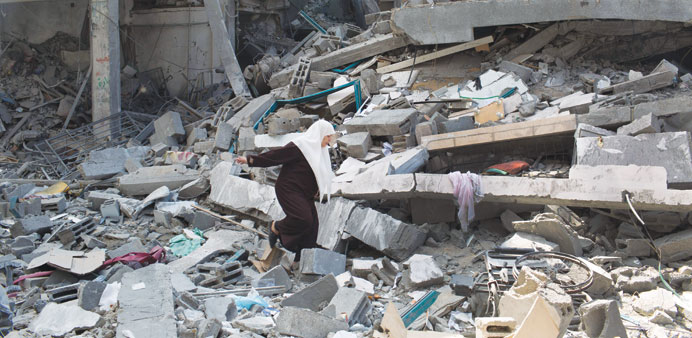
UN says the level of destruction in Gaza is ‘unprecedented’ as 30,000 people in Beit Hanoun alone must be rehoused.