


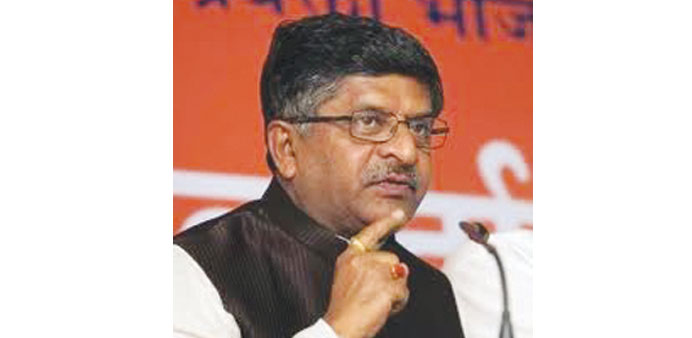
“We all want an independent judiciary, but the sanctity of parliament is equally important”
IANS/New Delhi
The government yesterday said it favoured an independent judiciary, but also wanted the sanctity of parliament to be maintained.
“We all want an independent judiciary, but the sanctity of parliament is equally important, which we all appreciate,” Law and Justice Minister Ravi Shankar Prasad said in the Lok Sabha, the lower house, while tabling two bills which seek to replace the collegium system of appointment of judges.
The National Judicial Appointments Commission Bill 2014 and the 125th Constitution (Amendment) Bill seek to regulate the procedure to be followed for recommending people for appointment as chief justice of India and other judges of the Supreme Court and high courts and their transfer.
The two bills were introduced in the lower house on Monday by the minister who had earlier in the day withdrawn the previous government’s Judicial Appointments Commission Bill, 2013 in the Rajya Sabha, the upper house.
Prasad said in the Lok Sabha yesterday that separation of powers was important and a part of the constitution.
He said: “The government doesn’t have any intention whatsoever to have any confrontation with the judiciary. We respect the judiciary as an article of faith.”
The law minister appealed to all members of the Lok Sabha to rise above all considerations and ensure that the judiciary’s dignity is maintained.
The Constitution (Amendment) Bill seeks to put the proposed judicial commission and its entire composition in the constitution.
According to the proposal, the chief justice of India will head the commission.
Besides the chief justice, the judiciary will be represented by two senior judges of the Supreme Court.
Two eminent personalities and the law minister will be the other members of the proposed panel.
The Constitution (Amendment) Bill needs to be passed by two-thirds majority.
Meanwhile, Parliamentary Affairs Minister M Venkaiah Naidu has indicated that the parliament session may be extended.
According to sources, at a meeting of the Bharatiya Janata Party’s parliamentary party yesterday morning, Naidu asked the MPs to “be prepared” in case the session is extended.
BJP leader Rajiv Pratap Rudy, meanwhile, told reporters that the government had legislative business which needs to be completed.
“The opposition has been disrupting the House. The government has some key bills to pass and, if needed, the session may be extended,” said Rudy.
• All India Anna Dravida Munnetra Kazhagam leader M Thambidurai is all set to be elected the deputy speaker of the Lok Sabha unanimously, a parliament official said yesterday.
Thambidurai filed his nomination for the post earlier in the day. The election will be held today.
According to the official, all major parties, including the Congress, have extended support to the AIADMK leader.
The AIADMK has 37 MPs in the lower house and is the third largest party after the BJP and the Congress.
Bill to amend Juvenile Justice Act tabled
The government yesterday introduced a bill in the Lok Sabha to amend the Juvenile Justice Act that will allow treating 16-18-year-olds as adults when involved in heinous crimes. The Juvenile Justice (Care and Protection Children) Bill 2014 was introduced by Women and Child Development Minister Maneka Gandhi. The amendment will empower Juvenile Justice (JJ) Boards to take a call on whether to treat 16-18-year-olds as adults if they are involved in heinous crimes. Such juveniles may face a jail term, if convicted, but will not be awarded life terms or the death penalty. Currently, if an accused is determined to be a juvenile (under 18 years), he is tried by the JJ Board and, if convicted, is sent to a juvenile home for a period of three years. The bill will enable other changes in the Juvenile Justice (Care and Protection of Children) Act, 2000.