


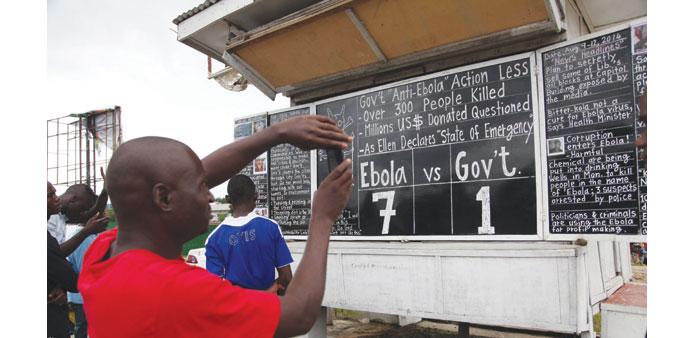
This picture taken over the weekend shows Liberians reading the Daily Talk chalk board on the Ebola outbreak situation in Monrovia.
By Clair MacDougall and Umaru Fofana, Reuters/Monrovia/Freetown
People in Sierra Leone and Liberia filled churches on Sunday to seek deliverance from an outbreak of the deadly Ebola virus, defying official warnings to avoid public gatherings to contain an epidemic that has killed nearly 1,000 people in West Africa.
With their creaking healthcare systems completely overrun, Sierra Leone and Liberia have both declared states of emergency to tackle the highly contagious and incurable disease, which has also stricken neighbouring Guinea.
People still flocked to sing and pray at churches in Liberia’s ramshackle ocean-front capital Monrovia, many of them comparing Ebola to the brutal civil war that ravaged the country between 1989 and 2003, killing nearly a quarter of a million people.
One of the deadliest diseases known to man, Ebola kills up to 90% of those infected.
Discovered nearly 40 years ago deep in the forests of central Africa, its symptoms include internal and external bleeding, diarrhoea and vomiting.
“Everyone is so afraid,” said Martee Jones Seator at Saint Peter’s Lutheran Church. “Ebola is not going to shake our faith in any way ... because we’ve been through difficult times.”
With the disease now in four African countries – following the death in Nigeria last month of a US citizen who arrived from Liberia – the World Health Organisation (WHO) on Friday classified the epidemic as an international health emergency.
The WHO has said that the world’s worst outbreak of Ebola – with 1,779 cases and 962 deaths – will likely continue for months as the region’s healthcare systems struggle to cope. It has appealed urgently for funding and emergency medical staff.
With no other treatment available, churches in Monrovia furnished plastic buckets containing chlorinated water for worshippers to disinfect their hands.
Inside, pastors told their congregations to follow instructions from health workers, some of whom have been attacked by locals terrified by the disease.
“We are in trouble here. We are in trouble,” Reverend Marcus MacKay, dressed in a green gown, said before the altar. “But you know what? There is no way this devil is going to do its work!”
Though this outbreak was first identified in March in the remote forest region of southeastern Guinea, scientists have traced the first recorded case as far back as early December, to a two-year-old boy near the town of Gueckedou.
Many believe the virus was carried by fruit bats from central Africa, where it is regarded as endemic. Yet it is not clear how it jumped into the human population in West Africa.
Quarantine measures imposed on infected communities have hit trade and food supplies in some of the world’s poorest countries.
In Sierra Leone, Bishop Abu Aiah Koroma of the evangelical Flaming Bible Church in Freetown said price hikes were destroying the nation’s economy, branding Ebola “a devil”.
Speaking amid chants of “Alleluia” and “Amen” from his packed church, Koroma called for penitence “to avert this plague from our country”.
Concern over the spread of Ebola grew after it spread to Nigeria – Africa’s most populous country – in late July.
Ten cases of Ebola have now been confirmed there, including two deaths, and authorities have declared a national emergency.