


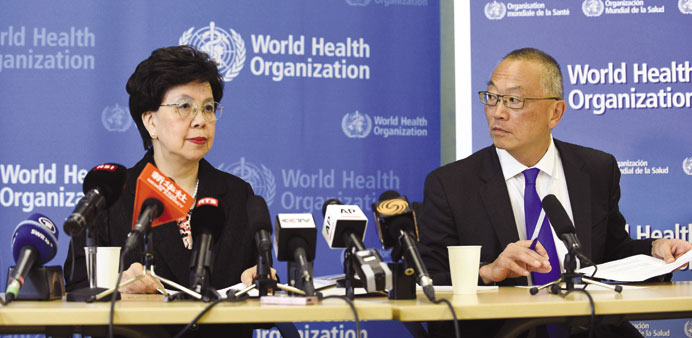
WHO chief Chan and Fukuda at the news conference in Geneva following a two-day emergency meeting on West Africa’s Ebola epidemic.
The Ebola outbreak in West Africa amounts to an international health emergency, the World Health Organisation (WHO) declared yesterday, calling for global action to stop the virus from spreading further.
“This is the largest, most severe and the most complex outbreak in the nearly four decades history of this disease,” WHO Director-General Margaret Chan said in Geneva. “The outbreak is moving faster than we can control it.”
Chan stressed that designating the Ebola epidemic a “Public Health Emergency of International Concern” does not mean that the WHO expects the virus to spread around the globe, but that it wants all countries to be more vigilant.
“This is not a mysterious disease. This can be stopped,” WHO health security chief Keiji Fukuda said.
One reason for declaring an emergency was that most of the affected countries have weak health systems, which urgently need international support, Chan said.
She called for aid to improve health services, provide protective gear for health workers, and for fielding more international medical staff.
The EU Commission announced it had earmarked another €8mn ($10.7mn) to help humanitarian groups and UN agencies that are active in the region.
The new pledge brings the total amount of EU aid to €11.9mn.
The World Bank pledged up to $200mn in emergency funding this week to help Guinea, Liberia and Sierra Leone, the countries that have been hit the hardest by the epidemic.
Medical aid group Medecins Sans Frontieres (MSF) criticised that the international community has not done enough to help these countries cope with the crisis.
“Lives are being lost because the response is too slow,” said Bart Janssens, the operations chief of the group that has been at the forefront of providing medical aid on the ground. “For weeks, MSF has been repeating that a massive medical, epidemiological and public health response is desperately needed to saves lives.”
The WHO had said on May 18 that the outbreak could be declared over by May 22.
It has since become more conservative in its predictions, said Fukuda.
“At that point we thought that it was likely that it would come under control based on our experience. This outbreak has developed in ways we have not seen before,” Fukuda told reporters.
“The likelihood is that things will get worse before they get better,” the official admitted, adding that the WHO is prepared for an outbreak that persists at a high level for months.
A total of 1,779 cases and 961 deaths have been reported so far.
Most of the infections have occurred in Guinea, Liberia and Sierra Leone, while a small number of cases have appeared in Nigeria.
“We do believe there are more cases than is being reported,” Chan said. “That is often the cases with such a high fear factor and anxiety factor.”
The WHO said it was key to further raise awareness of Ebola among the local population, so that those infected seek medical help as soon as possible, and others know how to protect themselves with hygienic measures.
Confirmed and suspect cases should be immediately isolated, the organisation recommended.
The Liberian government imposed a quarantine on five counties and deployed the army to enforce it through checkpoints, the newspaper Front Page Africa reported yesterday in the capital Monrovia.
The army in Sierra Leone on Thursday blockaded rural areas hit by Ebola.
But some local people said the restrictions, while necessary, risked increasing their economic hardship.
In one example, about 30 military officers armed with AK-47s guarded a checkpoint blocking a line of trucks laden with goods from travelling from Montserrado County to the rest of Liberia.
One of the drivers, Sackie Sumo, said the closed road prevented him transporting his truckload of logs, which in turn meant he would not be paid.
“I feel bad. I need to get money to my family,” he told Reuters.
Market seller Musa Kweh whose shared taxi had been stopped at the same checkpoint, also said she was unsure how she would generate income from her goods now that the market in Monrovia she was heading to was closed.
In an attempt to make some money from the potatoes and other goods, she spread them on the ground at the checkpoint to sell to passersby.
The WHO also called on affected countries to postpone mass gatherings if possible and to screen outbound air travellers.
People who had direct contact with Ebola patients should not leave the country for three weeks, the WHO said.
But it did not recommend a general travel ban to and from West Africa.
Some airlines have cancelled flights to the affected countries, but Chan said the infection risk on flights was low.
Governments of Guinea, Liberia and Sierra Leone should also boost aid to citizens to discourage them from migrating within this three-state region, the WHO said.
In addition, these countries must get health personnel back to work by paying them adequately, providing them with protective gear, the UN agency recommended, calling also for better security at health clinics.
There is no approved vaccine or medication for Ebola, although two infected US patients have been treated with an experimental-stage drug.
The WHO will consult with ethical experts on Monday whether non-approved drugs should be used in this emergency.
The experts will also discuss where such drugs would be used, given that only very small quantities are currently available.
The Ebola virus is one of the most dangerous pathogens. It causes fever and bleeding.
The risk that Ebola would start spreading in the European Union is “extremely low”, EU health commissioner Tonio Borg said, pointing out that Ebola spreads only through direct contact with body fluids.
The last time the WHO declared an international emergency was in May, when it said that the increasing spread of polio across borders must be countered with immunisation programmes.
In 2009, WHO declared an international health emergency during the H1N1 influenza pandemic.