


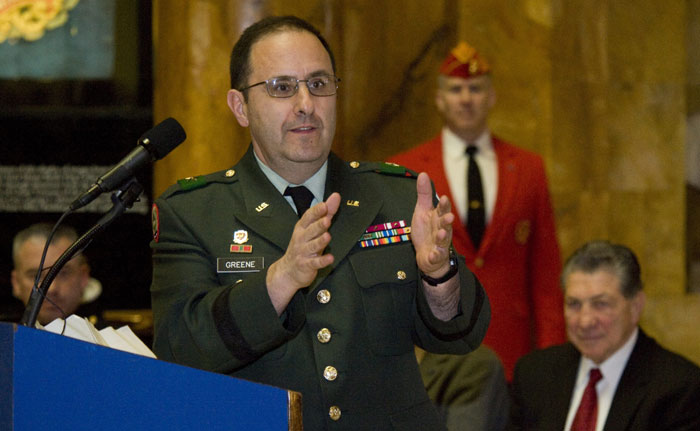
A handout image provided by the US Army shows Major General Harold Greene speaking at the Iwo Jima Day ceremony in Boston, Massachusetts. A uniformed Afghan soldier killed the top US officer and wounded a German brigadier general and 14 others in a shooting at a military complex west of Kabul on Tuesday.
Reuters/Kabul
The Afghan soldier who killed US Major General Harold Greene had spent three years in the army before he squeezed off two to three bursts of gunfire from a first-floor window at a senior military delegation in Kabul, officials said.
As details emerged about Tuesday's attack at a military complex in the Afghan capital, a picture was forming of a rogue Afghan soldier who may have been difficult to spot before he killed Greene and wounded 14 coalition troops.
Greene was the most senior US military official killed in action overseas since the war in Vietnam. His father described him to Reuters as a popular kid growing up whose intellect led to his military success.
"He was unique to the military," the father said. "He was performing a function that took in everything from research to development and he helped develop weapons systems that really help save a lot of lives in the field."
A US military official in Washington offered details about the positioning of the gunman firing on the group from inside a building and the limited number of bursts of gunfire.
A spokesman for the German forces' mission command in Potsdam, near Berlin, said the shooting at the complex on the outskirts of Kabul came from a neighbouring building. Brigadier General Michael Bartscher of Germany was among the wounded.
"(The) delegation was listening to a speech in the open air on the premises of the Marshal Fahim National Defence University when somebody opened fire," the spokesman said.
High-ranking officers such as generals normally travel with their own small security details.
In the immediate aftermath of the attack, the Afghan Defence Ministry had described the gunman, who was also killed, as a "terrorist in army uniform", indicating its belief he was an Islamist militant who had infiltrated the army from outside.
Details about the identity of the soldier and his motivation remained vague, but the fact that he had spent so long in the army before turning on fellow soldiers was likely to be a major line of inquiry in an investigation launched on Wednesday.
"What motivated the shooting is still under investigation, but the shooter was an army soldier, not a terrorist from outside the base," an Afghan defence official said.
The attack raised questions about the ability of NATO soldiers in Afghanistan to train local forces.
Most foreign soldiers plan to withdraw from the country by the end of 2014, but, recognising the challenge Afghan forces face in battling a vicious insurgency led by the Taliban, a contingent could remain beyond the deadline in a training and counter-terrorism role.
The US official said Tuesday's apparent inside attack was still seen as a somewhat "isolated case" and not the start of a new campaign. "Right now we're looking at this as an outlier," the official said.