


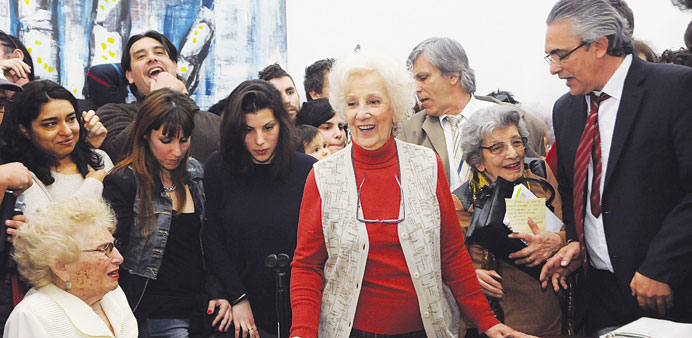
Plaza de Mayo Grandmothers leader, Estela de Carlotto, celebrates after finding her grandson, during a press conference in Buenos Aires. The Plaza de Mayo Grandmothers organisation aims to find children stolen and illegally adopted during the Argentine Dirty War.
Her face aglow after finding her grandson 36 years after he was stolen by Argentina’s military regime, activist Estela Carlotto vowed yesterday to keep fighting to find hundreds of others still missing.
Carlotto, the 83-year-old head of the Grandmothers of the Plaza de Mayo, said she had still not met her grandson Ignacio Hurban a day after news that he had been found through DNA testing.
But she said the 36-year-old, who was taken from his mother Laura after she gave birth to him in detention during the dictatorship’s “dirty war” against leftists, had spoken with relatives on the phone.
“I don’t want to force the situation,” the white-haired grandmother told journalists outside her house in La Plata, around half an hour south of Buenos Aires.
But she beamed with grandmotherly pride as she recounted how he had asked an aunt “How is Estela?” during a phone call.
“You can tell he’s an exceptional boy,” said Carlotto, who got the news from a federal judge after Hurban went in for DNA testing at a national commission that identifies missing people.
She said “many details of the story” were still being investigated, but that it appeared her grandson had been taken by an agent of the regime and given to a couple in the countryside to raise.
“I think they were workers and he was their boss,” she said.
“They must have raised him well in the countryside. They were very good people. Well, you can see that he’s good anyway, so there’s something of that in him.”
The story revived deep emotions in Argentina, where some 500 children were taken from political prisoners during the 1976-1983 military regime.
Carlotto, whose grandson became the 114th stolen child to be found, said she would keep working to locate the nearly 400 others who are still missing.
“It doesn’t end here. I will keep up the struggle. I’m going to keep working... to find all the others who are missing,” she said.
Hurban’s other grandmother, 91-year-old Hortensia Ardua, broke into tears describing how he resembled his father, Walmis Oscar.
“Seeing him was like seeing my son, because they’re exactly alike. It’s overwhelming to know he’s ours. I want to see him, to hug him, to know he’s my grandson,” she told radio network Red.
Friends said Hurban, a jazz musician and composer who lives in Olavarria, a city about 350km southwest of Buenos Aires, had gone in for testing on a hunch and was himself caught off guard by the news.
He had done the tests about two weeks ago and been told the results would take three months, a friend told newspaper La Nacion.
Instead, they came back in 10 days.
“They took him by surprise,” said the friend, who asked not to be named.
He said Hurban, whom friends call “Pacho,” had revealed the news Tuesday to the pianist in his band, a close friend.
“He was calm about it,” said the friend who spoke to La Nacion. “What’s worrying Pacho is how the news is going to affect his parents, who raised him, because they were going to find out on TV.”
Laura Carlotto, a leftist militant, was three months pregnant when she was taken to a prison camp by the right-wing authoritarian regime in 1977.
She gave birth on June 26, 1978, while in captivity. She had named the boy Guido but was killed two months after he was born. The woman’s body was later handed to her mother.
She was with her baby for just five hours before he was taken from her, according to her brother, lawmaker Remo Carlotto.
Walmis Oscar, Hurban’s father, was also killed in captivity.
The Grandmothers of the Plaza de Mayo and a sister group, Mothers of the Plaza de Mayo, have led a nationwide effort to reunite the 500 children who were taken from leftists and government opponents during the dictatorship.
Many stolen children were raised by military and police officials. Others were even taken in by their parents’ killers.
An estimated 30,000 people were killed or abducted and presumed killed during the dictatorship.
In 2012, former dictators Jorge Videla, who has since died, and Reynaldo Bignone were sentenced to 50 years and 15 years in prison, respectively, over the regime’s theft of babies.