


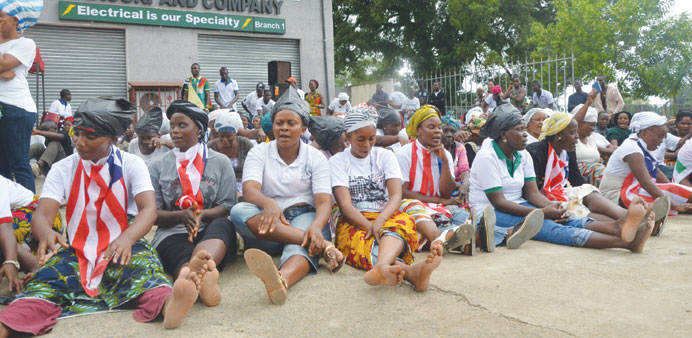
Members of Women in Peace Building Network (WIPNET) pray yesterday on a field not far from the residence of Liberia’s president, in Monrovia, to drive away Ebola from Liberia.
AFP/Lagos
The death toll of the Ebola epidemic neared 1,000 yesterday as fears rose that the disease is now taking hold in Africa’s most populous nation of Nigeria after a second death among seven confirmed cases in Lagos.
The spread of the disease comes as the World Health Organisation (WHO) met in an emergency session in Geneva to decide whether to declare an international crisis.
The latest official toll across west Africa hit 932 deaths since the start of the year, it said yesterday, with 1,711 confirmed cases, mostly in Guinea, Liberia and Sierra Leone.
The death of a nurse in Lagos, a megacity of more than 20mn people, came as 45 deaths were confirmed across west Africa between Saturday and Monday, with aid agencies, including Doctors Without Frontiers, saying the terrifying tropical disease is out of control.
In Liberia’s capital, Monrovia, where the dead have been left unburied on the streets or abandoned in their homes, President Ellen Johnson Sirleaf appealed for divine intervention and ordered three days of fasting and prayer.
And in Sierra Leone, which has the most confirmed infection cases, troops were sent to guard hospitals to “deter relatives and friends of Ebola patients from forcefully taking them from hospitals without medical consent,” a presidential aide said.
The closed-door WHO meeting was not expected to make a decision until tomorrow. But the session itself underscored the severity of the threat the disease, which causes severe fever and unstoppable bleeding, poses.
Meanwhile, a Spanish airforce plane left for Liberia yesterday to bring an infected Spanish missionary priest home for treatment.
The outbreak in Nigeria remains minor compared to the other affected west African nations, but rising cases in Lagos - sub-Saharan Africa’s most populous city - poses unique challenges to health workers.
Nigeria’s Health Minister Onyebuchi Chukwu said all seven confirmed cases in his country had “primary contact” with Patrick Sawyer, a Liberian finance ministry employee who brought the virus to Lagos on July 20.
Sawyer, who travelled to Nigeria from Monrovia via Togo’s capital Lome for a regional meeting, was visibly sick upon arrival at the international airport in Lagos.
Officials said he was immediately transferred to a hospital next to the bustling Obalende market, where thousands of Nigerians shop for basic goods.
Sawyer died in quarantine on July 25 after infecting several hospital staff, including a nurse who died on Tuesday night.
Chukwu had previously said that Nigeria was monitoring 70 people believed to have come into contact with Sawyer.
A Lagos state health official, who requested anonymity, said health workers were trying to track down all potential contacts of the six other patients, but he could not estimate how people now needed to be monitored.
“There is no number yet,” the official said.
The Spanish victim in Liberia, Miguel Pajares, a 75-year-old Roman Catholic priest, had worked in the Saint Joseph Hospital in the capital Monrovia for seven years before falling sick with Ebola.
Two Americans who worked for Christian aid agencies in Liberia were brought back to the US for treatment in recent days.
A Saudi Arabian who had travelled to Sierra Leone and had Ebola-like symptoms died yesterday of a heart attack, the health ministry said.
Aside from medical workers caring for those infected, people who bury Ebola victims are among the most at risk.
First discovered in 1976 and named after a river in what is now the Democratic Republic of Congo, Ebola spreads through contact with bodily fluids such as blood, saliva and sweat.
It has killed around two-thirds of those it has infected over the last four decades, with two outbreaks registering fatality rates approaching 90%. The latest outbreak has a fatality rate of around 55%.