


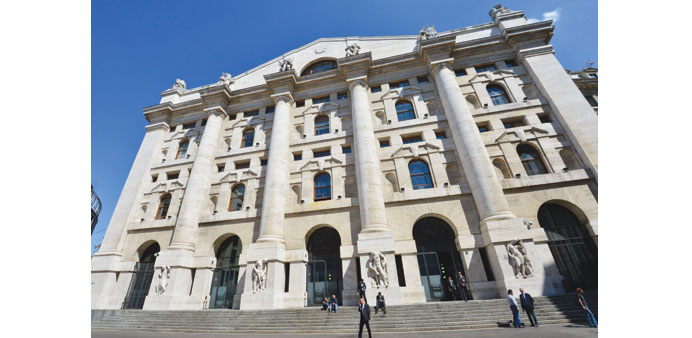
People standing in front of the stock exchange in Milan. The Italian economy shrank by 0.2% in the second quarter, dragging the eurozone’s third-biggest economy back into recession, the national statistics agency said yesterday.
Reuters
Italy slid into recession for the third time since 2008 in the second quarter, underlining the chronic weakness of the eurozone’s No 3 economy and pressuring Prime Minister Matteo Renzi to complete promised reforms.
Figures yesterday from statistics agency ISTAT showed gross domestic product unexpectedly declined by 0.2% in April-June from the previous three months. A Reuters poll of economists had forecast growth of 0.2%.
The economy also shrank by 0.1% in January-March, meaning it has returned to recession, defined as two consecutive quarters of contraction.
Unions and opposition parties said the figures showed Renzi had failed to address the problems of the country, which the leftist SEL party said faces a “real economic disaster”.
Italy has posted only one quarter of growth since mid-2011, expanding 0.1% in late 2013. Adjusted for inflation, second quarter GDP was the lowest for 14 years, ISTAT said.
Italian stocks fell more than 2% after the data and the risk premium between Italy’s 10-year bonds and those of Germany widened by 12 basis points from Tuesday’s close.
Renzi has announced ambitious labour and tax reforms to revive growth needed to curb Italy’s 2tn euro debt burden but progress has been slow, with his energies taken up for weeks by a draining parliamentary battle over constitutional reform.
His calls for a more expansive interpretation of European Union budget rules have been met sceptically by partners, who fear slackening fiscal discipline will simply push up the debt — already the world’s fourth biggest — without growth.
“What the Council has recommended in June that Italy should strictly adhere to its budget, of course the budget recommendation is still valid,” European Commission spokesman for economic policy Simon O’Connor said yesterday.
In a newspaper interview before the data release, Economy Minister Pier Carlo Padoan said that despite indications growth would fall short of forecasts on which 2014 tax and spending plans are based, Italy would not need an emergency budget.
Italy’s official projections for 2014 see growth of 0.8% and a deficit of 2.6% of GDP, fuelling speculation that extra measures may be needed to meet EU budget targets.
Repeating previous assurances, Padoan told business daily Il Sole-24 Ore that Italy would report a budget deficit within the EU’s ceiling of 3% of GDP.
“The 3% limit will not be breached in 2014 or in 2015. There will be no need for a supplementary budget,” he told the newspaper.
The Italian GDP reading and data showing German industrial orders fell at their fastest in almost three years in June will reinforce concerns about feeble growth and inflation in the eurozone ahead of a European Central Bank meeting today.
Germany and France, the bloc’s two biggest economies, are due to report second quarter GDP figures next week.
Spain, once at the fore of the eurozone debt crisis alongside Italy, posted second quarter growth of 0.6% last week, suggesting their economic fortunes are diverging.
Italy’s bond yields have plunged since the ECB pledged at the peak of the crisis to save the euro, but Wednesday’s data highlights the lack of progress made in addressing the problems of an economy that has stagnated for more than a decade.
The Bank of Italy said last month that GDP had contracted by 9% since the global financial crisis began in 2007.
Beyond an 80-euro-a-month tax break for millions of low income workers introduced in the second quarter, Renzi has yet to translate promises to revive growth made when he took office in February into action.
Even the impact of the tax break has been questioned after the head of Italy’s retail association Confcommercio said the effect on consumer spending had been “almost invisible”.
Last month, the Bank of Italy cut its growth forecast to just 0.2% for 2014, in line with forecasts from other bodies including the International Monetary Fund and the Organisation for Economic Cooperation and Development.
The data did offer some encouraging signs, however.
ISTAT said industrial output, which in Italy is usually closely correlated with GDP, rose 0.9% in June, driven by gains in investment and consumer goods, after posting its steepest drop since 2012 a month before.