


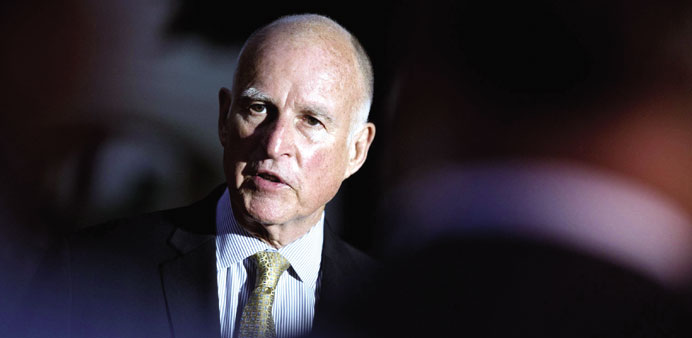
Jerry Brown was a 27-year-old law school graduate when he first traveled to Mexico, trying to pick up the language by staying with a family that didn’t speak English. Five decades later, whatever Spanish he learned has faded, and the California governor used translators to speak with local officials during his trip to Mexico City last week.
But he repeatedly emphasised his long ties to the country that has sent California more immigrants than any other. During a reception with business leaders, he recalled jogging down quiet roads before they became plagued with traffic.
In an interview with the Los Angeles Times, he rattled off the names of Mexican intellectuals he encountered during his visits over the years. And he spoke fondly of how the country’s culture has transformed his state.
At a time when Republicans fret over the lack of Latino support, the governor is cementing ties that could benefit him and fellow Democrats.
While in Mexico, Brown announced a new effort to protect the rights of migrant workers and signed agreements aimed at increasing economic, educational and environmental co-operation with California’s neighbour.
“Anything the governor can do to show empathy to the Mexican community helps Democrats here,” said Allan Hoffenblum, a former Republican strategist who publishes a non-partisan election guide.
Brown, running for an unprecedented fourth term this year, demurred when asked about the political ramifications of his visit.
“To the extent that there are any important issues in this campaign, this probably won’t be one of them,” he said.
Still, Brown repeatedly included references to California’s liberal view of immigrants in his public events this week.
“Some people are trying to keep them out,” Brown said at the announcement of a tourism partnership with Mexico’s largest airline. “And here we are, on the side of bringing more people in.”
Brown’s Republican opponent, former U S Treasury official Neel Kashkari, said the governor is mistaken if he thinks he has a lock on Latino voters. In particular, he cited Brown’s silence on a court case in which a state judge ruled that teacher tenure rules were preventing some students from receiving a quality education.
“At the end of the day, Latino parents are going to care which candidate is fighting for the future of their children,” Kashkari said. Brown is “not fighting for Latino kids who are stuck in failing schools.”
Dan Newman, Brown’s campaign spokesman, rejected Kashkari’s criticism, noting that the governor pushed to increase funding for poor schools with large numbers of students learning English. “He’s fundamentally reformed the ways schools are funded,” Newman said.
Brown is viewed as a strong favorite in November, and a USC Dornsife/Los Angeles Times poll released shortly before the June primary showed Latino voters favored Brown over Kashkari, 65% to 14%.
Although the governor may not need the extra political bounce, analysts said boosting Latino turnout can help other Democrats. Reps. Ami Bera, Julia Brownley, Scott Peters and Raul Ruiz are all freshman members of Congress facing tough battles with GOP candidates.
“Every vote counts, and driving the Latino vote in those ... races is extremely important,” said Roger Salazar, a Democratic political consultant. The governor’s Mexico trip, Salazar said, “reminds us of how long he’s been in tune with the Latino community.”
During his first tour of duty in the governor’s office, from 1975 to 1983, Brown appointed a Mexican-American civil rights leader as his secretary of health and welfare and placed the first Latino on the state Supreme Court. He also worked with labour leader Cesar Chavez to establish union rights for farmworkers.
Brown “was one of the first California politicians to recognise the emergence of the Latino electorate,” said Gray Davis, who was Brown’s chief of staff before becoming governor himself.
In 1982, Latinos were less than 8 percent of voters, according to the California Civic Engagement Project at the University of California, Davis Center for Regional Change. When Brown ran for governor again in 2010, they were 19.2%.
Although GOP candidate Meg Whitman made a multi-million-dollar effort to win their support with Spanish-language advertising when she ran against Brown that year, Brown capitalized on the hard line she had taken on immigration in the primary campaign.
Democrats that year also played on Latino distrust of the political party that fostered Proposition 187, the controversial 1994 ballot initiative intended to cut off social services for immigrants in the country illegally.
Since Brown’s return to the governor’s office, his advocacy for Latinos has continued.
Shortly before his latest trip, Brown nominated the first Latino immigrant, Mexican-born law professor Mariano-Florentino Cuellar, to the state Supreme Court. Asked about the significance of that choice, Brown noted that half of the state’s schoolchildren are Latino. - Los Angeles Times/MCT