


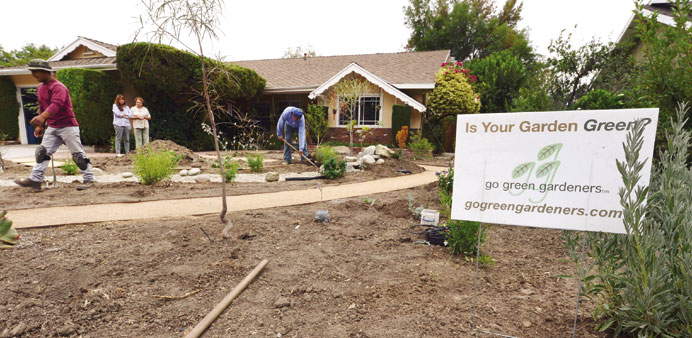
In an effort to get homeowners to rip out their water-guzzling grass lawns, the local water authorities are offering cash incentives of $3 per sq ft of grass removed and replaced with drought-tolerant landscaping.
AFP/Los Angeles
Lush green lawns, a symbol of the American way of life, are under attack in California, where “cash for grass” programmes have sprouted like weeds amid a severe drought.
With the western US state struggling to conserve water, locals are re-landscaping their outdoor spaces as attitudes shift about what constitutes an attractive yard.
And municipal monetary incentives - reflecting the dire circumstances depleting reservoirs and underground aquifers - are making it that much easier for many to make the switch.
Los Angeles, for example, is offering $3 for every square foot of grass that is replaced with more water-efficient options such as drought-tolerant plants, rocks and pebbles.
Under the “Cash in Your Lawn” incentive, property owners can get up to $6,000 for making the conversion.
“People forget we live in the desert - why do we try to make it the Midwest?” asked Larry Hall, a jazz musician and LA resident as he ripped up his front lawn to replace it with a more environmentally friendly one.
His wife Barbara said the city’s programme made it possible to actually follow through and foot the bill for the project.
“We’ve thought about it, we’ve had estimates on re-landscaping but they were a little bit too high,” she said. “So the rebate made it more of a reality.”
Similar programmes have sprung up elsewhere in California as the three-year drought shows no signs of abating and threatens the water supply of the state’s 38mn inhabitants.
Two weeks ago, Governor Jerry Brown took emergency measures aimed at the watering of lawns, forbidding residents from doing so more than twice a week.
He has also temporarily prohibited fines that some communities and homeowner associations typically impose on people who let their lawns turn brown during the summer months for tarnishing a neighbourhood’s image.
In local media, meanwhile, readers and editorials calling for banning the watering of lawns and especially golf courses have multiplied of late as farmers face restrictions.
Anne Phillips, owner of Go Green Gardeners hired by the Halls, said it was time to let go of what was once considered the norm.
“You know the 50s, 60s image of the traditional ranch style home with the lawn and ... you know there is something maybe in our childhoods or whatever about the way our house should look,” she said.
“I think we just need to kind of move beyond that.”
For Phillips, the “cash for grass” programmes have proven to be a windfall, with her company seeing a 30% spike in business.
To make a garden more ecological, she replaces sprinklers - which result in a large amount of evaporation and water loss - with systems that are precisely placed and emit water sparingly.
In terms of plants, she favors succulents, herbs, lavender and agaves, among others.
“It isn’t something that has to be just boring and unattractive and really dry looking,” she said.
Spawned by either increased environmental awareness or soaring water bills, dry or desert gardens are gaining ground in Los Angeles, especially in chic parts of town.
But they’re still not standard.
Stephanie Pincetl, director of the California Center for Sustainable Communities at the University of California Los Angeles, said she received an anonymous letter asking her to remove hers.