


Conrad Williams of England celebrates after he and his teammates won the men’s 4x400m relay at the 2014 Commonwealth Games in Glasgow. Right: England’s Joseph Joyce celebrates winning the men’s super heavy weight boxing final against Australia’s Joseph Goodall at the 2014 Commonwealth Games in Glasgow. (Reuters)
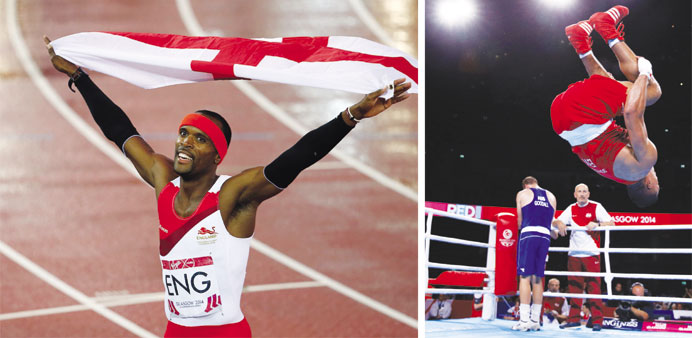
England triumphed in the Commonwealth Games medals table for the first time in 28 years on Sunday, but there were final day consolations for former top dog Australia with wins in the men’s hockey and in the netball.
England started the day already assured of top spot in the medals table for the first time since 1986, dethroning Australia.
They had 165 total medals, with 56 of them being gold, while Australia had 132, 45 of gold, and just 11 events to be decided on a rain-hit final day, not all of which had Australians competing.
Lizzie Armitstead then struck further gold for England in the women’s cycling road race going one better than four years ago in New Dehli.
Fellow English rider Emma Pooley finished 25 seconds behind to finish second and add to the silver she won in the time trial.
“I can call myself a champion finally. It’s special and something I’ve always dreamed about,” Armitstead said.
“I just feel like I deserve this. I’ve trained so hard and I’m always on the podium but I don’t win too many races.
Australia then won gold in the men’s hockey with a 4-0 thumping of India for a fifth consecutive Commonwealth title, and in the netball with a 58-40 revenge win over New Zealand, who beat them at the same stage four years ago.
There was disappointment early on for Scotland, hoping for a 20th gold medal, when Kirsty Gilmour lost 21-14, 21-7 to Canada’s Michelle Li in the badminton women’s singles final.
Games officials, meanwhile, turned out to sing the praises of the Glasgow games with Mike Hooper, CEO of the Commonwealth Games Federation calling them “the stand-out Games in the history of the movement.”
“The spirit of these Games has continued to endure,” he added.
In men’s road cycling David Millar of Scotland was looking to sign off his career with gold in the streets of central Glasgow where his career began.
But there was stern competition in prospect from the likes of Peter Kennaugh of the Isle of Man, who won silver in the men’s 40km points race on the track, and Welsh rider Geraint Thomas, who took bronze in the individual time trial.
Millar, who won road race bronze at Delhi, finished eighth in the individual time trial on Thursday.
In squash, Australia’s David Palmer and Cameron Pilley take on defending champions Nick Matthew and Adrian Grant of England in the final of the men’s doubles.
Palmer is also in the mixed doubles final alongside Rachael Grinham where the Australian pair face England’s Peter Barker and Alison Waters.
Following Li’s gold medal win in the women’s singles, there were badminton golds for second-seeded Kashyap Parupalli of India who edged Derek Wong of Singapore in three sets in the men’s singles and for the husband and wife team of Chris and Gabby Adcock defeating compatriots Chris Langridge and Heather Olver 21-9, 21-2 in the mixed doubles.
The women’s doubles title went to Malaysia’s Hoo Vivian Kah Mun and Woon Khe Wei who defeated Jwala Gutta and Ashwini Ponnappa of India with the final gold still to be decided in the men’s doubles where Tan Wee Kiong and Goh Wei Shem of Malaysia were facing Danny Chrisnanta and Chayut Triyachart of Singapore.
The closing ceremony takes place at Hampden Park from 2000GMT with the Commonwealth Games Federation flag to be entrusted to officials from Australia’s Gold Coast, the hosts of the 2018 Games.
Glasgow organisers hail ‘Friendly Games’
The Commonwealth Games in Glasgow were hailed yesterday as a “stand-out” event by organisers who insisted the movement, comprising largely former British colonies, was well and truly alive.
A combination of the high quality of sports on show, a well-defined legacy plan, the home nation’s success, top-class venues, and friendly reception offered by 15,000 volunteers and the city’s residents helped make the Games a success, according to Mike Hooper, CEO of the Commonwealth Games Federation.
“These have been great Games and in my view the stand-out Games in the history of the movement,” said Hooper.
Bringing together more than 4,000 athletes from 71 nations, including 53 former British colonies - the rest mainly territories or dependancies, in 17 sports, the Commonwealth movement remained strong with high expectations for the next Games in Australia’s Gold Coast in 2018, he added.
“The spirit of these Games has continued to endure.”
The federation, Hooper said, was “delighted with the Glasgow Games and they’re all very excited about the future of the movement going forward to Gold Coast and beyond”.
“We’ve got 37 nations on the medal tally, one more than in Delhi and that’s a very good outcome for the Games movement,” Hooper said.
“With 52 medals, Scotland has at least doubled its tally from Delhi. To finish fourth overall on the medals tally is a great outcome for our hosts and it really has contributed to ensuring that these Games will be truly remembered as fantastic.
“Congratulations to England as well. Its position atop the medal table has been guaranteed. I’m sure the Australians will now come out hard in Gold Coast in four years’ time to regain top spot.”
Hooper praised the public for embracing the Games before the announcement of top-drawer names such as Usain Bolt or Mo Farah, saying that one million tickets had been sold before any potential line-ups had been revealed.
In the first 10 days of competition, he said, there had been 142 Games records and nine world records.
“What an amazing 11 days,” added Lord Smith of Kelvin, chairman of the Glasgow 2014 organising committee, who was quick to praise Scottish politicians for deferring talk on next month’s independence referendum.
“I think all politicians have kept politics out of this. We’re apolitical and we stay that way.
“I think people have behaved very well over this. I have not detected any politics throughout my six-and-a-half years of actually chairing these Games.”
Glasgow 2014 chief executive David Grevemberg, an American, hailed the “sensational support” in Glasgow.
“That wall of sound we absolutely wanted to create has created the perfect stage for athletes in this sports-focused Games. Glasgow and all the fans that came to support these Games delivered,” he said.
Grevemberg also praised the 15,000 volunteers, dubbed “Clydesiders” for putting the “friendly into the Friendly Games”.