


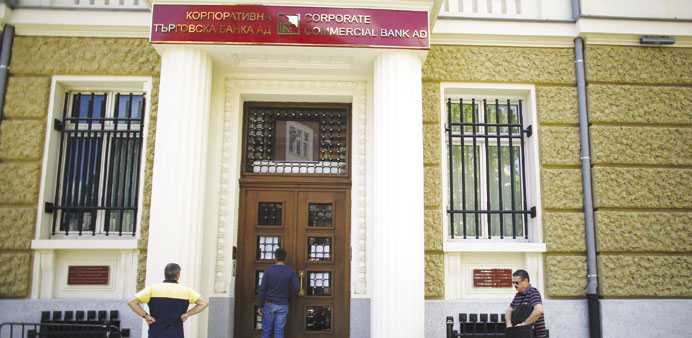
A man reads notes pasted on the front door of the main office of Corporate Commercial Bank in Sofia. A default has looked increasingly likely after a run on deposits at Corpbank in June, which prompted the central bank to seize control of Bulgaria’s fourth-largest lender, shut down its operations and block depositors from taking out money.
Holders of dollar-denominated bonds at Bulgaria’s Corporate Commercial Bank (Corpbank) are gearing up for legal action against the government if the bond defaults and the bank is tipped into insolvency, two sources told Reuters.
A default has looked increasingly likely after a run on deposits at Corpbank in June, which prompted the central bank to seize control of Bulgaria’s fourth-largest lender, shut down its operations and block depositors from taking out money.
There is still no solution in sight for a rescue of the bank, whose closure sparked the Balkan country’s worst banking crisis since the 1990s, especially after lawmakers rejected a proposed rescue package earlier in July. The maturity of the bond, which had an original issue of $150mn, falls on August 8.
A group of bondholders, which includes hedge funds and institutions in the US and Europe, have formed a committee and hired legal representation in Bulgaria in the event the government tips Corpbank into insolvency, the sources said.
One source, a manager at a London-based hedge fund, said the government and the central bank had reassured the bondholders at a government investor road show in June that they would be protected and their money paid back in full.
Failure to do so would send a poor signal about Bulgaria’s investment climate and raise the cost of the country issuing sovereign debt in the future, the manager said, speaking on condition of anonymity.
“What these guys don’t realise, is that they run the risk of turning Bulgaria into the Argentina of Europe,” the manager said, referring to news this week of Argentina’s second default in 12 years.
“If they don’t mature these bonds in a timely fashion, several bondholders are prepared to move forward with fraud and misrepresentation claims against the Bulgarian government,” the manager said.
“When we met with government officials, they were telling us, don’t worry, these bonds are good,” the manager said.
Days after the run on Corpbank, the Bulgarian government and the central bank toured several European cities and were able to successfully launch a €1.5bn ($2.01bn) bond despite the country’s worsening problems. “... a creditors’ committee has been formed and represents more than the required threshold of 25% of bondholders,” a second source, also in the financial sector, said. “(The) group (comprises) hedge funds and institutions in the US and Europe and is prepared to declare bonds in default and due and payable with an eye towards August 8.”
The Bulgarian finance ministry was not immediately available to comment.
The hedge fund manager said the sums involved to pay back the bondholders appeared to be relatively small - about $50-$75mn - as the manager believed Corpbank had already been buying back some of the bonds prior to the bank run.
But Bulgarian lawmakers, who have to approve a rescue package and also a proposal to raise new sovereign debt that could help pay for Corpbank’s rescue, have been at loggerheads about whether and to what extent the Bulgarian government and the central bank should protect depositors and bondholders.
Making matters worse, the banking crisis hit Bulgaria at a time of heightened political instability, with the government resigning last week after a poor showing in recent European elections, to make way for an interim government in August and a snap election on October 5.
Political instability has dogged Bulgaria for two years, stymied efforts at reform and prompted Standard & Poor’s to downgrade Bulgaria’s sovereign credit rating to one notch above junk in June. The hedge fund manager said the bondholders had sent a letter to the finance minister, a central bank official and other government officials about the bond.
“They’re all very aware of the problem, they want to resolve it, but they need political cover,” the manager said. “We’re prepared to move forward with the legal claims against the government, but we prefer an amicable resolution.”
The hedge fund manager said the best course of action would be for Corpbank to reopen with a guarantee from the government and the European Central Bank behind it, as the Bulgarian authorities had done after a run on a second lender in June.
Clients unnerved by reports of alleged shady deals involving Corpbank’s main owner withdrew more than a fifth of deposits in a week-long bank run.