


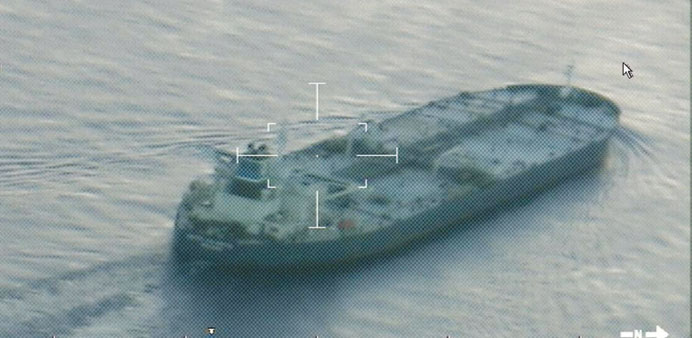
A still image from video taken by a US Coast Guard HC-144 Ocean Sentry aircraft shows the oil tanker United Kalavyrta (also known as the United Kalavrvta), which is carrying a cargo of Kurdish crude oil, approaching Galveston, Texas on July 25. Kurdistan’s long-standing aspiration of exporting oil independently has been at the heart of a bitter conflict with the central government in Baghdad, which claims the sole authority to Iraqi oil exports and has taken legal action against Kurdish oil exports.
Reuters
Oil pumping in Iraqi Kurdistan’s pipeline has been halted for the past week as the storage tanks in the Turkish Mediterranean port of Ceyhan are full, industry sources and an energy official told Reuters yesterday.
“There is no flow at the moment and it has been stopped about a week ago because the storage tanks at Ceyhan are full, even the back-up ones,” one source familiar with the matter said.
Tanks at Ceyhan held around 2.7mn barrels of Kurdish oil and awaited for the arrival of new tankers to load, the source said, without giving a date for fresh loading.
“Once the tankers start coming and going with a routine programme, the flow will resume,” the source said.
Iraqi Kurdistan’s long-standing aspiration of exporting oil independently has been at the heart of a bitter conflict with the central government in Baghdad, which claims the sole authority to Iraqi oil exports and has taken legal action against Kurdish oil exports.
Arbil has begun selling its oil via a new pipeline through Turkey in May but a weeks-long dispute over one of the $100mn crude cargoes in particular has highlighted how bumpy the road for Kurds will be towards seizing greater political and economic autonomy.
A US judge issued on Monday an order for the cargo of an oil tanker carrying 1mn barrels of Kurdish oil to be seized once it enters the US territorial waters, but then she ruled that she lacked jurisdiction.
Baghdad’s lawyers had laid the claim to the oil in the United Kalavrvta tanker, currently anchored in the Gulf of Mexico, in a law suit filed on Monday, saying Kurdistan sold the crude without permission from the central government.
Iraq warned companies against trying to buy other shipments of Kurdish crude after it won the seizure order, while Kurdish leaders asserted their right to sell the oil but said they would face obstacles.
Washington has publicly opposed direct oil sales by the autonomous region, fearing they could contribute to the break-up of Iraq. It has stopped short of banning US companies from buying the oil while warning them of potential legal risks.
While the rulers of Iraq’s northern Kurdish enclave have long aspired to independence, their position has strengthened in recent months as Kurdish Peshmerga troops have outperformed Iraqi soldiers against Islamist militants.
Kurds have also succeeded in cementing their control of land and oil reserves around the resource-rich city of Kirkuk, while Iraqi Prime Minister Nuri al-Maliki, who has been an adversary of Iraqi Kurds, has fallen out of favour in Washington.