


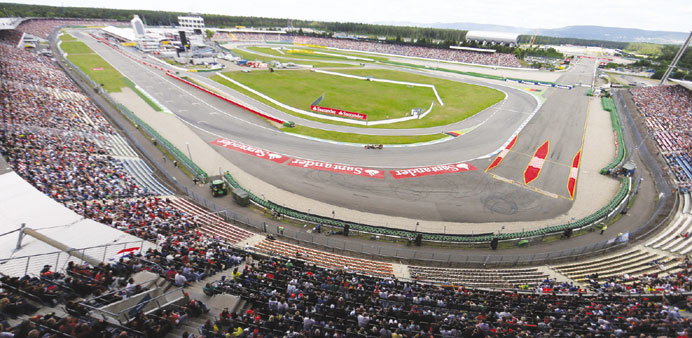
Hockenheim first hosted a world championship race in 1970, but even before that it had earned a reputation as a home for the brave, a circuit for the daring. It was a flat-out blast through the forest; a track where, as two-time Hockenheim winner Gerhard Berger put it, “your foot keeps on wanting to come off the accelerator”.
Over the decades small modifications were made to the breath-taking blend of long straights and sweeping bends, but the circuit retained its fundamental character up until the turn of the century, when radical revisions were implemented.
The old circuit, while unique and fondly remembered, was not without limitations: its layout was fast and narrow - with limited run-off - and not particularly conducive to overtaking. At 6.8 kilometres, it was felt to be too long - particularly as a small spectator capacity meant it was prohibitively expensive to run. The circuit in general needed to modernise. Bosses were therefore at a crossroads, striving to update the track while also retaining the characteristics which had come to define it as a driver’s favourite, and a test not just of machine and skill but also character.
“The Hockenheimring has always been a magnet of attraction for the area,” explains the circuit’s CEO Georg Seiler. “Having recognised this factor, and the competition of new, modern race tracks - in Germany and abroad - the decision was made to finance a complete modernisation in 2002 and ‘03.
The task itself fell to renowned circuit designer Hermann Tilke, who was approached, says Seiler, “for three reasons: experience, expertise and vision.”
That vision, however, would change over time as various considerations and restrictions came into play.
“The old Hockenheimring was a fast-lane track with long straights,” Tilke explains. “There was something very special about it, about how rare its layout was, so we wanted therefore to keep as much as possible of the old track.
“The original idea was just to broaden the existing track according to current safety regulations, and to keep the track to its original length. At that time the restrictions and possibilities the site offered were not clear however and the idea eventually proved unfeasible.
“The task became to design something new, on the existing site, and make it more interesting and accessible for visitors, all without impacting upon the woodland. Today’s track layout is the result of that intense idea exchange and development process, conducted alongside the Hockenheim management.”
The revamp was also the product of extensive simulation work, and consultation with the men who would actually race on the new circuit. Michael Schumacher, who at the time was in the early stages of his record-breaking run of five straight world championship crowns with Ferrari, was among those to have an input.
Nor did it. On 28 July 2002 the new Hockenheim hosted its first Grand Prix, with Michael Schumacher triumphing for Ferrari - his first victory at Hockenheim. “I like this new circuit and in my opinion it’s a great success,” Schumacher enthused during the weekend.
The seven-time world champion was not the only man to praise the changes. Seiler believes they helped usher in a new era for the track, even if as CEO he admits to a certain romanticism about the old venue.
“It is a real asset for fans, particularly areas like the Mercedes tribune, where they have the opportunity to see a huge area of the track from the Parabolika to the hairpin,” he reflects.
“Old parts of the track, running through the forest, were an outstanding attribute of the old Hockenheimring, and are sometimes dearly missed - but the changes achieved everything we wanted, and gave us a modern track worthy of hosting Formula One racing.”
(Formula1.com)