


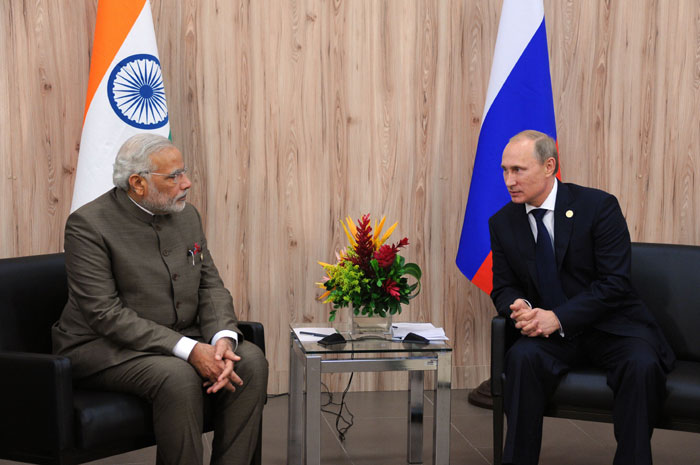
India's Prime Minister Narendra Modi speaks with Russian President Vladimir Putin during their meeting on the sidelines of the BRICS group leaders summit in Fortaleza, Brazil, on Tuesday.
Reuters/Fortaleza, Brazil
Leaders of the BRICS emerging market nations launched a $100bn development bank and a currency reserve pool on Tuesday in their first concrete step toward reshaping the Western-dominated international financial system.
The bank aimed at funding infrastructure projects in developing nations will be based in Shanghai, and India will preside over its operations for the first five years, followed by Brazil and then Russia, leaders of the five-country group announced at a summit.
They also set up a $100bn currency reserves pool to help countries forestall short-term liquidity pressures.
The long-awaited bank will be called the New Development Bank.
It is the first major achievement of the BRICS countries - Brazil, Russia, India, China and South Africa - since they got together in 2009 to press for a bigger say in the global financial order created by Western powers after World War Two and centred on the International Monetary Fund and the World Bank.
The BRICS countries were prompted to seek co-ordinated action following an exodus of capital from emerging markets last year, triggered by the scaling back of US monetary stimulus.
The new bank reflects the growing influence of the BRICS, which account for almost half the world's population and about one-fifth of global economic output.
The bank will begin with a subscribed capital of $50bn divided equally between its five founders, with an initial total of $10bn in cash put in over seven years and $40bn in guarantees. It is scheduled to start lending in 2016 and be open to membership by other countries, but the capital share of the BRICS cannot drop below 55%.
The contingency currency pool will be held in the reserves of each BRICS country and can be shifted to another member to cushion balance-of-payments difficulties. This initiative gathered momentum after the reverse in the flows of cheap dollars that fuelled a boom in emerging markets for a decade.
"It will help contain the volatility faced by diverse economies as a result of the tapering of the US' policy of monetary expansion," Brazilian President Dilma Rousseff said.
"It is a sign of the times, which demand reform of the IMF," she told reporters at the close of the summit.
China, holder of the world's largest foreign exchange reserves, will contribute the bulk of the contingency currency pool, or $41bn. Brazil, India and Russia will chip in $18bn each and South Africa $5bn.
If a need arises, China will be eligible to ask for half of its contribution, South Africa for double and the remaining countries for the amount they put in.
China's official Xinhua news agency, citing unidentified sources at the Chinese Finance Ministry, said the new bank would give developing countries a greater say in the international financial order, a theme President Xi Jinping struck ahead of the summit.
The new bank "will promote the global system of economic governance to develop in a just and fair direction," the agency said.
Negotiations over the headquarters and first presidency lasted until the eleventh hour due to differences between India and China. The impasse reflected the trouble Brazil, Russia, India, China and South Africa have had in reconciling stark economic and political differences that made it hard for the group to turn rhetoric into concrete action.