


By Gautaman Bhaskaran
When two giants of cinema meet, there is bound to be sparkle. One of the greatest ever such encounters took place in the early 1960s between Francois Truffaut, one of the luminaries of the French New Wave, and Alfred Hitchcock, the master of suspense. This lead to a brilliant book by Truffaut – Alfred Hitchcock: The Definitive Study.
One of the reviews of the tome that appeared then was by Raphel Shargel. He wrote: “Any book-length interview with Alfred Hitchcock is valuable, but considering that this volume’s interlocutor is François Truffaut, the conversation is remarkable indeed. Here is a rare opportunity to eavesdrop on two cinematic masters from very different backgrounds as they cover each of Hitch’s films in succession.” Though this book was initially published in 1967 when Hitchcock was still active, Truffaut later prepared a revised edition that covered the final stages of his career.
It’s difficult to think of a more informative or entertaining introduction to Hitchcock’s art, interests, and peculiar sense of humour. The book is a storehouse of insight and witticism, including the master’s impressions of a classic like Rear Window (“I was feeling very creative at the time, the batteries were well charged”), his technical insight into Psycho’s shower scene (“the knife never touched the body; it was all done in the [editing]”), and his ruminations on flops such as Under Capricorn (“If I were to make another picture in Australia today, I’d have a policeman hop into the pocket of a kangaroo and yell ‘Follow that car!’”). This is one of the most delightful film books in print.
Another reviewer, Philip Lopate, said in The New York Times: “One is ravished by the density of insights into cinematic questions ...Truffaut performed a tour de force of tact in getting this ordinarily guarded man (Hitchcock) to open up as he had never done before (and never would again) ...”
Far away from Europe and America, we have Adoor Gopalakrishnan, who shares one quality with Hitchcock. Gopalakrishnan, like the American director, is generally a man of very few words, and is often reluctant to talk. When I wrote my biography of Gopalakrishnan a few years ago, one of the greatest apprehension my publisher, Penguin/Viking, had was whether I would be able to draw Adoor out. Well, I could, and he spoke to me extensively.
I suppose the most important thing is to establish confidence in the man whom you want to write about. I am sure Truffaut managed that, and he did so splendidly.
Adoor, one of the pioneers of the New Indian Wave whose first creation, Swayamvaram (in Malayalam), stormed Kerala’s conservative citadel in 1972, has authored 10 more features, all in Malayalam. Some of my favourite ones are Elippathayam (his best, according to me), Kathapurushan, Vidheyan and Mathilukal.
Not far from Gopalakrishnan’s abode in Thiruvananthapuram lives another giant of Indian cinema, Girish Kasaravalli – in Bangalore. He is a fantastic exponent of India’s parallel cinema having made his debut feature in Kannada, Ghatashraddha, in 1977 and followed this up with movies like Tabarana Kathe, Thaayi Saheba and Dweepa among others.
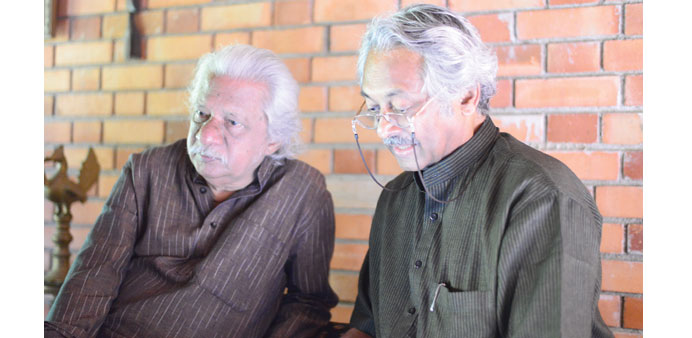
At the moment, these two greats of Indian cinema have begun a conversation, and the words will weave into celluloid. Kasaravalli is shooting a documentary on Adoor that has been sponsored by the Films Division in Mumbai.
Kasaravalli told me over the telephone from his Bangalore home that he would complete the documentary in three schedules, and hopefully before the year is out. Last month, when Girish and Adoor met, they visited places like Adikad (where Elippathayam was filmed), Adoor (where Kathapurushan was made) and Ambalapuzha (the scene of Naalu Pennungal). All these are in Kerala.
Elippathayam or The Rat-Trap is one of the finest works on Kerala’s dying feudalism and we see this in all its transparency through the lead character, Unni, with his debauch ways, cowardice and general disdain to the world around him. The movie was screened at Cannes in 1982. And Mrinal Sen who was on the main jury that year, said that had Elippathayam been in completion, he would have certainly voted for it.
Kathapurushan is the most autobiographical of all Adoor’s films. It was shot in Medayil, the house in Pallickal, Adoor district, where Gopalakrishnan was born and spent much of his childhood. It was a majestic two-storey structure which in the 1940s was such a rarity that passers-by would stop to stare. Kasaravalli and Gopalakrishnan had a long session there.
Kathapurushan and Elippathayam – as well Vidheyan – are all powerful documentation of the changing social order in Kerala that Gopalakrishnan himself witnessed. We see how Unni in Elippathayam degenerates because he refuses to move with time. We see how Veluchar, the man servant in Kathapurushan, disappears – taking along with him the last vestiges of feudalism. We also see how the rich, arrogant and cruel landlord in Vidheyan is eventually humiliated and destroyed. In the end, he has to eat and rub shoulders with the servant he had ill-treated.
Finally, Kasaravalli’s road trip with Gopalakrishnan took him to Ambalapuzha, where Naalu Pennungal was shot. Ambalapuzha is part of the Allepey district with its picturesque lakes and backwater, a great spot for houseboat tourism.
Kasaravalli says he is fascinated by Adoor’s Gandhian way of celebrating cinema, and his economy of words and sparseness of frames. The focus of the documentary will not be biographical, but rather on the thought process that went into the making of the movies, and the auteur’s quest for completeness.
A final word from Kasaravalli that I found so beautiful. He has no desire to be objective. He wants to be subjective – to look at Adoor the filmmaker as Girish perceives.
Ramanujan
The Indian Administrative Service officer-turned-filmmaker, Gnana Rajasekaran, began his love affair with cinema in 1994 with Mogamul, a mushy story about a young boy falling in love with an older woman. But Rajasekaran switched tracks and settled down to creating biopics like Bharathi and Periyar.
His latest, Ramanujan, on the Indian mathematical prodigy, traces his short life from 1887 to 1920 – a life of brilliance that would have gone unsung and wasted had it not been for an equally eminent British maths professor, G H Hardy, at Cambridge.
The man recognised Srinivas Ramanujan’s (played in the picture by Abhinav Vaddi, grandson of yesteryear stars, Gemini Ganesh and Savithri) genius in numbers and invited him to work at Cambridge. Which Ramanujan did, but the food that he found unpalatable there led to malnutrition and finally tuberculosis. He died young.
The movie is a poignant look at the way a prodigy struggled and suffered in a penurious family, a mastermind whose mathematical wizardry invited ridicule and revulsion in far lesser mortals. Rajasekaran, who also scripted the film, takes us a through linear narrative to tell us about the intelligence of boy Ramanujan as he completely foxes his school-master with a little insight into the importance of zero, and later about Srinivasa’s frustration as he hits wall after wall in his quest to sink into and shine with numbers.
Shot by Sunny Joseph – who captures the mood and ambience at Cambridge to contrast them with those in what was then Madras, where Ramanujan returns from Britain to be with his young wife, Janaki (Bhama) and mother, Komalatammal (Suhasini Maniratnam). Rajasekaran does give us a nuanced and balanced view of Ramanujan’s life with figures and, outside these, with especially his mother and wife. We see pride in the mother’s face when the son’s talent is honoured, and we also see her concern when he begins to grow close to his wife. There are a couple of outstanding scenes between Janaki and Ramanujan as there between the mother-in-law and daughter-in-law.
But in the end, what Rajasekaran stresses in his work — as he did tell me last October during an interview in Chennai – is the kind of punishment and humiliation a prodigy has to face in India. In a sea of mediocrity and in a country, which not only tolerates ordinariness, but celebrates it, men like Ramanujan could lead a doomed existence.
On the flip side, Ramanujan is far too long, and a good story-teller can deliver what he wants to in 90 minutes. Cinema is an arrestingly visual medium in which economy of words can work wonders. And make it far more effective and even riveting. While Suhasini is superb as the scheming mother-in-law out to separate Ramanujan from Janaki (we get to know the reason right in the end), Bhama excels as the young wife forced to spend nights alone and, later, years away from her husband when he is at Cambridge.
British actor McGowan is a brilliant Hardy, but Abhinay is stiff and wooden. When he is neither of these, he is shown as a weak and weepy guy – who bursts into tears at the slightest of misfortune. Some say that Ramanujan was never such a weakling. Whatever that be, the fact remains that Ramanujan loses out because its title character is not just right for the role.
* Gautaman Bhaskaran has been writing on Indian and world cinema for over three decades, and may be e-mailed at [email protected]