


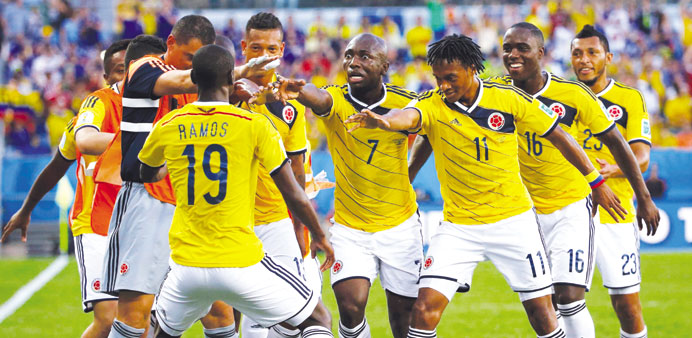
Colombia team celebrates their goal against Japan.
Following is a brief analysis of how each of the 32 finalists at the World Cup performed in Brazil:
Winners: Germany
Joachim Loew’s side thoroughly deserved their triumph and perhaps the abiding memory of their campaign was their stunning semi-final performance when they shocked the soccer world by thrashing Brazil 7-1.
Runners-up: Argentina
Messi, the four-times world player of the year, was unable to carry his nation to the title and turned in a subdued performance in the final against a well-organised German side.
Third: Netherlands
A relatively inexperienced team came mighty close to doing just that under canny coach Louis van Gaal, opening their campaign by thrashing holders Spain 5-1 before being edged out on penalties by Argentina in the last four and comfortably beating hosts Brazil 3-0 in the third-place playoff.
Fourth: Brazil
Anything less than victory on home soil was always going to be seen as a failure but nobody could have predicted Brazil would suffer a 7-1 humbling at the hands of Germany in the semi-finals.
Quarter-finals: Colombia
The flamboyant South Americans provided some of the standout moments of the tournament including the team’s catchy dance-routine goal celebration. Jose Pekerman’s side went far further than expected.
France
Another team who outperformed following low expectations, France went some way towards restoring their image after their debacle in South Africa when their campaign was wrecked by in-fighting and ill-discipline.
Costa Rica
The Ticos remained unbeaten in normal or extra time but for all their defensive prowess it was ultimately a lack of firepower that ended their hopes and they were knocked out on penalties by the Dutch.
Belgium
With a relatively youthful squad the Red Devils were outwitted by a tactically-superior Argentina in the last eight but showed they have the potential to develop into a force to be reckoned with.
Last 16
Chile
It was the fourth time the Brazilians had knocked Chile out of the World Cup but once the disappointment of defeat passed, Chileans were able to draw comfort from another admirable World Cup performance.
Uruguay
The second-round exit was in stark contrast to Uruguay’s march to the semi-finals in 2010 but without Suarez leading the line and apparently worn out by the controversy they slipped to a limp 2-0 defeat by Colombia.
Algeria
Under Bosnian coach Vahid Halilhodzic the North Africans were full of fight, disciplined and showed outstanding fitness in unexpectedly taking the Germans to extra time.
Nigeria
Their four matches, including the 2-0 defeat to France that knocked them out, served only to emphasise the extremes in their play, from the sublime in attack and sporadically brilliant goalkeeping to slapstick in defence.
Mexico
Two late goals, including a disputed penalty in stoppage time, consigned the Mexicans to a 2-1 defeat by the Netherlands and a sixth successive exit in the round of 16.
Greece
The southern Europeans had qualified twice before but managed just two goals in their previous six World Cup matches and were eliminated on penalties by surprise packages Costa Rica.
Switzerland
Ottmar Hitzfeld’s vibrant side epitomised by the cheeky skills of Xherdan Shaqiri, were a far cry from the teams which bored fans previously.
United States
Coach Juergen Klinsmann squeezed everything he could out of his squad of gritty and determined players but the team were ultimately hamstrung by a lack of creativity in midfield and a dearth of genuine goal scorers.
Group A
Croatia
A battling but unimaginative Croatia discovered that a wealth of experience can only get teams so far if it is coupled with a lack of youth.
Cameroon
For a second successive tournament the overriding image was one of ill-discipline, conflict and greed, with the players striking over bonus payments even before the tournament began.
Group B
Spain
Holders Spain never recovered from a 5-1 drubbing by the Netherlands and crashed out with the reputations of key figures like captain Iker Casillas and centre back Sergio Ramos in tatters.
Australia
Coach Ange Postecoglou was not alone in thinking that his young and inexperienced squad showed enough positives to provide considerable optimism for the future.
Group C
Ivory Coast
Ivory Coast lost to Greece via a controversial call stoppage-time penalty, confirming their reputation as “chokers” for failing within sight of victory.
Japan
The Asian champions slumped meekly out after a winless showing from a pool they had more than enough skill and talent to escape from.
Group D
Italy
The 1-0 defeat by Uruguay condemned the four-times champions to a second successive group stage elimination. Their tally of two goals was their lowest since 1966.
England
There was not enough quality or self-belief, or faith from coach Roy Hodgson in his youngsters when it was most needed, and the coach’s questionable tactics raised doubts about his future.
Group E
Ecuador
Ecuador’s 2-1 victory against Honduras was as good as it got for coach Reinaldo Rueda’s side.
Honduras
Carlo Costly’s strike against Ecuador broke the team’s 32-year World Cup goal drought but that was the only highlight for the team.
Group F
Bosnia
Coach Safet Susic came under fire for using a cagey 4-5-1 formation. They ended up finish third in the group.
Iran
Iran justifiably left Brazil with their heads held high but the departure of coach Carlos Queiroz after the team’s exit leaves the future uncertain.
Group G
Portugal
Captain Cristiano Ronaldo never lived up to his world player of the year status and the team didn’t help his cause either.
Ghana
Although they gave favourites Germany a scare in a 2-2 draw, the wheels came off as the players refused to train in a bid to try and force the payment of promised bonuses.
Group H
Russia
Their failure under experienced Italian coach Fabio Capello raised concerns about the side’s prospects in 2018 when Russia hosts the tournament
South Korea
After a creditable 1-1 draw with Russia, Korea’s defensive frailty was exposed by their 4-2 loss to Algeria and a 1-0 loss to 10-man Belgium confirmed their exit.