


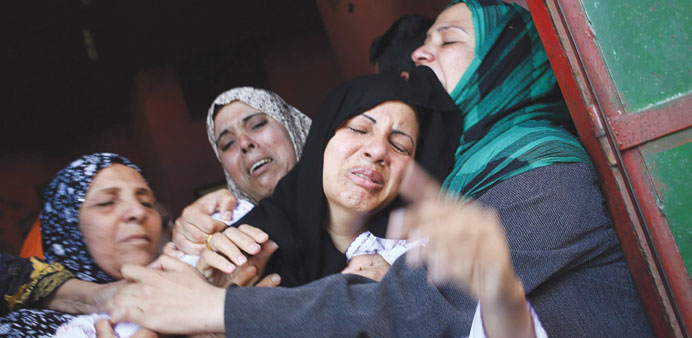
The mother of three-year-old Saher Abu Namous mourns during his funeral after he was killed in an explosion in the east of Jabaliya refugee camp in the northern Gaza strip yesterday.
DPA
Noor and Kenan Hammad, five-year-old cousins, lay in parallel beds at Shifa Hospital, the main medical centre in the Gaza Strip.
Kenan lost his father, mother and his sister, while Noor lost his father, brother and grandmother in an Israeli air strike which left many more injured, including the boys.
Since Israel launched its large-scale aerial assault on targets across the densely populated coastal enclave on Tuesday, medics say about 40% of the more than 100 Palestinians killed have been women and children.
Efforts to treat the more than 700 injured are hampered by lack of basic medical supplies and drugs, a doctor at Shifa Hospital said.
“We are working in a terrible situation. I did not have the necessary materials to stitch my trauma patients today and had to improvise,” said the doctor.
Noor and Kenan had gathered with family members to break the Ramadan fast and celebrate the recent return of Noor’s grandmother from Saudi Arabia, where she had gone on a pilgrimage.
“On Wednesday night, the whole family was sitting together in a small garden in their house. Suddenly a rocket struck the house and killed six people. Three men and three women,” said Kenan’s grandmother Amal Hammad.
“They did nothing. They were not throwing rockets on Israel,” she said.
The grandmother was among the dead.
In the hospital’s intensive care unit, Khaled, a seven-year-old boy, received urgent medical care. The prognosis remained unclear. His father, Majed Abu Maraheel was distraught.
“My son Khaled was playing outside our house in the Zeitoon neighbourhood in Gaza City on Thursday morning and suddenly we heard a huge explosion,” Majed said. An Israeli missile landed in an open area near their house, which was damaged.
“Khaled got a fragment of an Israeli missile in the head and as you see he is in very critical condition.”
Majed said he watches ambulances bring in the wounded for treatment, as he stands vigil over his son.
“I hope my son will overcome his injuries and come back to us, but what will happen to the others who lost their families, their children and their women?” he asked.
Mahmoud Daher, the head of the UN’s World Health Organisation in the Gaza Strip, said the medical system was in a dire state even before Israel began its latest offensive.
One man in need of a gall bladder operation has had his surgery put off repeatedly for the past 10 months.
“Patients like him are suffering on a daily basis, they are experiencing lots of pain,” Daher said.
“We are warning of a collapse of health services. With the current availability of medical supplies, if there is a further deterioration on the ground, such as a massive number of casualties, the system just cannot cope.”
Hospitals rely on generators - which consume vast quantities of expensive fuel - to deal with the regular power outages, sometimes lasting nearly half the day.
Ashraf al-Qedra, a spokesman for the health ministry in Gaza, has not left Shifa Hospital since the offensive began. He is unshaven and tired, like much of the medical staff.
“The emergency room and all the employees, including doctors, surgery staff nurses worked round the clock during the last four days despite the shortages of medicines, equipment and other supplies. They never sleep,” he said.
He wishes he was better able to care for the sick, the injured and the frail.
“I expect more people will die. People who are not killed by missiles may die due to lack of medicine and other medical services,” said al-Qedra.