


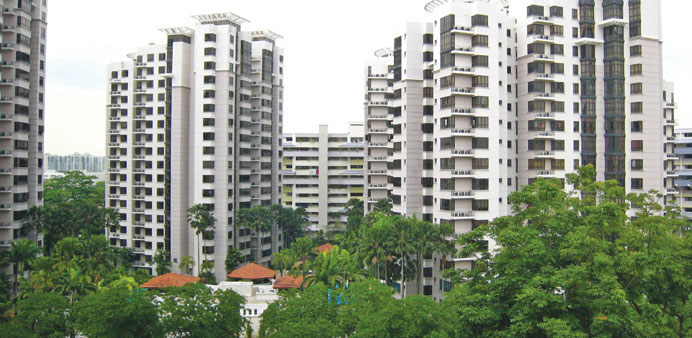
While in most of Singapore’s latest luxury developments the majority of units have been sold earlier, the rest of the stock faces headwind from the cooling measures that include tightened loan policies and additional stamp duties, for both of which regulations have been introduced last year.
By Arno Maierbrugger/Gulf Times Correspondent/Bangkok
Since the Singaporean government has introduced what it called “cooling measures” to prevent the market for residential property from overheating, prices for homes in the city state have seen a decline — not a rapid decline, but a steady decline to levels that are far from what the government feared the most before it launched the new regulations.
Singapore’s Finance Minister Tharman Shanmugaratnam on July 3 at a conference hosted by DBS Group in Singapore said he expects property prices to fall further, days after data showed home values in the city-state dropped for a third consecutive quarter. “I don’t think the cycle is over,” Shanmugaratnam said. “I think further correction would not be unexpected.”
This is bad news for speculators, but certainly good news for genuine buyers. Developers have started presenting discount offers to push new projects and clear old stock. Buyers are literally spoilt for choices.
In fact, the residential property market in Singapore has turned into a buyer’s market, and there is reason to believe that it is the rest of this year that people who are interested in buying a home in the city state will be able to make a great deal. This is particularly true for luxury projects in sought-after neighbourhoods designed and marketed to attract wealthy foreigners. Prices there have come down too in the wake of the governmentally initiated slowdown, and for sure there are some potential bargains on the menu.
According to local property agents, luxury developers are more than willing to negotiate price tags and offer packages such as reduced prices for early purchases and free furniture vouchers. While in most of the latest luxury developments the majority of units have been sold earlier, the rest of the stock faces headwind from the cooling measures that include tightened loan policies and additional stamp duties, for both of which regulations have been introduced last year. As a result, sales of luxury condos in Singapore fell more than 60% in the first quarter of 2014 compared to the first quarter of the previous year, a situation that forces developers to make “necessary adjustments”.
Foreigners are entitled to buy any apartment or condominium in Singapore — and most pay cash so that the mortgage regulation is not a problem for them. However, the higher stamp duties — which were introduced to curb flipping and other forms of speculation — still increases a purchasing price by 15% unless the buyer comes from one of a few duty-exempt countries (Norway, Switzerland, Iceland, Liechtenstein and the US). But developers are also mulling to introduce packages where they would absorb the stamp duty in an all-in price for a condo — this can certainly be a bargain especially for luxury property.
Basically, buyers of Singapore property don’t need to worry that there is a property price crash on the horizon, as some industry representatives feared. The city state’s finance minister has repeatedly ruled out such a scenario, arguing that a crash would rather have happened if the government would not have interfered and would have allowed the market to overheat.
While prices might come down slightly more for the rest of the year, the market is expected to stabilise in 2015 and gain traction from then on.