


By Adel al-Moslimani/Director of the Architectural Conservation Department, Qatar Museums
The Architectural Conservation Department within the Qatar Museums Authority is responsible for the preservation, conservation and restoration of tangible heritage in Qatar and, more precisely, of such historic buildings as mosques, houses, palaces, castles, forts and towers along with their decorative and artistic elements. In addition, the department is in charge of the rehabilitation of these buildings and their use for appropriate cultural and touristic events.
Owing to rapid urbanisation in Qatar, wells and springs have been neglected for a long time; located underground and often in uninhabited areas, they are no longer as indispensable as they once were. Most of them have dried up and deteriorated, while some have become receptacles for waste and other residue.
Wells and springs played and still play an important role as they are the main source of natural water since there are no perennial rivers in Qatar. They are useful in research as indicators for the location of past settlements that existed wherever there was a water source.
In 2004, a project was launched to document and preserve them as historic landmarks: wells and springs within Qatar were inventoried and recorded. Their exact locations, construction techniques (mostly built of gravel and clay), history, local names and traditions were acquired through interviews with locals and the collection of oral information. A total of 107 wells and springs have so far been documented. The Architectural Conservation Department constantly monitors their condition and when necessary takes action for their conservation.
Ain Hleetan
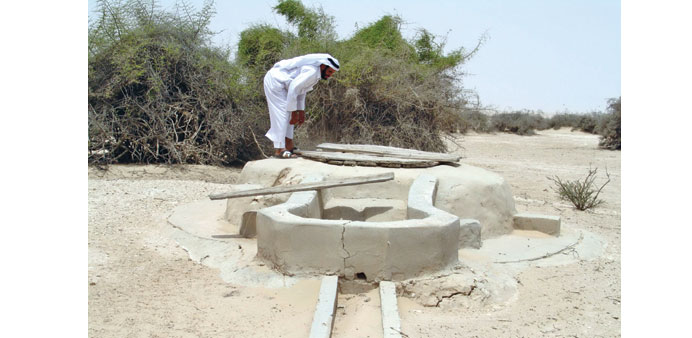
The well of Ain Hleetan located on the west coast of Al Khor is an example of restoration and preservation. The well, which has a cylindrical shape and is built of gravel, clay and plaster, is connected to an external water collection basin that served as reservoir for animal drinking water. It was the main reason for the settlement of the Al Mahanda tribe in the city of Al Khor.
According to a local tradition, around 150 years ago, a group of hunters found the water source accidentally thanks to a hare that they tried to catch; the source was then encircled with stones. In addition, some old oral sources describe the exceptionally salubrious features of the water from the well that reputedly cured many illnesses to the extent that local residents used to call it ‘the Doctor’. The people of Al Khor remember that the well used to be cleaned and maintained every six months, during which the well was closed to stop the water flow and, once the well was emptied, burlap was used to clean the inner walls of the well. Nowadays this water source is maintained and monitored by the Architectural Conservation Department.