


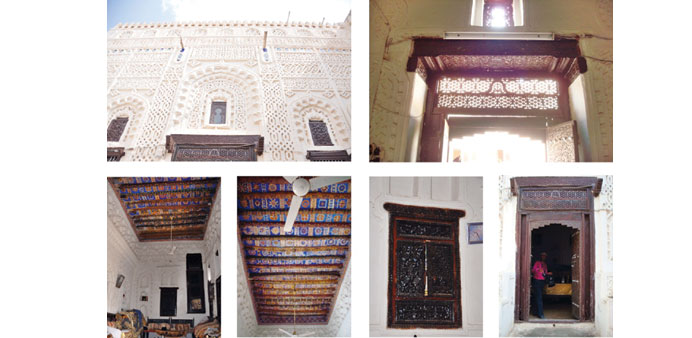
By Dr Kamal Bittar/Arab Regional Center for World Heritage, Bahrain
The golden age of Zabid is strongly connected with the spread of Islam during the Rasulid dynasty from the 13th to the 15th centuries. Being the capital of Yemen and a lighthouse for the dissemination of Islamic knowledge, Zabid played an important role in the Arab and Muslim world throughout that period.
The large number of remaining mosques and schools (madrasas), its defensive architecture, its characteristic example of Tihama costal plain courtyard houses, its central souq, as well as its unique Islamic urban structure in Yemen conferred Zabid its outstanding value that was translated in inscribing the city in 1993 on the list of World Heritage.
Shortly after, the glamour of Zadid started to shrivel. The traditional economic role of the ancient souq has vanished; most of its business activities have moved to the outskirt of the historic city leaving the shops vulnerable to rapid dilapidation. Moreover, in the absence of a leading conservation strategy, the ill application of building rules and regulations, and a wave of public neglect, Zabid has witnessed a significant lack of building maintenance and the replacement of a large percentage of its traditional houses by modern alien multistory concrete buildings.
As a result, the homogeneous urban fabric was seriously eroded and the visual and physical integrity of the city was about to be jeopardised. Therefore, the Yemeni government asked the World Heritage Committee in the year 2000 to inscribe Zabid on the List of World Heritage in Danger to facilitate its preservation, halt this decline and reverse the undesirable changes. Nonetheless, this action did not change the situation on the ground. Building encroachments have risen and a new trend represented by the invasion of open spaces by illegal provisional or permanent constructions has been revealed. Hence, in 2013 during the 37th session of the World Heritage Committee In Cambodia, the issue of possible withdrawing the Historic Town of Zabid from the Unesco World Heritage List was discussed as the Yemeni government was considered as not having taken concrete actions to improve its state of conservation.
In an attempt to keep Zabid inscribed on the Unesco World Heritage list, the minister of culture of the kingdom of Bahrain concluded an agreement with his Yemeni counterpart to support improvement of conservation of the Historic Town of Zabid. The agreement signed in the Kingdom of Bahrain on the 18th of August 2013 provided the framework for future support of the Arab Regional Center for World Heritage in Bahrain (ARCWH) to Zabid, which was crowned on September 29th, 2013 by sending an expert mission to Zabid.
The mission aimed at identifying a restoration and/or rehabilitation project in the historic town of Zabid to assist in preserving it on the Unesco World Heritage List. The selection of the project followed a list of preset social, economic and spatial criteria to ensure that the potential project would benefit a large segment of the population. In addition it was based on the outcome of a meeting with representatives of the local community and authority in Zabid during which the participants clarified their needs in terms of development.
Following the recent Conservation and Development Plan of Zabid, the mission succeeded in identifying three different projects. The selected project involves multiple interventions including the rehabilitation of one extensive public space into a playground for children and the rehabilitation of another interconnected smaller space into a green area with palm trees and parking (as reserved in the general plan of Zabid). As an integral part of this project the walls of the buildings surrounding the places as well as two outstanding dilapidated traditional houses will be restored. However, the whole process will be preceded by a social and economic survey in the defined area in order to inform the residents about the planned project and collect data related to their specific needs. The inhabitants will be also involved in the planning and implementation phases to ensure their ownership of the project.
Supported by the Gesellschaft für Internationale Zusammenarbeit (GIZ), the lab has employed and trained several women on wood restoration; unfortunately the lab was closed after the termination of GIZ activities in Zabid. As an integral part of the rehabilitation of the identified urban ensemble, the ARCWH will support the reopening of the wood restoration lab in Zabid. in addition, it will restore the largest brick oven (Mihraq) in the city to support the production and the fair distribution of traditional bricks to compete with the widely available cement blocks and promote the reuse of this basic building material.
By leading the administrative, technical and financial aspects of the project, the ARCWH will ensure that all works related to the documentation, urban design, preparation of technical studies and implementation plans, as well as the execution of the project are carried out according to international standards by Yemeni consultants, contractors and workers. At this stage, the ARCWH has received and analyzed the offers of two prominent and experienced consultant offices in Yemen for the preparation of the project’s study and documents. On the 6th of April 2014, a second mission of the ARCWH was sent to Yemen in order to visit both offices before taking a final decision on the best one. During this visit, as an added value to the planned project, the issue of training some employees of the General Organism for the Preservation of Historical Sites of Yemen (GOPHSY) on documentation techniques and the preparation of project’s documents was discussed with the potential consultant offices and agreed upon.
Yet, the successful implementation of the rehabilitation of urban ensemble in Zabid depends first on its ownership by the residents of the area and the citizens of Zabid. In addition, the central, regional and local government authorities have to assume their responsibilities by firmly applying the prevailing laws through their assigned officials to stop and remove building violations. This would constitute the first steps towards reversing the damage of the urban fabric and the historic building stock. Any unwillingness or hesitation of the local residents and the responsible official(s) in respecting and applying the rules at this stage would jeopardise the whole preservation efforts of Zabid, and would certainly extinguish the last flame of hope to safeguard the Historic Town of Zabid.