


Reuters/Dubai
Middle East funds have become more cautious about investing in equities after sharp pull-backs in some markets underlined how high valuations had left them vulnerable, a monthly Reuters survey showed.
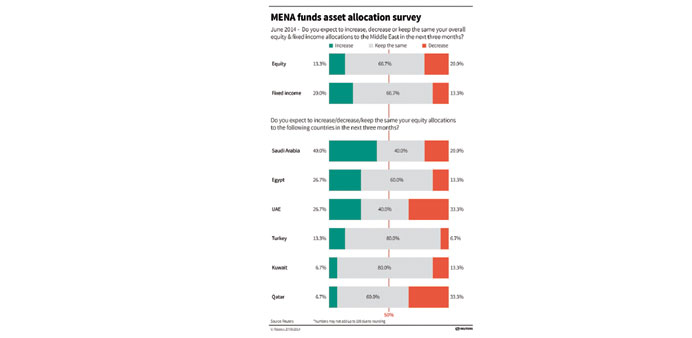
The latest survey of 15 leading investment managers, conducted over the past 10 days, showed only 13% expect to raise their equity allocations to the region over the next three months — the lowest ratio since the survey was launched in September last year.
Twenty per cent expect to decrease their regional equity allocations. The balance marked a significant shift from the last survey a month ago, when 33% intended to raise equity allocations and 20% to decrease them.
Heavy profit-taking pushed many Middle East stock markets down sharply in June. The Dubai market, for example, has plunged 19% since the end of May, partly because of a collapse of the shares of construction firm Arabtec after management turmoil at the company.
In some cases, the markets’ pull-backs have been the sharpest for over a year, suggesting an indiscriminate uptrend in the region — the result of its recovery from the global financial crisis and in Egypt, the easing of a political crisis — has ended.
“The forecast is for the market volatility to persist as broader market valuations remain rich,” said V Gowribalan, head of asset management at Ahli Bank Oman.
He said Ahli still saw value in Gulf Co-operation Council equities, particularly Saudi Arabia, Qatar and Oman, along with some areas of the United Arab Emirates.
But he added that the key driver of individual stocks would now be news headlines or rumours, not a broad uptrend.
“It is our view that the ‘reflation trade’ is done. Moving forward we expect stock picking to be the mantra.”
Middle East fixed income may benefit from the change. The latest survey showed 20% of funds expect to raise their fixed income allocations over the next three months, while 13% expect to reduce them.
It is the first time in the history of the survey that the number of managers intending to increase fixed income allocations exceeds the number intending to buy more equities.
The survey was conducted by Trading Middle East, a Reuters forum for market professionals. The pull-back in UAE and Qatar stocks has been partly due to profit-taking, after those markets soared in the run-up to their inclusion in MSCI’s emerging market index at the end of May. Many fund managers anticipated the post-MSCI drop and started reducing their positions a month or two previously, leaving local retail investors to bear the brunt of losses.
The latest Reuters survey shows some funds are now ready to consider going back into the UAE. Twenty-seven per cent expect to increase their equity allocations there, while 33% expect to reduce them; that compares with ratios of 20% and 40% a month ago. “UAE stocks started to be attractive again and a bottom will be formed near the current level,” said Hazem Kamel, managing director for asset management at Egypt’s Naeem Financial Investments.
However, sentiment has not improved towards Qatar. Only 7% of managers now expect to raise their Qatari equity allocations and a third foresee decreasing them, compared to 20% and 33% a month ago. Qatar has denied allegations over successful bid to host the 2022 soccer World Cup and fund managers do not expect it to lose hosting rights.
Kuwait remains near the bottom of fund managers’ preferences among major Middle East stock markets, with only 7% expecting to raise their allocations and 13% to decrease them.
This is partly because of political tensions in the country, which threaten to continue blocking economic development projects. Last week Kuwait’s ruler told his people not to threaten stability by playing “games” with politics; he urged Kuwaitis not to talk publicly about an investigation into reports of a recording of people discussing an alleged plot against the governing system.