


AFP
A powerful jihadist group known for its ruthless tactics and abuses in the Syrian and Iraqi conflicts announced yesterday the establishment of a “caliphate”, or Islamist state.
In an audio recording distributed online, the Islamic State of Iraq and the Levant (ISIL) declared its chief Abu Bakr al-Baghdadi “the caliph” and “leader for Muslims everywhere”.
The jihadists said they would impose their caliphate on areas they have conquered in Syria and Iraq.
“The Shura (council) of the Islamic State met and discussed this issue (of the caliphate)... The Islamic State decided to establish an Islamic caliphate and to designate a caliph for the state of the Muslims,” said ISIL spokesman Abu Mohamed al-Adnani.
“The jihadist cleric Baghdadi was designated the caliph of the Muslims,” said Adnani, adding that the caliphate will extend “from Aleppo (in northern Syria) to Diyala” in Iraq.
Baghdadi “has accepted this allegiance, and has thus become the leader for Muslims everywhere”.
“The words ‘Iraq’ and ‘the Levant’ have been removed from the name of the Islamic State in official papers and documents,” Adnani said, describing the caliphate as “the dream in all the Muslims’ hearts” and “the hope of all jihadists”.
Adnani demanded that “all Muslims all pledge allegiance to the caliph”.
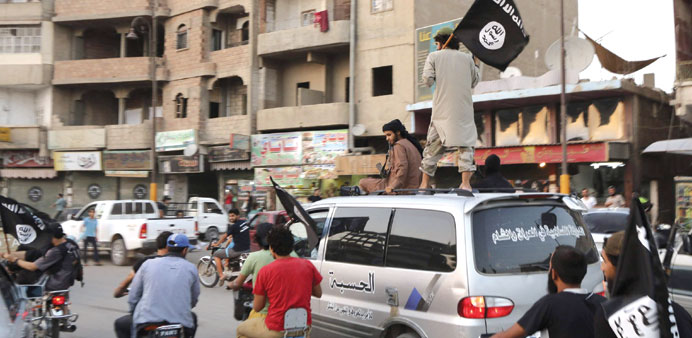
An activist in Raqa, the bastion of ISIL, told AFP via the Internet: “Large convoys of ISIL members arrived in the city just as the declaration was issued, to celebrate their caliphate.
“There was very intense gunfire. ISIL supporters were shooting in the air with joy,” Hadi Salameh said.
“I even saw seven ISIL members come into Raqa on horseback.”
Another activist, Abu Ibrahim, said via Facebook: “ISIL members in Al-Naim Square (in Raqa) are calling on all residents to pledge their loyalty.”
Opposed to ISIL, both Salameh and Abu Ibrahim said they feared the consequences of the declaration.
“More jihadists will be drawn to join ISIL, and they will become stronger. It’s crazy,” said Abu Ibrahim.
In Syria, ISIL’s fighters control large swathes of territory in Deir al-Zor near the Iraq border, Raqa in the north, as well as parts of neighbouring Aleppo province.
In Iraq, it has spearheaded a lightning offensive in recent weeks, capturing sizeable territories in the north and west of the conflict-torn country.
Once welcomed in Syria by rebels seeking President Bashar al-Assad’s ouster, ISIL quickly earned the wrath of the Syrian opposition because of its systematic abuses.
On a near-daily basis, reports have emerged of ISIL jihadists summarily executing political and military rivals, as well as average civilians.
It has kidnapped thousands of people, including many rebels seeking Assad’s overthrow.
The group has publicly executed and crucified eight rebels fighting both Assad’s regime and the jihadists, a monitor said yesterday.
“ISIL executed eight men in Deir Hafer in the east of Aleppo province” on Saturday because they belonged to rebel groups that had fought against the jihadists as well as Assad’s forces, the Syrian Observatory for Human Rights said.
ISIL then “crucified them in the main square of the village, where their bodies will remain for three days”, the Britain-based monitor said.
Also in Aleppo province, a ninth man was crucified for eight hours as a form of punishment in Al Bab town near the border with Turkey.
He survived the ordeal.
Activists say the group’s Iraq offensive and capture of heavy weapons—some of them US-made—appears to have boosted its confidence in Syria.
Until recently, the regime had rarely targeted ISIL bastions, but ever since the jihadists’ Iraq offensive, the air force has intensified its strikes against ISIL areas.
“On Sunday, there were intense air raids on Raqa and Buseira” in Deir al-Zor, Observatory director Rami Abdel Rahman said.
“It appears Assad’s regime wants to make the United States, which fears ISIL’s advances, see it as a partner in the war on terror,” he said.
Nonetheless, most of the victims in the air strikes in recent days, “some 80%”, have been civilians, Abdel Rahman added.