


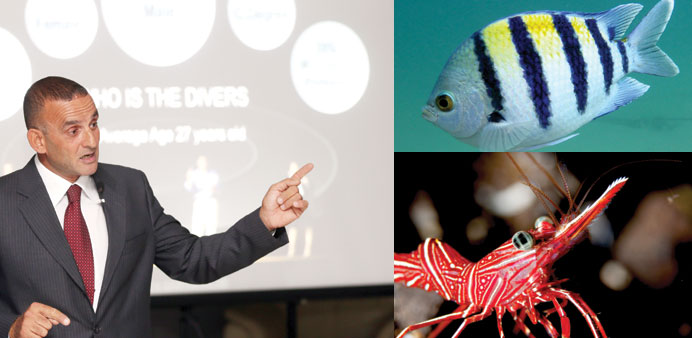
LISTEN! Khaled Zaki during the presentation. Inset: BEAUTY: Sergeant Major fish (top), and PAINTING THE SEA BED RED: A red shrimp that is as big as a fingernail.
By Anand Holla
For all our deep-seated fears about the myriad unknown creatures lurking underneath in the water world, Khaled Zaki keeps a calm, three-word-response handy — Water is safe. “Being in the water is much safer than being in the shower,” he says, dead serious.
With close to a quarter of a century of diving (scuba diving) experience behind him, Zaki’s assurance sounds credible. “It’s a wonderful, peaceful environment down there. You can feel the good vibrations,” he says, “Fishes never attack you. It’s only in the movies that you see sharks attacking people. In reality, no fish will harm you unless you do something silly. If you put your hand in a cave, of course, the fish will bite you.”
There sure must be reasons to worry about those scary sharks? “Absolutely not,” Zaki says, “They are there, but we are not on their menu. Of course, that is unless you do something unwise.”
The 40-something Egyptian settled in Qatar is a seasoned diving instructor with a fiery passion for filming an ecosystem we know little about. In fact, he has an incisive, even if humorous, piece of advice for smooth sailing: Take photos, leave bubbles.
Ever-ready to slip into his snorkel, goggles and flippers and take the plunge, Zaki’s love for diving led him to its natural progression — documenting what he saw in the waters.
Last week, Zaki, a Master Instructor with Professional Association of Diving Instructors (PADI), gave a well-attended presentation at the Qatar Photographic Society on what it takes to become an underwater photographer.
“You need to be comfortable, relaxed and smart. Good buoyancy control is crucial so that you don’t disturb the marine life which is rather shy,” he says.
Sea animals being shy or extremely wary is obviously not good news for an underwater photographer. “If a fish sees a big body leaving bubbles, it will instantly disappear, especially if it’s tiny. You need to be really quiet,” he says.
Sometime in 1988, Zaki had the good fortune to go to the Red Sea at Sharm el-Sheikh in Egypt, one of the world’s best diving destinations. “My friend and I had gone there for a two-week holiday. But I loved it so much that I couldn’t stop diving. I ended up staying three months. I then stayed there for 10 years, teaching diving and building diving centres and diving boards,” he recalls. In 2000, Zaki moved to Doha and has since been teaching diving across Qatar and the Middle East region, apart from filming underwater.
Back in 1994, when Zaki began underwater photography in the Red Sea by using his friend’s camera, things were different. “It was a tiny film camera with a 36-photo capacity. I loved the results even though they were terrible,” he says, and smiles, “The mere idea of holding in my hands, the photos I took under water, was amazing. Even if I had to travel 100 kms to develop four film rolls, I would ditch every work and rush if only to get five decent photos from that bunch.”
Though he does both, Zaki has focused mostly on videography ever since. In 2006, he won a competition held by Qatar’s Supreme Council of Environment for his video. Apart from having worked on documentaries and with news channels such as BBC News, BBC Arabic, Al Jazeera, Qatar TV, and, of late, Al Rayyan TV as well, Zaki has participated in a lot of environmental studies out of passion.
“When you build something like The Pearl Qatar or Lusail, you need to discover what’s at the bottom. In 2004, I filmed at those locations to take samples of almost every centimetre underneath,” he says, “Likewise, I have worked on projects at Messaied, Al-Wakra beach and Sealine Beach, apart from filming for pearl diving ventures and studies related to turtles.”
Without underwater photography and videography, we would be missing a lot on marine life and its vagaries, feels Zaki. “This is a super-micro shot I took. This dude is actually the size of a fingernail,” he says, pointing to a crystal-clear picture of a red shrimp. “In any case, 70 per cent of our world is water, and we discover only about 10-15 per cent of it. And we know almost nothing about the deep sea, which if one enters, is pitch dark.”
For his filming excursions, Zaki uses both the modest point-and-shoot variant and a fully-loaded Canon 5D Mark-III. Of course, he has a high-end Nauticam housing (outer shell that serves as waterproofing) to protect his DSLR. “It is incredible how safe and ergonomic the camera housing is. If there’s a pin-drop of leak, it sounds off an alarm. There’s also the pre-dive leakage check to ensure safety of my camera,” he says.
So Zaki’s one-man-cinematography-setup comprises his camera, its housing, a noiseless MKVI rebreather (a breathing apparatus that recycles expelled air) that doesn’t alarm the fishes, and two big bright lights that can turn a night dive into a day dive.
Usually, Zaki shoots under water for about two hours. “After that the camera’s battery runs out. It’s only that I can’t change it under water or that sometimes it gets too cold to stay there,” he says, “otherwise the rebreather is enough to keep me going for three hours.”
The more you dive with your camera, the more likely you are to get your special shots, believes Zaki. That’s because you never get the special shot when you go looking for it. “You won’t even find a turtle when you want to see one. But if you dive a lot, you will eventually find turtles, dolphins, marine birds, manta rays, you name it,” he says.
Zaki dives every day, and he has learnt what he calls a precious lesson on capturing the camera-shy underwater celebrities. “When you spot an interesting sea creature, the key is to not behave as if you are impressed,” he says, “Pretend like you didn’t see it. Ignore it, don’t move one bit but keep an eye on it. Allow it to develop the curiosity to come close to you. The beginners often get excited and in a flash, it vanishes.”
Even to position his camera on his latest muse, Zaki takes care to do so using slight movements. “I don’t use the zoom because the fish can feel the sound of the device’s internal motor. One audible breath or a bubble you exhale is enough to send the little fish scurrying away. What I do is I stay put until the fish goes into its cave, returns to check me out again, and then feels comfortable thinking I belong to another neighbourhood. Then I can film that dude,” he says and laughs, “They have to feel comfortable.”
Even Zaki feels comfortable when he is suspended in a vast expanse of blue. “It’s like yoga to me. Call it meditation or a zen-like feeling,” he says, fetching words to articulate the serenity, “You are on your own. You hear the sound of your lungs, the stretch of your breath, and the sense of a freedom of motion. What you can hear and see there is totally different. Things are slow. You are not walking. You are flying, you are floating. You are tripping out of life for a couple of hours.”
Peppered with such enticing descriptions of the diving experience, Zaki doesn’t have a hard time selling it to the fence-sitters. “Diving is as adventurous as it is educational. You are completely stress-free, you travel, you explore,” he says.
That said, filming itself can often lure you into its fantasyland. “When you shoot under water, you are moving so slowly that you may film only a few dozen cms in 20 minutes. You may get so involved in tracking the subject that you may forget about your diving buddy, your returning point, or even how much air you have left. It’s essential to train well so you always think about your and your group’s safety,” he says.
Though Zaki can go 120 metres below, Qatar’s waters are shallow; limiting his journey here to 50 or 60 metres below. “Qatar’s water is not too clear because of the suspended particles and higher water temperature. However, there’s great marine life here. Diving in North Qatar and the inland sea is amazing,” says the man who has shot at every diving hotspot in the region —Red Sea (Hurghada), Oman, UAE — and beyond. “Diving in Philippines is terrific, and it has such beautiful landscapes, too,” he says.
Those are too many names; let’s just know what the best place to dive is? “Honestly, if there’s a cup of water here now,” he says, looking at the table that his arms are rested on, “and if I have my diving equipment around, I am going in!”