


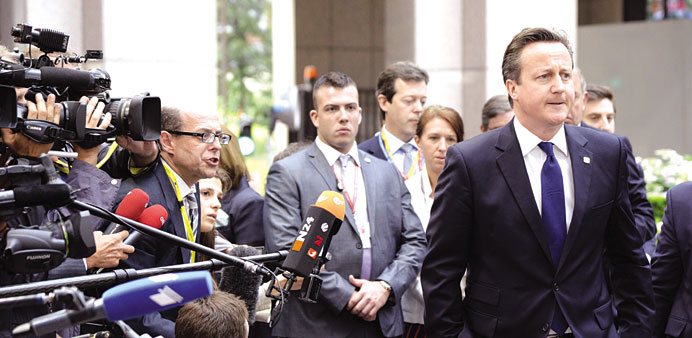
Cameron walks past journalists on the second day of the EU summit at the EU headquarters in Brussels. Cameron has insisted that Juncker was the ‘wrong person’ to head the European Commission.
AFP/Reuters /Brussels
Jean-Claude Juncker was named as the next president of the European Commission yesterday, dealing a bitter blow to Britain after David Cameron warned the EU could “live to regret” the move.
European leaders now face having to repair the relationship with Cameron after a very public row over one of the EU’s top jobs ahead of a slated referendum on whether Britain should leave the EU in 2017.
Cameron forced an unprecedented vote on the issue at a high-stakes Brussels summit despite having the support of only Hungary among the other 27 EU members.
Juncker’s nomination was confirmed on Twitter by Herman Van Rompuy, who heads the European Council of leaders.
“Decision made. The European Council proposes Jean-Claude Juncker as the next President of the European Commission,” he wrote.
The move has to be rubber-stamped in a European Parliament vote next month.
Downing Street confirmed the outcome but had no immediate reaction.
Cameron was defiant as he arrived for the summit, insisting Juncker was “the wrong person” for the role.
“I know the odds are stacked against me, but that doesn’t mean you change your mind – it means you stand up for what you believe and you vote accordingly,” he said.
The British leader later wrote on Twitter: “I’ve told EU leaders they could live to regret the new process for choosing the Commission President. I’ll always stand up for UK interests.”
Leaders are expected to try and appease Cameron, potentially by offering London a top job in Brussels, but the dispute threatens to fuel eurosceptic sentiment in Britain ahead of the referendum, to be held if Cameron’s Conservatives win next year’s general election.
Cameron could also “retaliate” against the nomination of Juncker – who he sees as too federalist and unable to deliver reform – by refusing to sign the conclusions.
The EU leaders offered political concessions to Britain: they added a paragraph to their final summit statement saying that Britain’s concerns about the future direction of the EU “will need to be addressed”, and that the concept of “ever closer union” in EU treaties allowed for different paths of integration for different countries.
They also said they would review the process for appointing the head of the EU executive once the new Commission was in place, a nod to Cameron’s objection that the European Parliament had effectively grabbed the nomination power from EU leaders.
A British official said that in a discussion after the vote on Juncker Cameron had argued: “It is important you recognise there are real debates here for Britain and British concerns.”
This had led to additions to the summit conclusions.
“It is a start,” the official said. “We have got that marker down now.”
The disagreement comes a month after anti-EU parties made sweeping gains in European elections, with outright victories for the UK Independence Party in Britain and the National Front in France.
German Chancellor Angela Merkel on Thursday urged EU colleagues to “compromise” with Britain.
“I think we can find compromises here and make a step towards Great Britain,” she said. “I repeatedly spoke of a European spirit which is needed and which will help us to find good solutions.”
She and Cameron met briefly for talks before the main discussions yesterday, officials said.
Other European leaders seemed to be heeding Merkel’s advice as they arrived for the summit yesterday.
“Europe needs Britain to be part of us,” Danish Prime Minister Helle-Thorning Schmidt told reporters. “I hope that after today that we can get back on track.”
European leaders enjoyed a lunch of fresh tomato gazpacho, turbot with chervil and baby vegetables and chocolate and apricot millefeuille before an afternoon of tough negotiations.
Facing rising euroscepticism at home, Cameron is demanding EU reforms including the repatriation of powers from Brussels ahead of the planned referendum.
A string of senior jobs in the EU are up for grabs this year which could be used in an overall package to sweeten the pill of Juncker’s nomination for Cameron.
Another summit is set to take place on July 16 to decide the positions, and analysts say a British politician could be offered a senior job.
Other compromises could include naming Thorning-Schmidt – who made headlines with a selfie with Cameron and US President Barack Obama at Nelson Mandela’s funeral last year – as Van Rompuy’s successor as European Council president.
Away from disagreements over top jobs, European leaders also signed landmark association and trade accords with Ukraine, Georgia and Moldova.
The accord, signed by Ukraine’s new President Petro Poroshenko, has been at the heart of a months-long crisis in Ukraine and is fiercely opposed by Russia.
Poroshenko described the move as “a historic day, the most important day since independence” from Moscow in 1991.
It was then Ukrainian president Viktor Yanukovych’s decision to put the agreements on ice in November, under pressure from Moscow, which led to protests in Kiev and his ouster, followed by Russia’s annexation of Crimea and subsequent unrest in east Ukraine.