


Reuters/Moscow
Russia’s economy may be set to perform better this year than officially forecast, but analysts say it may be too soon to celebrate as structural factors and the threat of inflation impede growth.
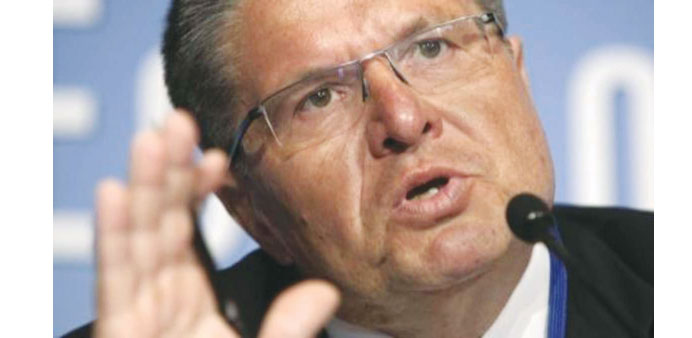
Economy Minister Alexei Ulyukayev told the Itar-Tass news agency yesterday that gross domestic product growth in 2014 could be around 1.1%, the same as in the first five months of the year - above an official economic growth forecast of 0.5% for 2014.
His upbeat prediction follows economic data that shows that in some ways Russia’s economy is weathering the storm caused by the Ukraine crisis better than many had feared.
Russia slashed its growth forecasts earlier this year after the escalation of the crisis around Ukraine, which fuelled large-scale capital flight, caused in particular by fears of harsher Western sanctions against Russia.
Lately, however, these concerns have been easing. The rouble and Russia’s stock market have recovered strongly after panicky sell-offs in March, as investors conclude that Russia is unlikely to send its army into Ukraine.
When it comes to macroeconomic statistics, there has also been some tentative evidence that the broader Russian economy may be doing better.
In particular, industrial output has been growing much more quickly than forecast. It rose by 2.8% year-on-year in May following 2.4% growth in April. Manufacturing has been doing particularly well, growing by around 4% in annual terms in May and April.
“For the moment we are still seeing surprisingly positive performance of economic activity,” said Natalia Orlova, chief economist at Alfa Bank. Analysts caution, however, that the pick-up in industry may be deceptive as other economic data paints a gloomier picture.
Even as the Economy Ministry signals upward revisions in its growth forecasts, the central bank has been doing the opposite. It this month revised down its growth forecast for the year to 0.4%, citing structural constraints on underlying growth potential that will not be easily fixed.
For example, the fact that Russia’s unemployment is surprisingly low, at 4.9% in May, indicates very little slack that would enable the economy to grow faster.
Alfa’s Orlova said the surprisingly strong industrial output growth appears to have been driven by rising government expenditure, which is rising twice as fast as projected. Spending on defence has risen in recent months, she noted, which may be linked to the Ukraine conflict.
The snag is that such measures will not raise the underlying potential growth rate, implying that they risk future inflation – already stubbornly high at 7.6% in May. “In the short run (government spending) can boost demand, but the key issue is that it will translate into inflation,” she said.
Higher government spending may help to explain why industrial output has risen despite weaker growth in household spending, which had been the major locomotive for the economy. Retail sales rose by a disappointing 2.1% in May.
Liza Ermolenko, emerging markets economist at Capital Economics in London, said that the industrial acceleration appeared to have driven by one-off factors, such as a single large order for railway equipment and a spike in petroleum product output possibly linked to refinery maintenance issues. “It’s unlikely to last,” she said.
Economists are sceptical about the argument that because the economy grew by 1.1% in the first five months of the year, the full-year figure will be something similar.
They note that output was subdued in the first half of last year but then accelerated in the second half, creating a statistical base effect that will weigh on the economic growth rate during the second half of this year.
When it comes to Russia’s longer-term economic growth potential, not much has changed that would justify more bullish expectations.
Capital investment, which fell last year, has also fallen every single month this year. The only silver lining is that the pace of the decline has been diminishing – from 7% in January to 2.6% in May.
For an economy which badly needs to boost such long-term investment, that is a slender thread on which to base hopes of strong economic growth in future.
“Things are not getting worse, but they are not getting better either,” said Ermolenko. “The bigger picture is that the economy is still very, very weak. It is too early to talk about any recovery.”
Central bank
completes forex
purchases for
Finance Ministry
Russia’s central bank has completed purchases of foreign currency used by the Finance Ministry to replenish the budget’s Reserve Fund, data published by the central bank showed yesterday.
Central bank purchases of roughly $100mn a day in recent weeks had weighed on the rouble although pressure has abated since the Finance Ministry revised the programme to link the volume and timing of purchases to market conditions.
The central bank, which publishes data on its market interventions with a two-day delay, said it had made no purchases of foreign currency on June 23.
Under a plan outlined in January, the central bank has sold 202bn roubles ($6bn) for foreign currency on behalf of the Finance Ministry, which is using the money to replenish its $87bn Reserve Fund, one of two sovereign wealth funds financed from oil taxes.
That has meant the central bank purchasing the equivalent of 3.5bn roubles ($104mn) on the open market each day.
The purchases were initiated in February but temporarily suspended in March as the Ukraine crisis raised market volatility, before being resumed in April under the revised conditions.
Analysts said that the end of the forex purchases on Monday was expected as it tallied with their calculations.
The central bank itself is not presently making daily forex purchases, as the rouble is trading in a range, near the centre of its floating corridor against a dollar-euro basket, where the bank makes no interventions.