


By Gautaman Bhaskaran
Tamil cinema has always dared to be different. Time was when some of the most socially relevant films were made by Madras-based production houses like Gemini, AVM and Vijaya among others. In fact, many Tamil movies were remade in Hindi with considerable box office success. Although the houses may not be as important today, given the cartelisation of the local cinema industry, the trend of remakes from Tamil to Hindi is re-emerging.
One important reason for this is the novelty of subject that Tamil films adopt, although I still feel that when it comes to production values, Bollywood scores. Of course, they have far bigger budgets than Tamil producers. Here are two recent Tamil movies I saw.
Incredible as this may sound, Ram Kumar’s, Mundasupatti tells the story of a village where people hide themselves the moment they see a camera. They believe that anybody being snapped will die soon. This illogical view or plain simple superstition emerges after some villagers whose pictures were clicked by an Englishman in 1947, die.
For all one knows, they may have succumbed to some of kind of virulent bug – with the camera being unjustly labelled the villain of the tragedy.
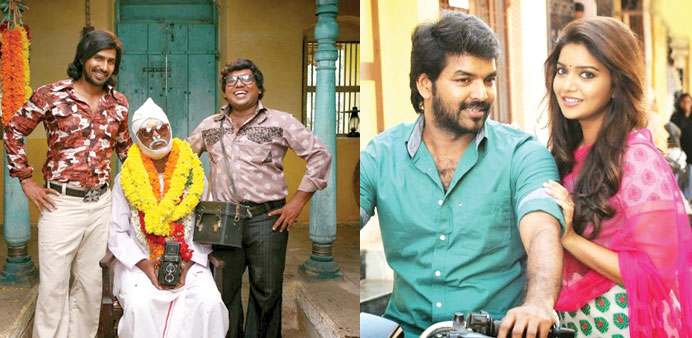
Thirty-five years later in 1982, Mundasupatti – that is the name of the village in the movie – had not shaken itself out of this fear. And when photographer Gopi (played by Vishnu) is asked to click shots of a respected elder as he lies dying, it cannot be done till the last signs of life ebb out. The sombreness of the situation is juxtaposed with hilarity: the mourners scoot at the sight of Gopi’s camera. They will not step anywhere near the dying/dead man lest they inadvertently slip into the frames.
Gopi and his assistant (Kaali Venkat) goof up their assignment, and find that they have not been able to get the dead man’s picture right. So they get hold of an aspiring actor who resembles the village elder, to pose as the dead man. But the trick fails, and Gopi and his assistant are told to dig a well in Mundasupatti as a punishment, and this is when the lensman meets the village beauty, Kalaivani (Nandita), and eventually falls in love with her.
Of course, it is early 1980s, a time when mobile telephones with cameras had not arrived in India, and the film’s storyline is believable all right. What is really commendable is the sheer novelty of Kumar’s theme. I do not remember a movie where a subject like camera phobia has been tackled, and the director takes us through a series of happenings – some humourously narrated – related to this blind belief. Kumar’s innovative climax is just brilliant.
Yes, unfortunately, as has often been the case with Tamil cinema, performances in Mundasupatti are disappointing – exaggerated and wanting in sophistry. And the first 30 minutes of the film can put one to sleep. But, well, if one were to brave this, Mundasupatti has some delightful moments of freshness to offer. If Mundasupatti focuses on camera phobia, Saravana Rajan’s Vadacurry talks about mobile mania, and how the little gadget is enslaving us. And not just this, but also look at the way mobile telephones are splitting Indian society into segments.
An iPhone, for instance, looks down upon an Android instrument, and Vadacurry’s Sathish (essayed by Jai) is harassed and humiliated by friends, colleagues, business associates and even casual acquaintances – because he has an inexpensive, no-frills device.
A fresh medical representative in a small firm, Satish has a hand-phone that may well belong to history, but I could not understand why it had such a loud ring tone and why it had its speaker permanently on.
If passers-by are startled every time the gadget shrieks, its speaker ensures that the poor guy has no privacy -- especially when his pal, Karikalan (R J Balaji), chooses to be abusive or just dirty. The conversations turn into public displays which tickle and nauseate those around Satish.
Till, in desperation he steals an iPhone – which ends up playing both Cupid and a criminal. If the gizmo impresses Naveena (Swati Reddy), it also gets Satish mixed up with a gang which passes off medicines past their expiry dates to unsuspecting patients. The bottles are relabelled.
Although, the mobile telephone had got one more screen hero into trouble in Pulivaal, it is still creditable that Tamil cinema is gutsy enough to deal with themes or plots which are unique. And in Vadacurry, Rajan also zeroes in on a terrible evil in society, that of spurious drugs, and here Satish comes across a notorious group which is pushed by profit to pass off old, ineffective (perhaps dangerous too) medicines meant for children and cardiac patients.
But, Rajan often injects into his narrative inane humour that takes away the sheen from the novelty of the subject -- and the nefariousness of an issue such as spurious drug loses its bite.
And, Jai sleepwalks through his role, delivering his dialogues in one of the most listless ways I have heard. Reddy as the girl Satish woos is more like a pretty vase on the mantelpiece, and Balaji impresses, though not quite when he is fooling around, but certainly in those sequences where he manages to soften his abductors – a la Stockholm Syndrome.
In the end, Vadacurry is stretchy and the story jumps lanes and badgers us with convolutedness. What could have been a stinging black comedy, a smarting satire on greed and profiteering sinks into a sink in the kitchen!
*Gautaman Bhaskaran has been watching Tamil cinema for well over three decades, tracing its highs and lows, and he may be e-mailed at [email protected]