


Reuters/Rustenburg, South Africa
South Africa’s AMCU union declared a five-month platinum strike “officially over” yesterday as thousands of miners roared their approval when leader Joseph Mathunjwa asked if they wanted to end the longest work stoppage in the country’s history.
“Yes! Yes!” the miners chorused as the union boss asked whether they wanted to accept the wage offers from producers.
“The strike is officially over,” Mathunjwa then shouted back, to unrestrained jubilation from the tens of thousands of workers packed into Rustenburg’s Royal Bafokeng Stadium, one of the venues for the 2010 soccer World Cup.
The spot price of platinum fell 1%, the rand firmed nearly 1% against the dollar to two-week highs and the London-listed shares of number three producer Lonmin rose as much as 7%.
The precious metal’s two biggest producers, Anglo American Platinum and Impala Platinum, are listed on the Johannesburg stock market. It had closed by the time Mathunjwa finished his two-hour-long speech, but their shares closed up 1.6% and 1.1% respectively.
Mathunjwa said wage deals would be signed today and workers would start reporting for duty the following day, ending industrial action that started on January 23 - five months ago to the day.
Industry sources said they could not confirm signings would take place today but expected workers to return this week.
“I’m very glad the strike is over, because we made a terrible wound in the South African economy and we are happy to heal that wound. Our children are suffering because they had no food,” said Lucas Makgwe, a miner at Amplats.
Mathunjwa, a Salvation Army lay preacher who casts himself as a class warrior doing battle for downtrodden black miners whose lives have changed little in the 20 years since apartheid ended, was exultant.
“Today we are creating a historic day in the mining sector,” Mathunjwa, clad in a trademark AMCU green shirt, told the crowd.
“The platinum sector will never be the same. What other unions have failed to do over many years, you have achieved in five months.”
Under the populist battle cry of a “living wage”, AMCU had initially demanded that basic wages be more than doubled immediately to 12,500 rand ($1,200) a month. In the end, its members settled for three-year deals that amount to monthly increases of around 20%, or 1,000 rand a month.
The mining companies, constrained by depressed prices and soaring costs, had said the massive hikes AMCU was initially seeking would sink the industry.
Marred at times by violence, the strike hit 40% of global production of platinum, which is used in jewellery and for emissions-capping catalytic converters in automobiles.
The stoppage dragged Africa’s most advanced economy into contraction in the first quarter and cost the companies almost 24bn rand ($2.25bn) in lost revenue, according to an online tally run by the three firms. (http://www.platinumwagenegotiations.Coza/)
Companies will lose revenue for several more weeks as the mines slowly grind back into life and production is restarted.
The resolution, while welcome, does not spell an end to the most turbulent bout of labour unrest since the end of white-minority rule, with the NUMSA metal workers’ union threatening a strike in the auto industry from next month.
The platinum sector also faces a painful restructuring, with job cuts almost inevitable - in part because of the losses incurred during the AMCU strike. That could trigger a further wave of walkouts or violence.
Eight suspected illegal gold miners were found shot dead at a disused mine near Johannesburg at the weekend, police said yesterday.
“There are eight bodies which were shot execution style,” Paul Ramaloko of an elite police unit told AFP.
The bodies were discovered by mine security between Saturday and Sunday.
Two of them were found underground and six on the surface at an abandoned gold mine in Benoni, east of Johannesburg.
Police spokesman Lungelo Dlamini said the eight had wounds on their upper bodies. They are yet to be identified.
“We don’t know the motive behind the killings,” said Dlamini.
Local media is speculating that they could have been killed by a rival illegal mining gang.
Fighting between competing gangs is commonplace among the illegal miners at South Africa’s abandoned gold mines, where unemployed and impoverished people extract any remaining gold with makeshift tools.
Much of the area around Johannesburg is pockmarked with old shafts, a testament to the city’s century-old history of gold mining.
While many are no longer commercially viable, they still contain enough deposits to attract scores of the city’s unemployed, and those from much farther afield.
The owners of the mine could not be immediately verified.
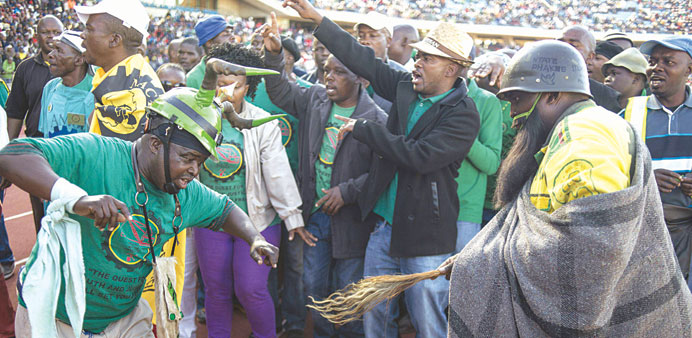
South African platinum miners dance at the Royal Bafokeng stadium near the northwestern town of Rustenburg yesterday.