


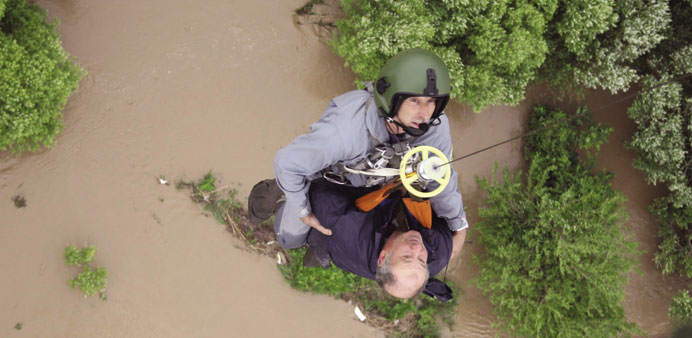
A man is pictured as he is being rescued by a military helicopter after heavy flooding near the Black Sea resort of Albena, northeastern Bulgaria, in this handout image released by the Bulgarian defence ministry yesterday.
AFP/Varna, Bulgaria
Flash floods in Bulgaria have killed at least 12 people, including two children, with others missing after torrential rains lashed the east of the country, authorities said yesterday.
The worst hit was the Asparuhovo neighbourhood of the Black Sea port city of Varna, where at least 10 people including the two children perished, Interior Minister Tsvetlin Yovchev said.
Two more victims were found in the nearby northeastern town of Dobrich, where 150 people were evacuated.
Dozens of smashed and upturned cars and uprooted trees littered the narrow mud-splattered streets of Asparuhovo yesterday morning, making the area almost impassable as authorities feared more bodies might be found by rescuers, an AFP photographer said.
The normally picturesque hillside area was submerged after torrential rain pounded the region on Thursday evening, clogging garbage-filled drainage canals and turning the steep streets into raging torrents.
“Thank God I managed to run away, otherwise I would have drowned,” said a resident Branimir. “Everyone panicked and started to run.”
The 38-year-old said his next-door neighbours were still missing after their house was swept away by the flood. “Neither I nor my grandfather have seen anything like this before. Everyone is shaking for fear that a new shock wave might come.”
Several rickety houses were totally destroyed by the water and authorities were unable to say whether their owners had survived.
Electricity in the area was cut off on Thursday and the authorities said it would not be restored for the time being due to safety concerns. Also, bad tap water quality made it unsafe for drinking.
Navy divers continued to search a canal linking Lake Varna to the Black Sea, where all the floodwater drained away, dragging with it cars, furniture, garbage and uprooted trees.
The body of the latest victim, a man, was recovered from a submerged car.
Soldiers and prisoners have joined in efforts to help evacuate people, clean up piles of garbage from the streets and drain the flooded buildings, including Varna military medical hospital.
Strong winds meanwhile prompted authorities to shut the port of Varna, Bulgaria’s largest.
Shocked Asparuhovo residents, home to some 25,000 people, likened the disaster to the set of a horror movie.
“I have never seen anything like this before, nor heard about a disaster like that from my father,” an elderly man told AFP, shaking his white-haired head in disbelief.
“We had to climb on the garage roof to save ourselves,” a woman in her 50s said.
“My house is beyond repair, buried under half a metre of mud,” Stefan Hristov, 25, told AFP.
The man, his small child and pregnant wife managed to save themselves by escaping through the roof.
There was no immediate information on the estimated cost of the damage.
The government is considering financial aid for the worst-hit families and volunteers organised a campaign to collect donations of bottled water, foodstuffs and clothes.
Almost 100,000 euros were also collected within just hours in a special donors message service campaign.
Bulgaria’s European Emergency Response Commissioner Kristalina Georgieva was expected to visit the area today.
Rescue efforts have been hindered as heavy rains were forecast across Bulgaria throughout the day. More floods, even if not as bad, were reported in eastern and central Bulgaria.