


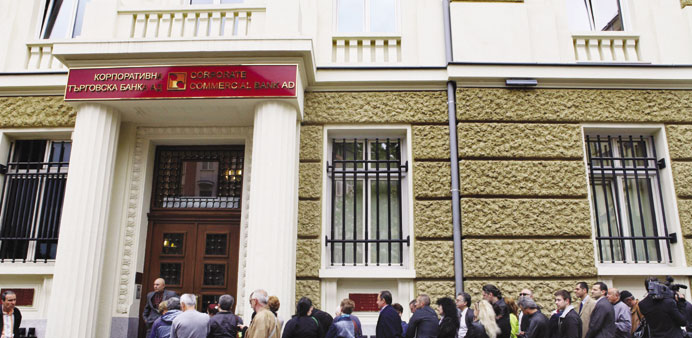
People wait in queue in front of the headquarters of the Corporate Commercial Bank (CCB) in central Sofia. The bank was put under special supervision by the country’s central bank, upon the CCB’s request.
Bulgaria’s central bank placed Corporate Commercial Bank, the country’s fourth-largest lender by assets, under special supervision and plans to start talks over its sale.
The Sofia-based Corporate Commercial Bank informed the central bank that it has run out of liquidity and stopped all banking operations, including payments, central bank Governor Ivan Iskrov said at a news conference in Sofia yesterday. The regulator has appointed two central bank administrators for three months, suspended the bank’s management and revoked the voting rights of the shareholders holding more than 10%, he said. The Bulgarian Stock Exchange said it suspended the bank’s shares from trading.
“The bank is not bankrupt, the central bank acted promptly and decisively to avoid bankruptcy,” Iskrov said. “It’s closed. Our idea is to clean up the bank, if needed, to reduce its capital and to negotiate with potential buyers.”
VTB Group, Russia’s second-biggest lender, holds 9.9% of Corporate Bank and “has expressed interest in discussing support” for the bank, Iskrov said. The bank’s majority shareholder is Sofia-based Bromak, with 50.66% stake. Luxembourg-registered Bulgarian Acquisition Co, controlled by the State General Reserve Fund of Oman, has 30.35%, according to Iskrov.
“The Bulgarian government will support the Bulgarian National Bank’s efforts with all necessary actions and resources,” the government said in an e-mailed statement today, adding it supports the regulator’s actions in stabilising Corporate Bank.
The bank participated jointly with VTB in the acquisition of Bulgartabak, the country’s dominant tobacco maker, and Viva Telecom, known as the Bulgarian Telecommunications Co. Corporate Bank also bought the Bulgarian unit of Credit Agricole on June 12 for an undisclosed price. In the past decade, Corporate Bank handled the accounts of most ministries and state companies, including the Bulgarian Energy Holding.
“The bank, which was one of the most liquid lenders in the country, came under serious attack in the past week, which led to an enormous run on funds,” Iskrov said. “It is a big bank and it’s important to restore its operation back to normal.”
Corporate Bank’s first-quarter net income rose 19% from a year earlier to 13mn lev ($9mn) and its capital rose 8.3% from the same period a year ago to 7.3bn lev, which accounted for 8.4% of the country’s banking system capital, the lender said in a regulatory filing on May 27.
A rift between businessman Delyan Peevski and Corporate Bank’s majority shareholder, Tsvetan Vassilev, who owns Bromak, prompted Peevski to pull out of Corporate Bank the accounts of his companies, including Bulgartabak, which he gained control from Vassilev, Capital newspaper reported on June 18, citing unidentified people.
Corporate Bank granted loans worth 1bn lev to companies linked to Vassilev, Monitor newspaper reported on June 17, citing unidentified people. Vassilev denied the allegations.
Bulgarian Chief Prosecutor Sotir Tsatsarov said on June 18 he had opened a pre-trial investigation against Tsvetan Gounev, the deputy governor in charge of bank supervision at the central bank, on suspicion of abuse of office by allowing the granting of 19 bad loans to 19 companies through slack supervision.
Tsatsarov did not name the bank or the companies. Gounev has taken leave of absence until proceedings are completed, the central bank said then. Iskrov declined to comment yesterday on Gounev’s investigation.
“We are witnesses of an unprecedented campaign against the bank, which had drawn in the judiciary,” Corporate Bank said on its website yesterday. “To protect the interests of its depositors and clients, CCB decided to seek the institutional support of the Bulgarian National Bank.”
The bank’s closing coincides with a June 17 announcement by Bulgarian President Rossen Plevneliev that leaders of ruling parties agreed to hold early elections some time from September 28 to October 12.
A poor showing of the ruling Socialists in the European Parliament elections on May 25 caused a rift between the Socialists and their junior coalition partner, the Movement for Rights and Freedoms. Senior politicians from the Movement had business links with Corporate Bank, according to Capital.
“There seems to be a lot of politics behind the issue and we don’t see the country’s currency-board setup being directly hit in a sustainable manner,” Simon Quijano-Evans, the head of emerging markets research at Commerzbank in London, said in an e-mailed note. “The whole issue does beg the question of why this is allowed to escalate to the degree of affecting a systemically important bank — a clear risk in our view.”