


By Clare Byrne/DPA/Paris
A nine-day strike by French railworkers looked poised yesterday to go out with a whimper rather than the wallop that trade unions had aimed to land on Francois Hollande’s Socialist government.
As stony-faced commuters in Paris again jostled for seats on the rare rush-hour trains bearing passengers from the suburbs to work in the city, some union bosses were beginning to urge a retreat in the face of what looked like certain defeat.
“We are no doubt reaching a turning point in the way that rail workers express themselves,” Thierry Lepaon, secretary-general of the General Confederation of Labour (CGT), told RTL radio.
The strike was “starting to pay,” Lepaon said, pointing to several amendments made to a rail reform bill in suggesting the time had come for the militant rail wing of the CGT to lift its protest.
For days the CGT has been trying to find a dignified exit to a protest, which has alienated the public by its intransigence.
The strike was called over a bill that merges the SNCF and railway infrastructure manager RFF into one public company and gears France up to compete in a liberalized European rail market by 2019.
The legislation was widely praised as long overdue, including by France’s biggest union in membership terms, the CFDT.
But the radical CGT-Cheminots and Sud Rail unions opposed it, saying it did not provide sufficient guarantees on the privileges enjoyed by railworkers, such as the right to retire at 57.
Each day of disruptions, which affected two out of three high-speed TGV trains at its peak and caused disruptions to the ‘baccalaureat’ end-of-school exams, widened the wedge between the unions and the public.
Gone are the days when stranded French passengers saluted railworkers for defending social gains.
An opinion poll by Harris Interactive published during the week showed three out of four people opposing the protest.
“It’s a disgrace,” said Juliette, a 75-year-old grandmother who stood bone-weary on a platform in Paris on Tuesday after spending two-and-a-half hours sitting in the luggage rack of an overcrowded train from the southern town of Valence.
“One day, two days, three days, ok. Then it’s time to stop. Those people, they’re never happy!”
Her husband Jean, 77, contrasted the strike with the general strike of November-December 1995.
Like many people in France he had fond memories of the three-week metro and rail strike, which paralysed the country but united the people against the government, forcing it to ditch public sector pension reforms.
“In ’95 I cycled to work, 20km there and back,” the dapper pensioner said with pride. “But the context has changed. Back then we didn’t have an unemployment crisis.”
The crisis is something Jean and Juliette have experienced up close.
Both their son and son-in-law have joined the ranks of France’s record 3.3mn jobless in the past few years - a prospect, which, as they point out, employees of state rail operator SNCF, will likely never face.
“It’s time to get back to work,” SNCF CEO Guillaume Pepy urged, estimating at 153mn euros the cost of the strike so far in terms of unsold tickets and reimbursements.
By Thursday, many train drivers had already quietly slipped back behind the wheel. Seven out of 10 TGV trains were operating as normal, even as the leaders of CGT-Cheminots and Sud-Rail vowed to fight on.
The strike, which comes as casual workers in the arts sector threaten to pull the plug on summer festivals over changes to their unemployment insurance programme, has tested the mettle of the government.
“You have to know when to stop a movement and be aware of the public interest,” an unusually resolute Hollande told reporters last week.
For Dominique Simonpoli, a former union official who now heads Dialogues, an association for dialogue between bosses and workers, this is one battle the Socialists can win.
French union membership has plummeted to just 7 to 8% of all workers, who are divided into a pragmatic camp led by the CFDT and a more militant camp led by the CGT.
Speaking to Liberation newspaper Simonpoli predicted that the pragmatic camp, which is generally supportive of reforms that aim to protect jobs by making France more competitive, is in the ascendant.
“The importance of social dialogue has generally risen these past years in France,” he noted, pointing to a number of accords struck by employers and workers that aim to cut costs in return for job security. “I’m not saying there won’t be difficult social conflicts with prolonged strikes but they no occupy the space they once did.
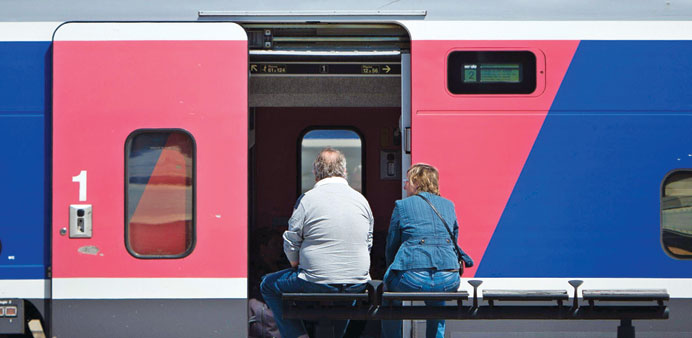
Travellers wait on a platform at the Saint-Charles railway station yesterday in Marseille, southern France, during a national strike by French SNCF ra