


By Anand Holla
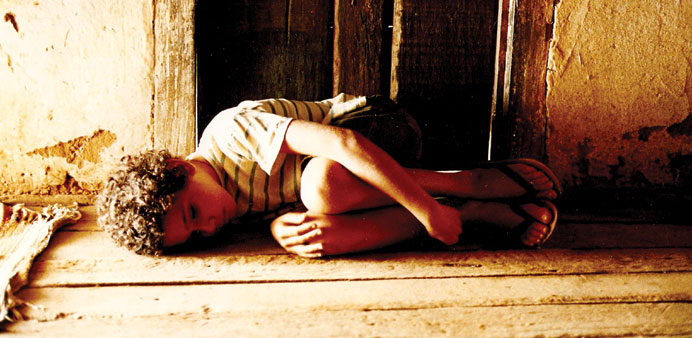
Of the many highlights of the immensely likeable Brazilian slice-of-life, coming-of-age film Mutum, the foremost is its ability to convert the adult viewer’s point of view into the child’s, for its entire runtime of 86 minutes. The film compels you to not merely empathise with a kid’s perspective, but adopt it.
After screening Brazilian films like Elite Squad and Bus 174, which delved into urban crime, violence, and poverty, the Doha Film Institute (DFI) has picked a gem that familiarises us with an unseen part of Brazil and an unexplored facet of Brazilian culture.
As part of DFI’s Qatar Brazil 2014 Cinema Showcase in partnership with Qatar Museums that will continue throughout the year on the last weekend of each month, Mutum will be screened next week.
Director Sandra Kogut’s multiple award-winning debut feature of 2007 is an adaptation of Campo Geral, a short story by J Guimarães Rosa. Thiago is an imaginative, sensitive young boy who lives on a small farm in a remote region of the Brazilian mountains. The shadow of his parents’ dysfunctional marriage and his father’s abusive behaviour looms large over his daily innocent pleasures of life, like bathing his dog. Even his father’s entry into the film comes about with this remark: “Ungrateful child. He goes away for days, comes back and hardly says hello. That kid doesn’t love me.”
The eldest of five children, Thiago’s only friend is his brother Felipe since his loving uncle too is sent away from the farm. The vulnerability with which he allows himself to become a silent spectator to the emotionally chaotic world of adults isn’t good for his future. Perhaps, his simmering maturity has made him aware of that as well. One fine day, a chance encounter and an unexpected gift change his life. To reveal anything more about the plot would be unfair.
Mutum is not only the name of the small town in the Brazilian state of Minas Gerais where the film is set, but it also means mute and a black bird that sings at night. Shot with the sensitivity that one would accord to a documentary on the daily lives of a rural family, the tender treatment goes a long way in making us not only feel for Thiago, but also feel as him. The simplicity of the countryside too is nicely weaved into the narrative. The lack of background music heightens the realism, allowing the ambient sounds of the crickets, birds, or the wind and the rain to take charge. The result is a moving film that reminds us to value a child’s precious perspective.
What may amaze you is that except Thiago’s father, all the actors were non-professionals, chosen from the people Kogut met during her research. In fact, the child actors had never seen a movie or even knew what movies were. Just to get to know the people, their lifestyle and the locations, Kogut spent more than a year in the region, and held workshops so that the kids could work with actors. The filming location was an actual working farm, with shooting scheduled around daily meals, tending the cattle, etc.
Born in Rio de Janeiro in 1965, Kogut began her career creating performance pieces and installations in Brazil, France and the United States. Her short films have won several awards at festivals across the world and her work has been featured in many prestigious venues, including the Museum of Modern Art, the Guggenheim Museum, the Harvard Film Archive and the Forum des Images.
Catch Mutum at the Museum of Islamic Art auditorium on June 26 and June 27, at 7pm on both days.