


 By Updesh Kapur/Doha
|
They’re getting bigger, slicker, plusher, swankier and glitzier. The adjectives just roll on. Cruise ships of today are a far cry from the old days going back more than 100 years. Mention the word cruising, the ill-fated Titanic springs to mind. |
The ship, the biggest of its era, tragically sank after hitting an iceberg during its maiden sailing from Southampton to New York in 2012 resulting in the deaths of over 1,500 passengers and crew.
With a capacity of 2,435 passengers, almost 1,000 crew members and a length of 270m, the Titanic was arguably the queen of the seas.
But that, as they say is history. Much has changed in the cruise industry since the Titanic found its resting place in the North Atlantic.
Cruising today is big business and has successfully overcome many hurdles over the years.
For non-cruisers, common remarks have been ships are too crowded, they’re full of obese people, are for old age pensioners, are floating cesspools, and have an insatiable appetite to waste food with some of the largest buffets in the world.
Despite this, cruising is one of the fastest growing sectors in the travel industry. The sector today has a global fleet of 410 ships of different length and capacity accommodating 470,000 beds.
Almost 22mn people are expected to take a cruise this year, up 400,000 from 2013. North Americans make up 55% of the global total, hence the world’s largest concentration of ships is in the US, namely the hotspot of Florida which is gateway to the cruise capital of the Caribbean.
Around 37% of the market is cruising around the Caribbean, while the Mediterranean captures 19%, the rest of Europe 11% and the remainder split in other regions of the world, including a lowly 4.5% in Asia.
According to figures released by industry trade body Cruise Lines International Association (CLIA), the UK and Ireland is the second largest cruise market with an 8% global share of around 1.7mn and 27% of the European total. The Middle East ranks very lowly, but is being eyed for future growth.
Over the next four years, 36 ships will be inducted around the world with passenger capacity ranging from 126 for the smallest to 5,400 for the largest – the latter from industry giant Royal Caribbean Cruise Lines (RCCL).
And it is RCCL that is literally raising the bar helping develop the public’s appetite for a growing love affair with cruising.
RCCL owns and operates the world’s biggest cruise ship, Allure of the Seas, which took to the seas in 2009 with its maiden sailing.
Compared with the Titanic, the figures are staggering.
At 360m, it is 90m longer than the Titanic. Putting the size into perspective, the ship is the length of 32 London buses, 3½ football pitches, or five of the world’s largest passenger aircraft, the Airbus A380.
Capacity is 6,296 passengers – two-and-a-half-times more than the industry pacesetter of over 100 years ago. And there are 16 passenger decks compared with nine on the Titanic.
Crew numbers total a massive 2,165 as opposed to 885 for the ill-fated ship.
The Allure’s weight is 225,282 tonnes, a sharp increase on Titanic’s mass of 46,328 tonnes.
Twenty one pools and jacuzzis compared with Titanic’s one where first class passengers had to pay a dollar for the privilege of using the first heated pool at sea.
More than 20 dining options covering global cuisine and fast food as opposed to only four sit down restaurants onboard the Titanic.
And a true comparison is the level of onboard facilities that we see today, significantly different from yesteryear.
Ships are not just floating vessels. They have developed into theme parks, entertainment centres shopping arenas and floating diners to suit individual tastes and different age groups.
We’re just weeks away from the summer holidays and for many, it can be torturous planning a long-deserved break. Where to go and how much to spend? For those with children, it is planning how to keep the youngsters entertained and ‘fed’ that always concern parents.
Cruising is a one-stop shop for everything from food, accommodation and entertainment all rolled into a single upfront price.
Broadway shows, aqua parts, spas featuring over 100 treatments, well-equipped fitness centres, 3-D movie theatres, surfing simulators, casinos, 45ft rock-climbing walls, and basketball and squash courts are just some of the onboard options.
There are also more refined activities for culture vultures such as guest speakers talking on a variety of topics from history and art to the life of a sea mammal, wines of the world and even celebrities hosting drama workshops.
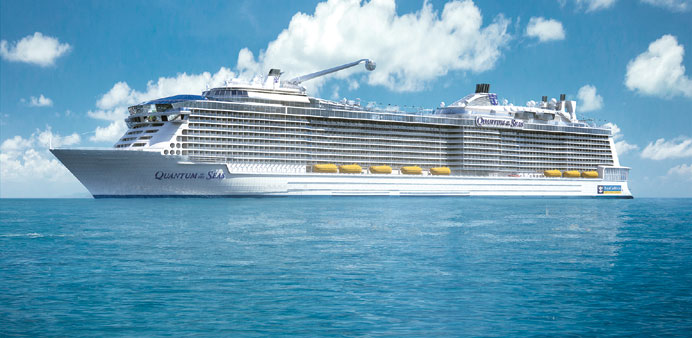
What caught my eye this week was RCCL’s next venture – two ships that are set to be introduced to the cruise market over the next 10 months and set to take the industry to new levels.
RCCL is pulling out all the stops to gain market advantage for its innovative Quantum Class of ships, promoted as the most technologically advanced cruise vessels with a game-changing experience for life-long cruisers and first timers.
Bumper cars, roller skating, circus schools, skydiving simulators and glass passenger capsules that extend over the side of the ship on a mechanical arm giving 360 degree views to those inside, the ships also boast the largest indoor sports and entertainment complex at sea that includes a 1,300 seat theatre.
Some of the interior bedrooms which have no sea view will feature virtual balconies to offer ocean views and make the rooms look bigger.
Two sister ships to be launched within six months of one another, they will offer the same features, each catering for over 4,100 passengers across 2,108 cabins spanning 16 decks.
Quantum of the Seas is scheduled to debut in autumn 2014 with sailings out of New York for North American itineraries. Set for an April 2015 launch, Anthem of the Seas will set berth in the British port of Southampton for a season of Mediterranean sailings before repositioning to Florida for the winter months.
Cruises are not just an onboard experience. The diverse ports of calls, often in different countries during a week-long itinerary, are adventurous and educational. Cruise companies have gone all out to make itineraries more varied and exciting, whether it’s in Alaska, South America, Far East or Europe.
According to Cruise Lines International Association, more and more cruise firms are looking for that extra special something beyond onboard products, hence ships are heading for destinations that would never have been considered five or 10 years ago.
From Natal in Brazil to Nosy Be in Madagascar; Angola in Southern Africa to Myanmar; or Montenegro in southern Europe to Afghanistan, cruise ships are entering new ports of call.
The Middle East is a market not yet fully tapped but is being watched closely by cruise lines keen to consider entering. Until now, Dubai remains the region’s primary cruise hub.
Cruising has clearly becoming an alternative holiday experience and though it cannot shy away from the fact that ships are home to thousands at sea for a few days, a week or more at a stretch, it has grown in appeal and continues to appeal.
More than 50,000 beds are to be added to the global cruise sector over the next four years demonstrating an appetite among cruise executives to cater for developing and developed markets around the world.
Competition is getting fierce and with so many ships sailing the same routes to popular ports around the world, every cruise line is under pressure to find the ‘wow’ factor to appeal to its customer base.
Exciting times are ahead in a thriving sector.