


|
The Ministry of Labour and Social Affairs (MOLSA) has always been keen to maintain close co-operation with the International Labour Organisation (ILO) to enhance technical capabilities in an effort to improve work environment in the country, a minister has said. |
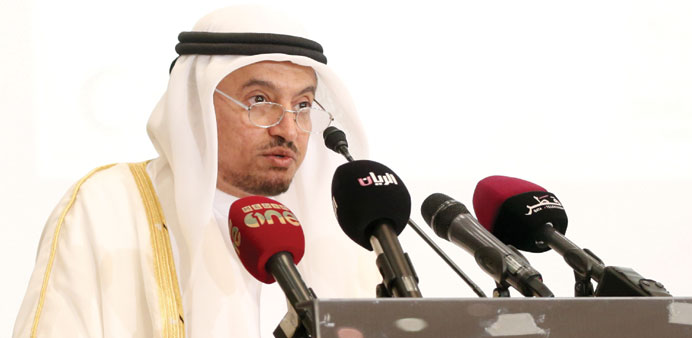
Addressing the international conference “Doha Dialogue on Migration 2014” yesterday, HE the Minister of Labour and Social Affairs Dr Abdullah Saleh Mubarak al-Khulaifi stressed that MOLSA has maintained a training programme with the ILO that includes labour inspection regarding occupational health and safety and the international standards of work.
The ministry also focused on improving the capabilities of local labour inspectors and the performance of the Labour Relations Department with regards the resolution of workers disputes.
“In 2013, the number of workers’ complaints amounted to 10,840 (submitted at the MOLSA Labour Relations Department), out of which 10,202 were settled … that is 94% of the overall number of complaint,” al-Khulaifi said.
The minister further explained that such complaints are often resolved by way of calling up both employee and employer, and explaining to both parties the legal issues involved.
Al-Khulaifi also said that as there is a degree of variation with regards to how employers address their obligations to employees, the MOLSA recently finalised the amendment to the labour law on the payment of workers’ salaries, in collaboration with Qatar Central Bank (QCB), the Ministry of Finance, the Qatar Chamber, and local banks.
In this way employers are required to transfer the salaries of their workers directly into their bank accounts or transfer them to their home countries.
“Work is ongoing … at the ministry to create a wage protection office and appoint an adequate number of staff, giving them the best training to undertake such duties,” said the minister.
Al-Khulaifi also stressed on his ministry’s efforts to ensure the workers’ right to high standard, comfortable accommodation and a work environment that guarantees the best health and safety standards.
Accordingly, the MOLSA has increased the number of labour inspectors – from 150 to 250 – and the number is constantly increasing as the recruitment process continues.
Further, inspectors are sent to the ILO International Training Centre in Turin, Italy.
“Qatar is witnessing a progressive economic development and GDP in 2013 approached 13% compared by 2012. This resulted in the influx of great numbers of expatriate workers at different economic sectors, in particular the construction sector,” said al-Khulaifi.
Accordingly, he reiterated the proposed amendments for the law on the entry and exit of expatriates announced by the government more than three weeks ago.
These would focus on abolishing the long established “sponsorship” relation between the employer and workers, replacing it with a contractual work relationship, and abolishing the need for obtaining an exit permit from the employer and make it only a notification by the employee expressing his wish to exit the country.
Also, the new law will allow expatriate workers to switch jobs without the need for the prior approval of their employer upon the expiry of the work contract duration and after five years in case of an open contract.
“The new law is now in the phase of review by the concerned entities in the country,” al-Khulaifi said.
The Doha Dialogue on Migration 2014, organised by the Qatar Red Crescent (QRC) in co-operation with the International Federation of Red Cross and Red Crescent (IFRC), concludes today.