


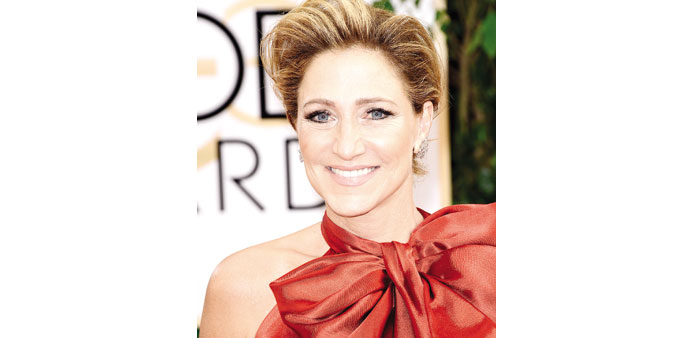
UNFAZED: Edie Falco
A flawed heroine? Edie Falco loves it. By Mary McNamara
Edie Falco has a cold. Actually, it’s more like a sinus infection, one that’s been plaguing her for weeks now, and so she enters the roof-top restaurant at the Peninsula hotel in Beverly Hills apologising if the medication has made her a little dingy.
It hasn’t, of course, or at least not in a way that’s noticeable. “Dingy” is certainly not a word associated with Falco, who has famously taken on roles often dismissed into caricature. Fifteen years ago, it was Carmela Soprano, who, between David Chase’s scripts and Falco’s radiant humanity, blew apart the conventional image of the mobster’s wife.
More recently, it’s been Jackie Peyton, super nurse and basket case, whose work-family juggling act is fuelled by all manner of pharmaceuticals.
Falco’s in Los Angeles doing press for Showtime’s Nurse Jackie, now midway through its sixth season, so she knows her way around posh hotel interviews and photo shoots. She had to miss Mother’s Day with her two children, who are back in New York, but it’s all part of the job, and as she says, she’s a good employee.
Which is quite telling for a multiple-Emmy winner who has been such a big part of the increasingly mythologised prestige drama. From the moment she sits down, she radiates a personal comfort level that recognises the line between frank conversation and intimacy but is not cowed by it. At 50, Falco is, as my grandmother would say, a good kitchen-table talker.
She is also a remarkable actor. For five years Falco has taken the unlikely, and easily unlikable, character created by Liz Brixius, Linda Wallem and Evan Dunsky and turned her into a fascinating portrait of human contradiction: loving but self-obsessed, competent but deluded, nurturing but ultimately destructive. In this case, a classic drug addict.
Television is riddled with drunks and druggies in various stages of secrecy and sobriety; Jackie may be high-functioning in that she remains thus far a very good nurse, but House had a similar conceit. What House didn’t have was a drug-addict lead character who was also a wife and mother.
Although strong female characters have increased in recent years, prestige television still leans heavily on certain hard-boiled characteristics — violence, promiscuity, mendacity — that are far less acceptable in a female lead. But from Weeds to Orange Is the New Black, a new form of dark comedy has emerged to explore the female version of the broken hero.
None do it better than Nurse Jackie, which is so unrelentingly honest that it can be difficult to watch. While the first couple of seasons played like a tense black satire of the multitasking mom — how does she do it? By snorting uppers! — last season saw Jackie go through rehab, only to blow it in the finale. This season, she appears to be closer to facing her problems, but if viewers want some pink-cloud recovery for Jackie, they’ll have to go through Falco first.
“I was so glad she slipped,” Falco says, referring to Jackie’s return to drugs. “She doesn’t go to enough meetings, and I don’t want it to end pretty for her unless she does the ... work. Addiction lasts a lifetime, and I know a lot of people who do not get it,” she adds, referring to recovery, “the first, second or third time around.”
As a recovering alcoholic herself, Falco feels a sense of responsibility in portraying Jackie’s journey toward sobriety, but that isn’t why she took the role. “Addiction wasn’t a big part of (the character) at first,” she says. “I had some resistance to the idea. Addiction has been such a big part of my life, and the lives of people I know. I didn’t want it treated in a lighthearted way.”
She signed onto Nurse Jackie because it was the first thing she saw that was truly different from The Sopranos. “I really did think for a while there that I was done,” she says. “I kept getting sent a lot of Italian wives — people are not terribly creative sometimes — and what I liked about Jackie was that her struggle was so internal.”
Also, she was the main character. “This was a story with a woman at the centre. It was about her, as a person, not necessarily as a wife or a mother or even a nurse.”
Indeed, in its early years, Nurse Jackie was one of the few shows on television that revolved around a woman. That observation seems to take Falco by surprise. “I don’t have a plan,” she says, laughing. “I’m not a champion. I do see a lot more women writing in television, especially on Nurse Jackie, and, yes, The Sopranos was a bit of a boys club.
“But I’ve always been hard to cast, I’ve never been an ingenue, I’ve never been the romantic lead. I’m an actor; give me the script, and I do what I do and hope it’s good.”
Just as no one could accuse Falco of being “dingy,” no one would characterise Nurse Jackie as being lighthearted. Certainly, there are hilarious moments, many supplied by the outstanding supporting cast that includes Merritt Wever and Anna Deavere Smith, but many, including Falco, have had a hard time with the “comedy” label; her acceptance speech for her 2010 Emmy for lead actress in a comedy included the perplexed admission that “I’m not funny.”
Comedy, drama or dramedy, Nurse Jackie is essentially a clear-eyed exploration of dishonesty. Jackie may be a good nurse, but she’s an even better liar. And with her big, blue eyes and qui
Radcliffe turned to alcohol to deal with pressure
The Harry Potter star Daniel Radcliffe, who shot to fame at the age of 11, says he started drinking to deal with the pressure of being famous. The 24-year-old admitted that he found himself struggling to deal with his celebrity status and the adoring fans, reports dailymail.co.uk. On occasions, he would even turn up to filming still drunk from a boozy session the night before.
He said: “I would have benefited from not drinking as it was not making me as happy as I wanted it to. It is not a real pressure but it is a pressure of living with the thought, ‘Oh, what if all these people are saying I am not going to have a career? “‘What if they are all going to be right and will be laughing and I will be consigned to a bunch of where-are-they-now? lists?’”
The actor, who has been teetotal since 2010, is now known for his theatrical work rather than Harry Potter.
“People don’t shout Harry Potter at me now, they tend to know my name, which is lovely... (but) I always will credit the opportunities I get to Harry Potter. I would not be a happy person if I was bitter about those 10 years of my life,” he said. — IANS
Douglas took Zeta-Jones for ‘granted’
Actor Michael Douglas says he took his wife and actress Catherine Zeta-Jones for granted before they split last year. But he says he has learnt from this. The couple are together again.
The 69-year-old actor temporarily split from the 44-year-old actress last August, but he insists he’s now learnt from his past “mistakes” and has re-evaluated his relationship, reports femalefirst.co.uk.
“When you are younger you care what other people think. And you take the person closest to you for granted. You waste a lot of energy on strangers to make a good impression. When you’re older you focus that energy on the people closest to you, on your family. And you’re courteous,” The Sun newspaper quoted him as saying. Douglas has son Dylan and daughter Carys with Zeta-Jones. — IANS