


Agencies/Thimphu
Narendra Modi held talks in Bhutan yesterday on his first foreign trip as prime minister, as he steps up a charm offensive with neighbours to try to check China’s regional influence.
The prime minister was greeted at the airport by his Bhutanese counterpart Tshering Tobgay at the start of a two-day visit to the Buddhist kingdom, a month after his landslide election victory.
Tobgay later wrote on Twitter that he had “very good discussions” with Modi, who shared his “passion for education, development and environment.”
“He declared B4B: that Bharat (India) is there for Bhutan, ready to support in all our endeavours,” Tobgay said.
Modi received a grand welcome with a ceremonial guard of honour, while schoolchildren in national dress lined the mountainous road between the airport and the capital Thimphu and waved the two countries’ flags.
Ahead of his visit, Modi said relations with Bhutan would be “a key foreign policy priority” of his government.
“India and Bhutan enjoy a unique and special relationship... forged by ties of geography, history and culture,” he said in a statement late Saturday, adding that Bhutan was a “natural choice” for his first visit.
The premier had an audience with King Jigme Khesar Namgyel Wangchuck and later inaugurated Bhutan’s Supreme Court, built with Indian assistance.
He is expected to address a joint session of parliament today.
Tobgay was one of seven regional leaders invited to Modi’s inauguration. Analysts say the decision to make Bhutan his first port of call is designed to underline the importance he places on neighbourly relations, which suffered under the last Indian government.
“Bhutan may be a small country but it is strategically very important and... China is on the other side,” said Ranjit Gupta, a retired ambassador.
“If you aren’t interested in your neighbours, they’ll lose interest in you.”
With the exception of Pakistan, India enjoyed generally close ties with its South Asian neighbours in the first six decades after independence.
But critics say the previous Congress Party government began to take relationships for granted, allowing economic giant China - which shares a border with four of India’s neighbours - to step into the breach.
The talks in Bhutan were expected to focus on strengthening ties over the kingdom’s hydropower plants, which supply much-needed clean energy to India.
Bilateral trade was worth $1.1bn in 2012, and Tobgay earlier told The Hindu newspaper that Bhutan’s hydropower industry was “the centrepiece of our bilateral co-operation.”
India, a power-deficit nation with severe outages, has helped Bhutan develop three hydropower plants with another three under construction.
In April the two countries signed a framework agreement on four more joint-venture power projects totalling 2,120 megawatts, and Modi was due to lay the foundation stone for a new project during the visit.
Amit Bhandari, from the Indian think-tank Gateway House, said electricity to India was Bhutan’s single largest export.
“Modi’s visit to Bhutan demonstrates the importance India places on furthering this relationship,” he said.
There was friction with Bhutan when India cut fuel subsidies before elections last year, although they were restored after Tobgay’s victory.
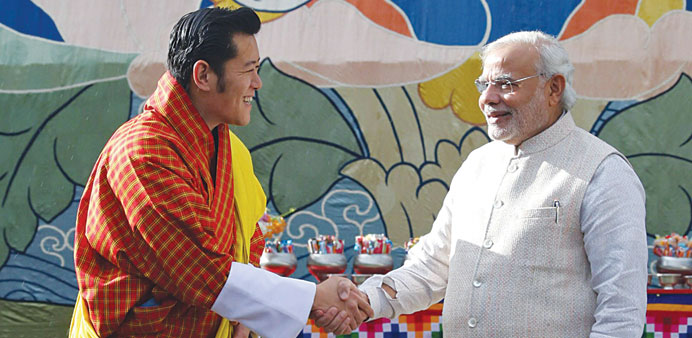
Prime Minister Narendra Modi is welcomed by Bhutanese King Jigme Khesar Namgyel Wangchuck at the Tashichhodzong Palace in Thimphu.