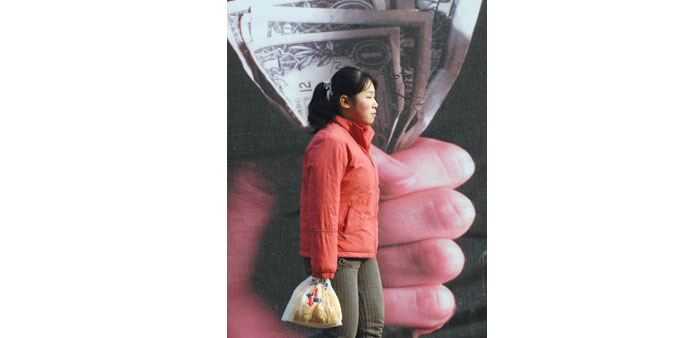
A Chinese woman walks past a sign featuring a fist holding US dollars in central Beijing. China’s rapid accumulation of foreign-currency reserves creates difficulties for steering economic policy, officials with the nation’s foreign exchange regulator said yesterday.
Reuters/Beijing
China’s rapid accumulation of foreign-currency reserves creates difficulties for steering economic policy, officials with the nation’s foreign exchange regulator said yesterday.
China will keep its foreign exchange reserves at a reasonable level, officials of the State Administration of Foreign Exchange (SAFE) said in a web cast.
“The excessively large foreign exchange reserves increase domestic money supply and create potential domestic inflation pressures,” said Huang Guobo, chief economist of the SAFE.
“They also put more pressure on the central bank to raise reserve requirement ratios and sterilise (inflows),” he said.
Foreign currency reserves account for more than 80% of the central bank’s assets, leading to a mismatch between its assets and liabilities, fuelling foreign exchange risks, Hung said.
China’s reserves, the world’s largest, grew by $130bn in the first quarter, reaching a record $3.95tn.
Large foreign currency purchases by the People’s Bank of China, which regularly intervenes to cap rises in the yuan, in effect create base money and can fuel inflation unless the central bank soaks up the excess yuan injected into the system.
Guan Tao, head of the SAFE’s international payments division, said that the pace at which reserves build up will slow as the country seeks to reduce its trade imbalances and curb hot money inflows.
As a percentage of gross domestic product, China’s trade surplus fell to 2% last year from as high as 10.1% in 2007, Guan said.
Increased two-way yuan volatility since February has helped curb arbitrage activities as there was a divergence in market views on which direction the yuan would move, Guan told the same webcast.
“Two-way volatility occurs as the market believes the yuan exchange rate has basically reached a balanced and reasonable level, which limits risk-free arbitrage activities,” Guan said.
Yesterday, the yuan inched up to 6.2197 to the dollar. This week, it has gained about 0.4%, recovering some of its more than 3% loss in the first five months of 2014.
In February and March, traders said they believe the central bank was intervening to weaken the yuan as a means of punishing speculators who bet on non-stop appreciation of China’s currency.
“The SAFE’s statement sent a clear signal that the government will do more to keep a balance of dollar supply-and-demand in the domestic market by curbing excessive capital inflows,” said a senior trader at a European bank in Shanghai.
“That means the government will also step up its efforts to make the exchange rate a main tool to achieve the goal.”
Premier Li Keqiang said in May that China’s war chest of foreign exchange reserves had become a headache as its continued rise could stoke inflation in the long term.
Yi Gang, vice central bank governor, said in November that the cost of holding the reserves would surpass earnings from them when reserves exceed a certain level.
China’s consumer inflation edged up to a four-month high of 2.5% in May but remained well within the government’s comfort zone, giving Beijing ample room to step up targeted measures to support the slowing economy.
The government is stepping up such efforts, but top leaders have ruled out any large stimulus as the country is still nursing a hangover from the 4tn yuan ($640bn) stimulus implemented during the 2008-09 global crisis, which took local governments deep into debt.
In yesterday webcast, the SAFE reiterated its plans to use some of the reserves for outbound investment and to improve the way it manages the reserves.