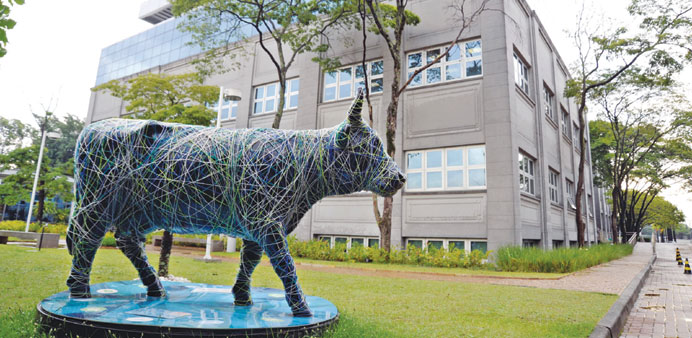
A cow sculpture is seen in front of the JBS headquarters building in Sao Paulo. The Brazilian meat producer’s latest attempt at a major deal was quashed this week when Tyson Foods won the bidding war for Hillshire Brands with a record premium for the food industry.
Bloomberg/New York
JBS is running out of consolation prizes.
The Brazilian meat producer’s latest attempt at a major deal was quashed this week when Tyson Foods won the bidding war for Hillshire Brands with a record premium for the food industry. Last year, JBS was preparing a bid for Smithfield Foods before the hog producer agreed to sell itself to WH Group, people familiar with the matter said at the time. After passing on those deals, the $10bn company’s acquisition options are narrowing, Deutsche Bank said.
One of the most appealing options for JBS — yet unlikely to ever go on the block — is Kraft Foods Group’s Oscar Mayer. Hormel Foods Corp would also be logical, although with a market value of $13bn, it’s probably too big for JBS, according to Morningstar. Other remaining North American targets are smaller. Chicken-producer Sanderson Farms and Maple Leaf Foods, which sold its bread unit this year to focus on packaged meats, are two options, Bloomberg Industries’ Kenneth Shea said. “They’ll certainly be looking,” Kevin Dreyer, a money manager at Gabelli Funds, said of JBS in a phone interview. “There isn’t a tremendous amount that’s out there. It’s probably a little bit difficult to find something quite as tasty as Hillshire.”
Gabelli Funds is a unit of Rye, New York-based Gamco Investors, which oversees about $48bn and owns Hillshire and Tyson stock.
Miguel Bueno, a representative for JBS’s parent company J&F Participacoes, said the company had no comment.
JBS’s North American poultry unit Pilgrim’s Pride Corp proposed buying Hillshire for $45 a share on May 27, kicking off a bidding war that ended when Tyson upped its offer to $63 a share this week. Pilgrim’s then withdrew its own sweetened proposal of $55 a share, saying it was “in the best interests of our shareholders not to increase” the bid.
Tyson’s offer was about 70% higher than Hillshire’s average share price in the 20 days before the Jimmy Dean sausage maker drew acquisition interest. No other food industry deal of more than $5bn has drawn such a high premium, according to data compiled by Bloomberg.
Hillshire hasn’t made any recommendation to shareholders on Tyson’s $7.7bn offer, nor has it terminated its May 12 agreement to buy Pinnacle Foods Inc, a condition of both the Tyson and Pilgrim’s proposals.
JBS now has been sidelined in at least two big meat deals by companies willing to bid more. After the Smithfield Foods deal was announced last year, chief executive officer Wesley Batista said he passed because the price was too high. The company also had expressed interest in Hillshire before, when it was still called Sara Lee Corp, people with knowledge of the matter said at the time.
With Hillshire likely out of reach, the takeover options for JBS and its Pilgrim’s unit are limited, Jose Yordan, an analyst at Deutsche Bank, wrote in a report this week.
Hormel is the first remaining acquisition candidate that comes to mind, Yordan wrote, although its size alone nearly rules it out as an option. As one of the few large unclaimed companies that’s focused on higher-margin consumer meats, Hormel shares Hillshire’s appeal, according to Liang Feng, a Chicago- based analyst at Morningstar.
“It’s very tough to see how Pilgrim’s Pride, even with JBS’s support, would be able to acquire a firm of Hormel’s size, unless it was a merger of equals,” Feng said in a phone interview. “But we haven’t seen any signs that Hormel really wants to do something like that.”
As a standalone company, Hormel, the maker of Jennie-O turkey, reported record revenue of $8.8bn for the fiscal year ended in October. That compares with about $8.4bn for Pilgrim’s in 2013.
Kraft’s Oscar Mayer also makes packaged meats. Annual net revenue for the brand exceeds $1bn, the company said in a regulatory filing. Dreyer of Gabelli said Kraft may have to take significant tax charges if it sells the unit, making such a move less appealing.
Other remaining targets in the meat industry include Sanderson Farms or Maple Leaf Foods, Shea of Bloomberg Industries said. Both companies are smaller than Hillshire, with Sanderson Farms valued at $2.1bn, and Canada’s Maple Leaf Foods at $2.4bn.
Sanderson Farms’ focus on meat processing, a more commoditised business, means a takeover probably wouldn’t yield as many ways to boost revenue and cut costs for a buyer like Pilgrim’s, Feng said.
Maple Leaf Foods last month sold its Canada Bread Co to Grupo Bimbo SAB. That followed the divestitures of its animal- rendering business, commercial turkey farms and hatchery operations in 2013. The company now focuses on protein products such as Top Dogs hot dogs and Golden Fry breakfast sausage.
Representatives for Northfield, Illinois-based Kraft and Austin, Minnesota-based Hormel said their companies don’t comment on acquisition activity. Representatives for Laurel, Mississippi-based Sanderson Farms and Maple Leaf Foods didn’t respond to requests for comment.
Kraft shares dropped 0.5% to $59.19 at 9:36 a.m. New York time, Hormel declined 0.2% to $48.46 and Sanderson Farms was little changed. Maple Leaf rallied 0.5% to C$18.76, while JBS rose 0.3% to 7.87 Brazilian reais.
JBS doesn’t have to do a deal. David Riedel, president and founder of Riedel Research Group, said he hopes that the company doesn’t make a purchase and instead focuses on digesting the deals it’s already done and paying down debt. JBS has spent $12.7bn on acquisitions in the last five years including its purchase of a majority stake in Pilgrim’s in 2009, according to data compiled by Bloomberg. The company has $14.3bn of debt.
“They cannot keep reaching for ever-larger acquisitions to fuel growth,” Riedel, whose independent equity research firm focuses on emerging markets, said in a phone interview. “Investors should be thrilled to have them pause.”
Even so, JBS’s interest in both Smithfield and Hillshire suggests the company is interested in some kind of deal. It just may have to wait a while before something as appealing as Hillshire comes along again.
The good news for JBS in losing to Tyson is that it avoided stretching its balance sheet and overpaying for Hillshire, according to Riedel, who said he was glad the company didn’t continue to chase the deal.
JBS’s shares climbed 6.3% the day Pilgrim’s withdrew its bid, compared with a 6.5% slump for Tyson.