


By Salman Siddiqui
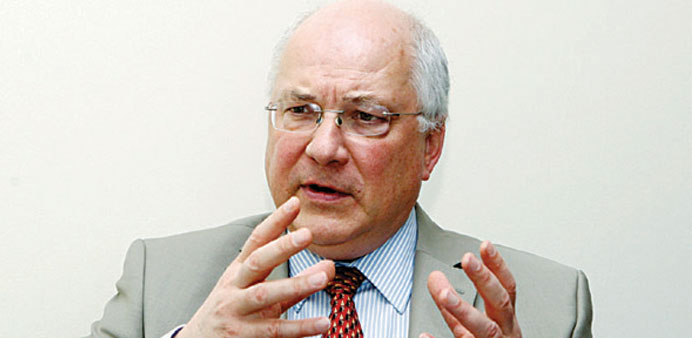
France welcomes “very warmly” Qatar’s central role in successfully mediating the May 31 prisoner swap between the United States and the Afghan Taliban, French ambassador Jean-Christophe Peaucelle told Gulf Times.
In an interview, the ambassador said the prisoner swap proved that Qatar could similarly play a responsible role in other conflicts in the world, including Africa and Syria.
“Why not! Sincerely, I think that Qatar has the potential goodwill and skills (to solve conflicts) which can be very useful in many cases. It has shown it in the (US and Taliban) case.
“I want to welcome this case very warmly and congratulate Qatar for this, (especially) for the liberation of the American soldier Sgt Bowe Bergdahl.... We welcome this without any hesitation,” he said.
France in the past had played a crucial role behind the scenes to bring all stakeholders in Afghanistan to the negotiating table. In December 2012, the Paris-based think-tank Fondation pour la Recherche Strategique, with the French government’s support, had arranged a key “intra-Afghan” talks in Chantilly that eventually paved the way for the “Qatar channel” to reopen in order to facilitate talks between the US and Afghan Taliban.
Current Taliban political office members in Doha, including the officially-nominated spokesperson Dr Mohamed Naeem Wardak and senior member Shahabuddin Dilawar, had reportedly attended that meeting in France in 2012 on behalf of the Taliban.
Although the ambassador did not specifically talk about France’s past role in facilitating the peace process between the US and Afghan Taliban, he said that France shared a partnership of responsibility with Qatar.
“This is also one part of our partnership in Qatar. Despite the differences of history, size, population, energy resources, climate, and environments between the two countries, I think that France and Qatar have a sense of their responsibilities in the international scene.”
The highly-experienced French career diplomat, however, cautioned against generalisation of the same formula to other conflicts of the world.
“(While there is space for mediation), let’s be very clear, terrorism is not something to be negotiated with, that’s the limit,” he said.
Giving an example of the Boko Haram group in Nigeria, Peaucelle said that it was unimaginable to have negotiations with them. “(The negotiation with the Boko Haram group is not possible because we can’t say), yes, you can keep half of the girls, while we bring back the others. You see that morally speaking, humanely speaking, it’s not possible.”
He said that while it was clear that one could not negotiate with the terrorist groups, there were many crises in the world, including the Middle East and even in Europe, especially Ukraine, where there were serious conflicts, and one must consider the path of diplomacy.
“I have to say your readers, as I say to my friends and children, never forget that peace cannot be taken for granted. You have to work on it to preserve peace,” he said.
Referring to the recently-commemorated 70th anniversary of the D-Day landings, the ambassador said that he was born 14 years after the Second World War ended. “My parents suffered from it, (but the memory of it for) my children is too far away (for them to grasp its reality). We have to teach the young people, please don’t forget that we all have to work to preserve peace,” he said.
About negotiations with “terrorists”, the diplomat said that one could have “some borderline cases”.
“You can have some situations. But the principle remains that terrorism is not acceptable. (At the same time) another principle is that negotiation is better than conflict. The third principle for political action is to try not to provoke situations, which would feed terrorism,” he added.