


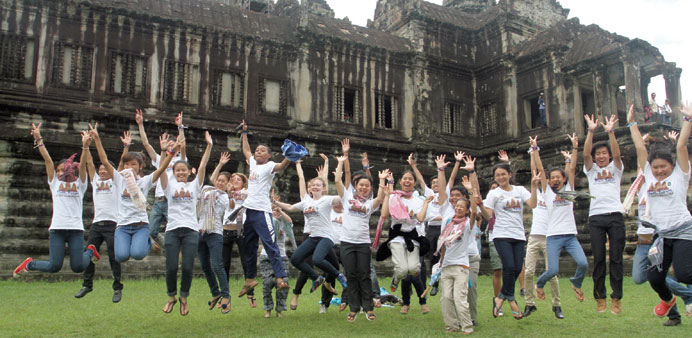
Youth forum participants take part in the World Heritage Youth Forum 2013, Cambodia (in conjunction with the 37th Session of the World Heritage Committee), at the world heritage site of Angkor, Cambodia.
By World Heritage Centre Paris, Communication, Education and Partnerships Unit
World Heritage sites are testimonies to and links between the past and present, as well as being places that contribute to a sustainable future. The World Heritage Education Programme strives to give young people the opportunity to learn and develop by acquiring knowledge about the importance of World Heritage preservation, conservation and promotion. The real driving force of the programme is the involvement of youth as a major segment of the community, taking cultural dimensions into account, fostering them to become thinkers and actors of development.
The transmission of heritage values is underpinned by the need to promote intercultural understanding and respect for cultural diversity, and to create an environment which is propitious to a culture of peace. These principles are central to Unesco’s mission. Youth are considered partners and stakeholders in this overall endeavour of the Education Programme. They can be a bridge between cultures and can serve as key agents in promoting peace and intercultural understanding. Their intellectual and human potential, their curiosity, creativity and their natural ability to forge links beyond their own group, position them as potent agents of positive social change that will yield greater economic and social well-being in the perspective of sustainable development for generations to come.
Mainstreaming World Heritage education is particularly relevant now in times of global financial and economic crisis. The impact of climate change and dwindling natural resources are more and more often leading to conflict between and within nations. Young people are among the most affected by the key development challenges. World Heritage education helps young people understand and face new threats and challenges of the present as well as of the near future.
One is never too young to start to understand other people, and the classroom is not the only place where World Heritage education can be practiced. There is a need to reconcile formal and non-formal education, extending actions to all areas of social organisation that pertain to the community. Hands-on activities at World Heritage sites provide the necessary skills in preservation and conservation that instill a life-long commitment to this endeavour.
The main tool of the programme is the World Heritage in Young Hands Educational Resource Kit for sensitising young people to the importance of preserving their local, national and World Heritage.
With the difficulty inherent in understanding the scope of the World Heritage Convention, which uses very specific terminology, the Kit was developed based on an interdisciplinary approach. It offers ideas to be adapted and seeks to incorporate World Heritage values into the curriculum as a way of delivering core subjects and transverse themes both in the classroom as well as through extra-curricular activities. It focuses on creative and participatory methods of teaching, involving students in research, in collecting and analysing data, in role-playing and simulation exercises, in information and communication technology, in taking part in well-planned trips and in conducting preservation campaigns. Most importantly it promotes discussion and listening to others, which results in re-affirming identity, and promoting mutual respect and respect for diversity.
To date, the Kit has been published in more than 37 national languages including an Arabic version, and more national language translations and adaptations are underway. In addition, two interactive DVD versions of the Kit, in English and French, have been produced. With each new language version the Kit is expanded by adding regional and national content. With each language version, national, sub-regional and regional training seminars are conducted to introduce the Kit and how to use it most effectively. More supplementary educational materials on World Heritage education are also being developed, including the cartoon series Patrimonito’s World Heritage Adventures, in which 12 episodes have already been produced.
Youth forums and international youth volunteer projects serve as a catalyst to spark inspiration to develop World Heritage educational and participatory activities on the regional and international levels. Through these activities, young people take stock of their perception of themselves and their surroundings, their attitude towards their origins and their future. Finding the balance between modern-day culture and the wisdom of our ancestors is a challenge. This gives rise to exchanges of intercultural approaches to learning by comparing realities, experience, difficulties and solutions, as well as exchanges concerning environmental issues such as global warming or excessive deforestation, sea-bed pollution and wildlife depredation that affect heritage sites.
The Unesco World Heritage Education Programme certainly has much to do. For the present, there is the need to reinforce the involvement of young people in world heritage preservation, and to pursue efforts to mainstream world heritage education in school curricula. There are actions that need to be taken at varying governmental levels, such as adding world heritage education to the agenda of States Parties to the Convention. Additional efforts must be undertaken to increase the participation of civil society and stakeholders in the programme.
The World Heritage Education Programme brings people closer together through the wealth of their diversity, and the values and experiences that unite them. It instills a sense of responsibility among youth and cultivates the will to participate in fostering a culture of peace through World Heritage preservation and promotion.
For more information: http://whc.unesco.org/en/wheducation/.