


By Wurflinger Ronald
Two World Heritage sites out of seven have joined the World Heritage Volunteers campaign in Austria. Since 2011, a nature conservation and landscape preservation project at Wachau Cultural Landscape involves World Heritage Volunteers in their work. This year an Austrian-Chinese partnership project at Hallstatt-Dachstein/ Salzkammergut Cultural Landscape has been launched.
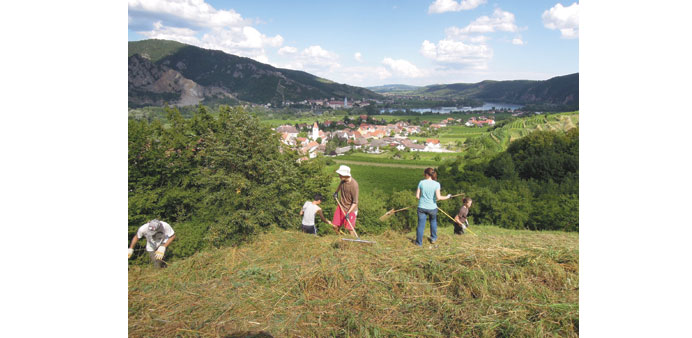
Arbeitskreis Wachau organises nature conservation workcamps, to preserve dry and half-dry grassland within the site (in total 60 hectares).
To improve the quality and the outcome of the last project, an internal evaluation on the viability and sustainability of the workcamps was carried out afterwards. The project team and the volunteers were supported by different local and regional institutions such as Jauerling-Wachau Nature Park, municipalities, hunting clubs and nature conservation organisations, who provided tools and manpower. The WHV-Wachau Cultural Landscape also benefited from the support through the Rural Development Policy of the European Union. In 2012 the project was awarded as best practice for youth involvement in nature conservation work by the Austrian Ministry of Environment and Nature Conservation.
China meets Hallstatt was initiated through the World Heritage Volunteer campaign. OeAV, SCI-Austria and The Chinese Society of Education and Training Centre (CSETC), which is also member of WHV, formed a partnership for this project. In the city of Huizhou, in the province of Guangdong in China an estate company and investment group rebuilt the Austrian alpine village in the World Heritage site of Hallstatt. The project caused an intensive discussion about the value and the distinctive character of historic buildings and sites in Austria. China meets Hallstatt is a tool to promote tourism and peace and to develop new relations between Austrian and Chinese institutions.
Both projects are based upon a strong co-operation between the world heritage site managements, youth organisations and the municipalities within the sites. For the recruitment of the volunteers the Austrian Alpine Association (OeAV) and the Austrian branch of Service Civil International (SCI) are the key partners. The OeAV is not only the biggest mountaineering and hiking organisation but also the biggest Austrian youth club in terms of members. In 1985, OeAV started a national volunteering program, called Umweltbaustellen for young people. Their work focuses on the reconstruction of old hiking paths and the preservation of traditional landscapes and nature conservation in the Alps and other places in Austria.
Every year between 15 and 20 projects are organised and joined by about 200 volunteers. Participation is open for all nationalities, but in general mainly Austrians apply. A key aspect of the Umweltbaustellen is public relations. Funded by the Austrian Ministry of Environment, Umweltbaustellen is supported by a professional media coach and trains media interns trough the PULS-Programme. Each project can be accompanied by such trainees who conduct press conferences, media work and the elaboration of a project report. PULS is a major success in the promotion for the work camps and plays a very important role for the two World Heritage Volunteer projects.
For both WHV projects in Austria national volunteers are sent by the OeAV. SCI and OeAV, which have been working together since 2006. Founded in 1945 SCI-Austria is the oldest peace and work camp organisation in the country and part of the global network of SCI.