


By ASPnet International
Coordination
Founded in 1953, the Unesco Associated Schools Network (ASPnet) is a worldwide network bringing together more than 9,900 educational institutions across 180 countries. It comprises public and private pre-schools, primary, secondary, vocational schools and teacher training institutes, in rural and urban settings.
In the past sixty years, ASPnet has become one of the largest global networks of schools, a world-class showcase of Unesco’s programmes and hence a powerful tool to achieve Unesco’s priorities and increase its visibility. The Network often serves as a pulse taker, sensitive to what is happening in the world and as a pace-setter -introducing new issues and topics in the classroom, along the lines of the UN’s four main priorities: education for sustainable development, peace, human rights and intercultural learning.
Unesco Associated Schools conduct pilot projects, undertake innovative approaches and test educational materials, making significant contributions to improving the quality of education, learning and content. ASPnet facilitates regional and global partnerships between schools, encourages long-term commitment of schools to global issues, and serves as a laboratory for developing, pilot-testing and introducing educational methods and materials that serve as good practices for other schools worldwide.
ASPnet schools were among the first to be involved in raising awareness of World Heritage in the minds of children and youth and their role in preserving it.
In order to promote the protection and awareness of World Heritage, encourage and enable tomorrow’s decision-makers to participate in heritage conservation and to respond to the continuing threats facing heritage, Unesco launched the Young People’s World Heritage Education Programme in 1994. The Programme is led by the Unesco World Heritage Centre in co-ordination with the Unesco Associated Schools Network and in close co-operation with Unesco Field Offices, National Commissions for Unesco and stakeholders.
This programme provides young people with the necessary knowledge, skills, network and commitment to become involved in heritage protection from local to global level. Young people learn about World Heritage sites and about the history and traditions of their own and other cultures. They become aware of the challenges facing the sites and learn how the international community can help in saving our common heritage. Most important of all, they discover how they can contribute to heritage conservation and make themselves heard.
The symbol of the World Heritage Education Programme is Patrimonito, which was designed by young people in 1995, who took part in The First World Heritage Youth Forum held in Bergen, Norway. Patrimonito means “small heritage helper” in Spanish and represents a young heritage guardian. The symbol has been widely adopted as the international mascot of the project and is used worldwide.
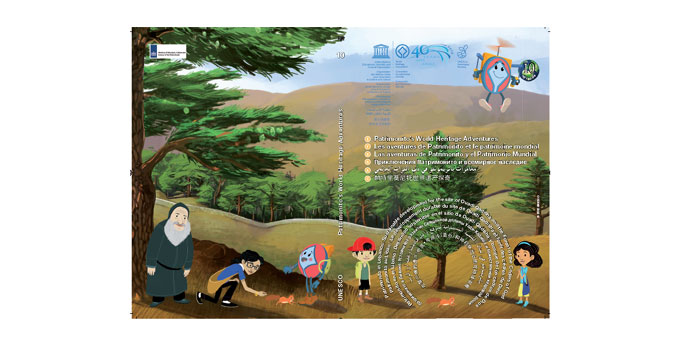
In 2002 the cartoon series entitled Patrimonito’s World Heritage Adventures was launched where Patrimonito introduces World Heritage sites, the threats they are facing and proposes solutions to preserve them. As an example, the 10th Episode was dedicated to Ouadi Qadisha and the Forest of the Cedars of God in Lebanon. The Qadisha valley is one of the most important early Christian monastic settlements in the world. The trees in the Cedar Forest are the last vestiges of an extensive, sacred forest that thrived in ancient times. The wood used to be one of the most highly prized building materials. In the episode, Patrimonito and young people help to rebuild the forest by planting local species of trees and protecting them against deforestation.
Another World Heritage educational tool is the resource kit for teachers entitled ‘The Kit: World Heritage in Young Hands’. Based on an interactive and interdisciplinary approach, the kit can be used in classrooms as well as in extra-curricular settings. The idea behind it is to raise students’ awareness of World Heritage, increase their knowledge about heritage conservation, and promote mutual understanding and respect for diversity. The kit is available in over 30 languages.
In order to enhance the use of the World Heritage in Young Hands Kit and encourage mainstreaming of World Heritage Education in school curricula, Unesco supports teacher-training seminars at national, regional and international levels. As an example, a regional workshop was held in Amman from 9 to 11 November 2013 with 60 participants from 18 Arab States to exchange their experiences in conducting World Heritage Education activities in their countries and to propose new activities to be included in the World Heritage in Young Hands textbook.
ASPnet continues to play a key role in promoting World Heritage Education by involving students and teachers to foster mutual respect, respect for diversity and appreciation for their local, national and World Heritage.
www.unesco.org/education/asp