


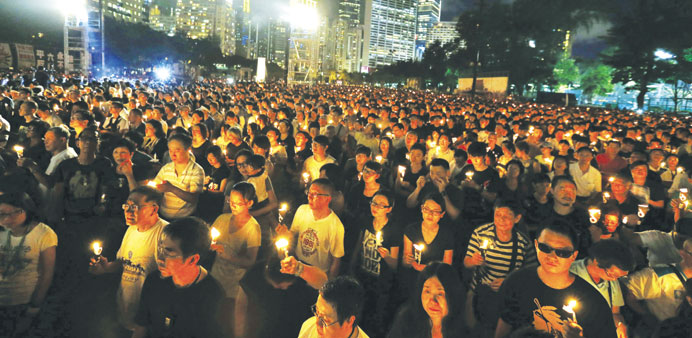
Tens of thousands of people take part in a candlelight vigil at Hong Kong’s Victoria Park to mark the 25th anniversary of the military crackdown on the pro-democracy movement at Beijing’s Tiananmen Square in 1989.
AFP/Beijing
China yesterday imposed smothering security in central Beijing on the 25th anniversary of the Tiananmen Square crackdown, a bloody watershed in history that remains taboo in the communist nation.
Counting down to the anniversary, the US demanded the release of scores of people detained in the run-up, as the semi-autonomous city of Hong Kong prepared for an annual candlelit vigil that this year is expected to draw as many as 200,000 attendees.
Thousands of police and security forces, some armed with automatic rifles, have been deployed across the Chinese capital. Police trucks were numerous on and around Tiananmen Square yesterday with fire engines and ambulances also visible.
Some security officers had fire extinguishers placed ready nearby. Security has also been heightened recently after a spate of attacks that authorities blame on separatists from the far-western region of Xinjiang.
Tourists and vendors went about the vast public square at the heart of Beijing, but uniformed and plainclothes officers were stationed at every corner and checking the ID cards of passers-by.
One Australian woman said she was prevented from visiting the Forbidden City, where China’s emperors lived, as she was not carrying her passport - not normally a requirement for tourists entering the historic site.
An AFP journalist was ordered to delete photos of scuffles between police and frustrated pedestrians waiting to enter the main part of the square yesterday morning.
An unidentified man followed and harassed an AFP journalist for several blocks after passing by the square on bicycle on Tuesday night.
Hundreds of unarmed civilians - by some estimates, more than 1,000 - were killed during the June 3-4 crackdown of 1989, when soldiers crushed months of peaceful protests by students who were demanding political reform to match China’s nascent economic opening up.
Since then, China has worked hard to quash public memories of the crackdown, censoring any mention of the incident from online social networks and detaining scores of activists, lawyers, artists and others in recent weeks.
On the eve of the anniversary, Washington renewed its call for Beijing to allow greater political freedoms and urged the release of those arrested.
“We’ve very clearly called on the Chinese authorities to release all the activists, journalists and lawyers who have been detained ahead of the 25th anniversary,” State Department spokeswoman Marie Harf told reporters.
“I think it’s time to allow some more space, quite frankly, for discussion in their own country, particularly around this kind of anniversary,” she added.
Foreign news organisations in Beijing have been warned by police and the Chinese foreign ministry against doing any newsgathering related to the anniversary, or else risk facing “serious consequences”, including the possible revocation of their visas.
In one incident reported on Monday by the Foreign Correspondents’ Club of China, a French television crew was detained for six hours by police as they attempted to interview passers-by on a downtown Beijing street.
The crew was trying to show people the iconic ‘Tank Man’ photo from the crackdown, when a lone individual marched out in front of a line of tanks, halting their progress.
In 1989, the demonstrations and subsequent crackdown played out on television screens across the world, and Beijing was briefly made a pariah in the West.
But 25 years later, the ruling Communist Party’s authority is intact and its global clout continues to rise in line with the country’s rapid growth, which has taken China to second place in the global economic rankings behind only the US.
China’s state-run media yesterday made brief mentions of the anniversary in their English-language editions.
The nationalistic Global Times contended in an editorial that China “has shielded relevant information in a bid to wield a positive influence on the smooth development of reform and opening up”.
“Chinese society has never forgotten the incident 25 years ago but not talking about it indicates the attitude of society,” it added.
The paper’s Chinese-language edition did not directly mention the crackdown.
But under the headline “Anti-China forces in the West making every possible effort to harm China”, the paper vaguely alluded to the crackdown by accusing the West of “actively provoking trouble for China recently and being very emotional”.
Hong Kong pro-democracy activists rally in their thousands for victims of the 1989 crackdown
Tens of thousands gathered in Hong Kong yesterday to remember the dead on the 25th anniversary of the Tiananmen Square crackdown, the only major commemoration in China as authorities clamped tight security on Beijing.
“Vindicate 6/4!” crowds shouted, waving banners, as the initially sombre candlelit vigil began in Hong Kong’s Victoria Park.
Organisers said a record 180,000 attended the vigil while police put the estimate at 99,500 - a significantly higher number than last year’s police estimate of 54,000.
Lights were turned out as old and young alike raised their candles in the dark. The names of those who died in Beijing on June 4, 1989 were read out over loudspeakers.
People bowed to pay their respects as footage of the clampdown was shown on large screens.
“This event must be instilled in everyone’s heart. We can’t let time dilute this,” said 19-year-old student Anna Lau.
“Let Xi Jinping see the lights of the candles,” chief organiser Lee Cheuk-Yan told the crowd, referring to the Chinese President.
“I don’t know what the (Chinese) government fears, banning all discussion about June 4. But in Hong Kong, we will keep fighting until the end.”
In the Taiwanese capital Taipei, exiled Chinese dissidents and witnesses to the crackdown addressed a crowd of about 500. Taiwanese President Ma Ying-jeou separately described the events of 25 years ago as an “enormous historical wound”.
Ma called on Beijing to “speedily redress the wrongs to ensure that such a tragedy will never happen again”.
Among the crowds in Hong Kong were many from the Chinese mainland.
“I came here to take part in this vigil, because in China we don’t have any rights or freedoms... so to express my views I have to come to Hong Kong,” 35-year-old Huang Waicheng, an engineer from the neighbouring city of Shenzhen, told AFP. “In China, there are too few people that know about (the crackdown).”
Under the agreement governing Hong Kong’s handover to China in 1997, the semi-autonomous city has far greater civil liberties than the mainland.
A 52-year-old businessman from China’s neighbouring Guangdong province brought his son.
“Freedom for the whole Chinese nation ought to be the country’s ultimate goal. It’s a good thing that some people still remember (the movement),” he said.
Meanwhile on Hong Kong’s harbour front a handful of pro-Beijing supporters were involved in angry confrontations yesterday evening with a much larger crowd of those commemorating the Tiananmen crackdown.